



Key Takeaways
- Nasdaq 100 futures tumbled approximately 1.8% Friday morning, leading broad market declines
- Semiconductor stocks extended Thursday’s selloff, with the PHLX Semiconductor Index plummeting over 4%
- Netflix shares crashed more than 10% premarket following disappointing Q3 revenue guidance
- Global contagion spreads as Japan’s Nikkei 225 plunged 4% in Friday trading
- Oil prices climbed higher amid escalating tensions between Washington and Tehran
Wall Street braced for significant losses Friday as futures trading painted a grim picture across all major indices. The tech-heavy Nasdaq 100 futures experienced the steepest decline, falling approximately 1.8%. S&P 500 futures retreated roughly 0.9%, while Dow Jones Industrial Average futures shed about 374 points, representing a 0.7% decline.
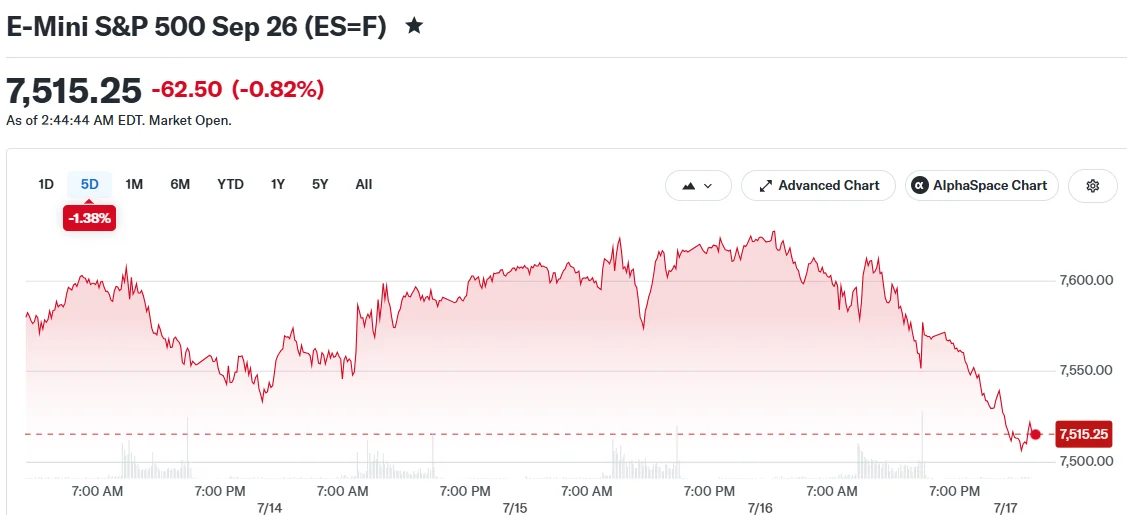
The technology sector, particularly semiconductor manufacturers, spearheaded the downturn. Thursday witnessed the PHLX Semiconductor Index crashing more than 4%, with major players including Advanced Micro Devices, Broadcom, and Micron experiencing substantial losses.
These semiconductor giants had previously been instrumental in propelling markets higher from their March lows. However, mounting skepticism regarding the sustainability of the artificial intelligence investment frenzy has triggered a reassessment among market participants.
Adding fuel to the bearish sentiment, streaming giant [[LINK_START_2]]Netflix[[LINK_END_2]] suffered a brutal premarket decline exceeding 10% after delivering third-quarter revenue projections that fell short of analyst expectations.
The company attributed its cautious outlook to an increasingly “dynamic and competitive” entertainment ecosystem as streaming rivals intensify their challenge.

International Markets Caught in Downdraft
The turbulence has transcended American borders. Japan’s benchmark Nikkei 225 index collapsed 4% during Friday’s session, demonstrating that concerns surrounding artificial intelligence expenditures and technology sector valuations have become a worldwide phenomenon.
[[LINK_START_3]]Oil prices[[LINK_END_3]] bucked the broader risk-off trend. Brent crude advanced 0.3% to reach $84.49 per barrel, while West Texas Intermediate climbed 0.8% to $79.55 per barrel, benefiting from heightened geopolitical tensions between the United States and Iran.“Global equities are continuing to slump, as fresh doubts about the AI trade have driven a pronounced sell-off in tech stocks,” said Deutsche Bank macro strategist Henry Allen.
He added: “There’s no sign of any letup this morning in Asia.”
The benchmark 10-year US Treasury Note yield declined 3 basis points to settle at 4.53%, while the US dollar traded relatively unchanged against a basket of major global currencies.
Regarding corporate earnings, financial institutions Truist Financial and Fifth Third Bancorp are scheduled to announce quarterly results Friday. Additionally, the University of Michigan will publish its closely-watched consumer sentiment index, providing insight into American consumer confidence and reactions to fuel costs.
Between March and mid-2026, equity markets had staged an impressive rally, powered predominantly by excitement surrounding artificial intelligence capabilities and the semiconductor manufacturers enabling the technology. That upward trajectory has lost steam in recent trading sessions as investors scrutinize the tangible return on investment from AI-related capital expenditures.
As Friday’s opening bell approached, futures across all three primary indices signaled widespread losses, with technology shares shouldering the most significant pressure.
Get 3 Free Stock Ebooks
Discover top-performing stocks in AI, Crypto, and Technology with expert analysis.
- Top 10 AI Stocks - Leading AI companies
- Top 10 Crypto Stocks - Blockchain leaders
- Top 10 Tech Stocks - Tech giants


