


Key Highlights
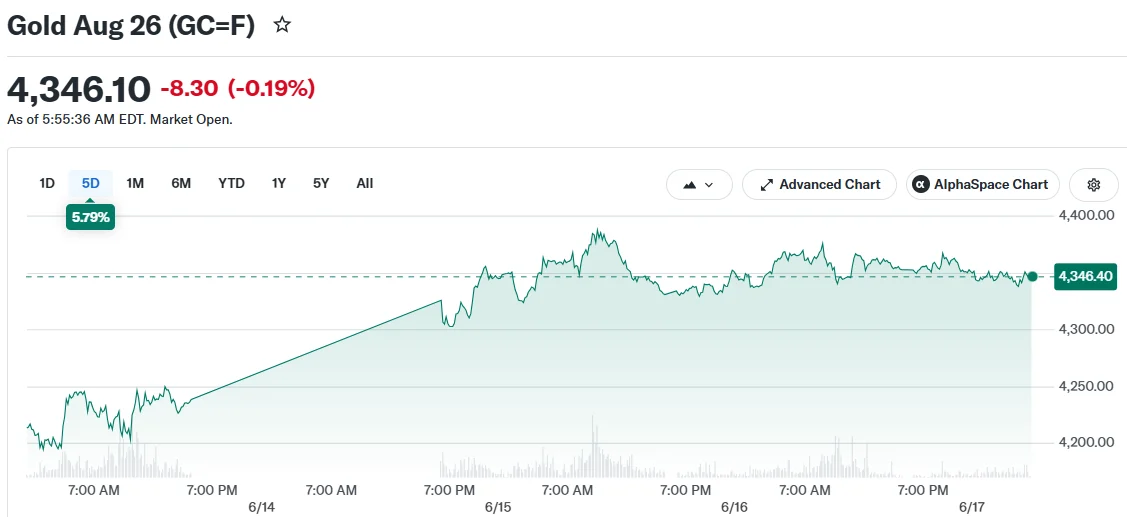
- Precious metal prices remain relatively unchanged on Wednesday, hovering between $4,327 and $4,344 per ounce following four consecutive days of upward movement.
- An interim peace agreement between the United States and Iran, featuring provisions allowing Iranian oil exports to restart, has driven crude prices downward and alleviated inflation concerns.
- Declining energy costs have diminished expectations for more restrictive monetary policy, typically favorable for assets without yield like gold.
- The greenback has declined to its weakest level in ten days, providing additional tailwinds for gold.
- Market participants are focused on the Federal Reserve’s upcoming policy announcement, where Chairman Kevin Warsh is anticipated to maintain current rates while potentially indicating future policy trajectory.
Gold markets are maintaining positions near recent peak levels on Wednesday as market participants process significant geopolitical news and anticipate the Federal Reserve’s inaugural policy declaration under newly appointed Chairman Kevin Warsh.
Spot gold declined marginally by 0.1% to reach $4,327.56 per ounce during early Wednesday trading. U.S. gold futures decreased 0.2% to trade within the $4,344–$4,347 range. The precious metal had accumulated gains throughout four consecutive trading sessions after recovering from multi-month low points near the $4,000 per ounce threshold.
U.S.-Iran Agreement Alleviates Energy and Inflation Concerns
The primary catalyst behind recent price movements in gold markets stems from an interim peace agreement reached between the United States and Iran. The accord permits Iran to recommence oil exports and establishes a ceasefire framework while comprehensive negotiations proceed.
This breakthrough has resulted in a significant decline in crude oil prices. As energy costs retreat, market participants have begun reducing their expectations for more aggressive monetary policy tightening.
This dynamic benefits gold. Since the precious metal doesn’t generate yield, it typically performs more favorably when interest rates are projected to remain subdued or decline further.

The weakening dollar has provided additional support. The U.S. Dollar Index has fallen to its lowest point in ten days, and a declining greenback generally enhances gold’s appeal to international buyers utilizing alternative currencies.
However, the Iran agreement hasn’t eliminated all market uncertainty. Persistent geopolitical risks and prudent investor attitudes continue supporting demand for gold, according to MUFG analyst Soojin Kim.
Federal Reserve Announcement Represents Critical Market Catalyst
The Federal Reserve concludes its current policy meeting on Wednesday. Market consensus anticipates interest rates will remain unaltered.
However, the primary emphasis centers on the Fed’s refreshed economic forecasts and its interest rate “dot plot,” which illustrates policymakers’ projections for rate trajectories throughout upcoming months and years.
Should the Fed indicate continued plans for rate reductions later in 2025, this would probably provide additional support for gold. Conversely, a more hawkish stance could elevate Treasury yields and strengthen the dollar, potentially pressuring gold’s recent advances.
This marks the inaugural Fed meeting led by Kevin Warsh, who succeeded Jerome Powell. Market observers will scrutinize his messaging and communication approach closely.
Fundamental demand for gold continues showing resilience. A recent World Gold Council survey revealed that 45% of central bank reserve managers intend to expand their gold holdings throughout the next twelve months.
Additional Precious and Industrial Metals
Silver increased 0.5% to reach $70.34 per ounce. Platinum declined 1.1% to $1,788.72 per ounce.
Copper also experienced movement. London Metal Exchange copper futures advanced 0.3% to $13,833.33 per ton, while U.S. copper futures climbed 1% to $6.54 per pound.
Get 3 Free Stock Ebooks
Discover top-performing stocks in AI, Crypto, and Technology with expert analysis.
- Top 10 AI Stocks - Leading AI companies
- Top 10 Crypto Stocks - Blockchain leaders
- Top 10 Tech Stocks - Tech giants


