


Key Highlights
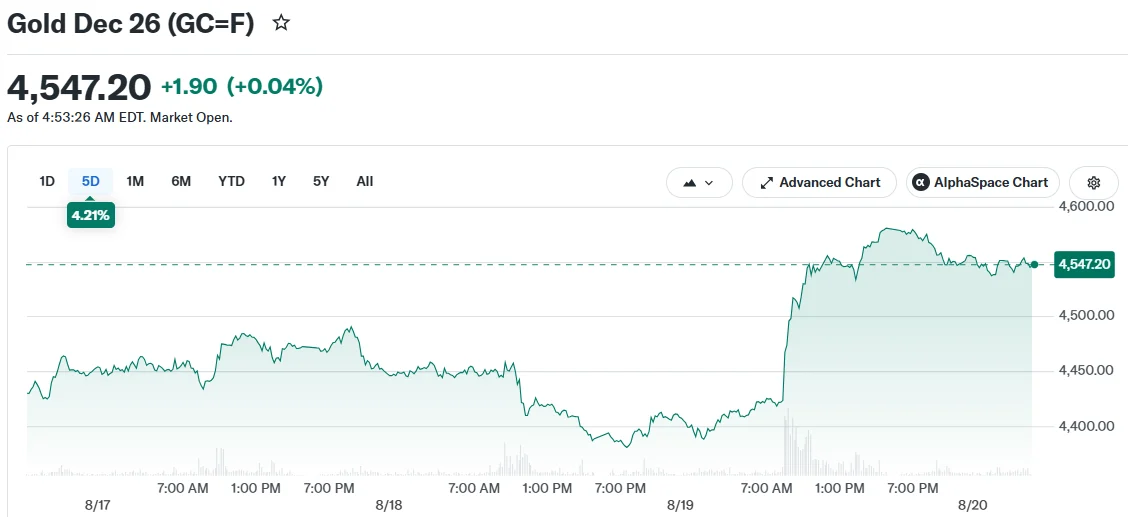
- Gold futures climbed 0.1% to reach $4,549.14, maintaining stability around the $4,500 threshold following Wednesday’s 4% rally
- U.S. Treasury’s decision to at least double its bond-buyback operations drove long-term yields downward
- July Federal Reserve meeting minutes revealed multiple policymakers remain willing to implement rate increases amid persistent inflation concerns
- Current market expectations show a 67.3% probability of unchanged rates at the Fed’s upcoming September policy meeting
- Recent World Gold Council data indicates 45% of global central banks intend to boost their gold holdings
The precious metal continues to trade in the vicinity of $4,500 per ounce following Wednesday’s robust performance, buoyed by declining Treasury bond yields and diminished dollar strength. Despite modest weakness in Thursday’s early session, gold maintains proximity to its recent peak levels.
As of 02:37 ET, spot gold prices retreated 0.7% to $4,491.95 per ounce, whereas gold futures contracts advanced 0.1% to $4,549.14. Silver prices increased 0.1% to $67.08 per ounce, while platinum declined 0.8% to $1,807.32.
Bond Buyback Initiative Pressures Yields Lower
Wednesday’s significant price movement stemmed primarily from an unexpected U.S. Treasury Department announcement. Officials revealed plans to expand certain bond-buyback operations focused on longer-maturity government securities by at least twofold.
This enhanced demand exerted downward pressure on long-term Treasury yields. Since gold generates no yield, declining bond returns diminish the opportunity cost associated with holding the non-interest-bearing metal, thereby enhancing its investment appeal.
Meanwhile, the dollar maintained its subdued position. Dollar weakness effectively reduces gold’s cost for international purchasers utilizing alternative currencies, typically boosting global demand.

ANZ research analysts interpreted the Treasury’s action as a clear signal that government officials seek to reduce borrowing expenses. They emphasized that more accommodative financial conditions typically create a favorable environment for gold appreciation.
The precious metal had already shown signs of recovery following a brief dip to $4,000 per ounce during the previous month. ANZ attributed this rebound to revitalized investor appetite and sustained central bank accumulation.
Central Bank Maintains Vigilant Inflation Watch
Minutes from the Federal Reserve’s July policy meeting painted a more cautious outlook. Multiple Fed policymakers expressed readiness to implement interest rate increases. Several officials indicated rate elevation would become necessary should inflation fail to progress toward the central bank’s 2% objective.
Ariane Curtis of Capital Economics observed that the minutes validated the Fed’s increasingly hawkish pivot since June. Nevertheless, she highlighted that recent indicators spanning inflation metrics, employment figures, and economic activity have all registered softer readings, diminishing the immediate likelihood of rate increases.
According to CME FedWatch data, market participants currently assign a 67.3% probability to unchanged rates at the September Federal Reserve meeting, alongside a 32.7% chance of a rate hike.
Elevated interest rates typically exert downward pressure on gold valuations by enhancing the relative attractiveness of yield-generating investments. This dynamic tension between the Treasury’s yield-reducing initiatives and the Federal Reserve’s inflation-fighting posture will likely continue shaping gold market direction in coming months.
U.S. national debt has crossed the $40 trillion milestone for the first time in history, recent Treasury Department figures confirm.
Survey results from the World Gold Council revealed that 45% of central banking institutions worldwide intend to expand their gold reserve positions, primarily driven by inflation hedging considerations and geopolitical risk management.
Get 3 Free Stock Ebooks
Discover top-performing stocks in AI, Crypto, and Technology with expert analysis.
- Top 10 AI Stocks - Leading AI companies
- Top 10 Crypto Stocks - Blockchain leaders
- Top 10 Tech Stocks - Tech giants


