



Key Takeaways
- Gold futures declined between 0.7% and 0.9% on Tuesday following Iranian military action against commercial vessels in the Strait of Hormuz region
- Spot gold decreased to $4,121.25 per ounce; silver tumbled 2.1% while platinum retreated 1.2%
- The U.S. dollar gained strength as investors worried about inflation linked to possible energy supply disruptions
- Investors are anticipating the Federal Reserve’s June meeting minutes for clues about future monetary policy direction
- Federal Reserve Chair Kevin Warsh has reinforced the central bank’s commitment to achieving a 2% inflation objective
Precious metals experienced a significant selloff on Tuesday following news that Iran launched attacks on two commercial ships near the strategically important Strait of Hormuz, intensifying worries about potential energy supply interruptions and inflationary pressures.
Spot gold tumbled 1% to settle at $4,121.25 per ounce, while futures contracts for gold decreased 0.9% to reach $4,132.15. During European market hours earlier in the day, New York gold futures had declined 0.7% to trade at $4,138.50 per troy ounce.
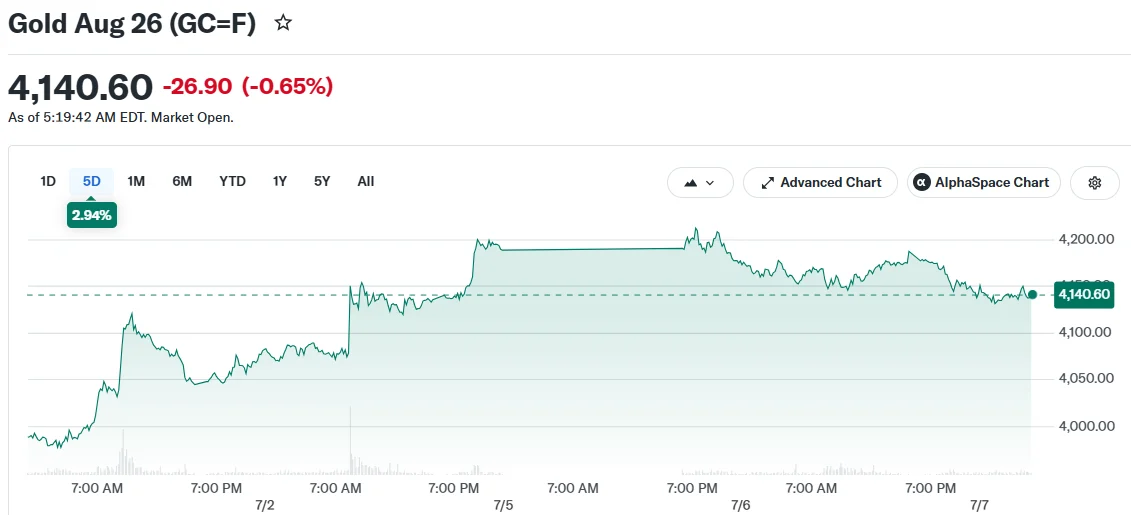
The broader precious metals complex mirrored gold’s downward trajectory. Spot silver plummeted 2.1% to $60.76 per ounce, while spot platinum shed 1.2% to close at $1,614.72 per ounce.
The military action in the Hormuz strait caused oil prices to surge, reigniting concerns that energy-driven inflation could remain persistent. This scenario bolstered the U.S. dollar, which typically creates headwinds for precious metal valuations.
Tuesday’s declines erased substantial gains from the prior week, when disappointing U.S. employment figures had temporarily boosted gold prices and pressured the dollar down from its 13-month peak levels.

Attention Turns to Federal Reserve Communications
Market participants are closely monitoring the upcoming release of minutes from the Federal Reserve’s June policy meeting, scheduled for this week. Traders are eager for additional insight into the central bank’s thinking on future interest rate adjustments.
Federal Reserve Chair Kevin Warsh has emphasized that policymakers remain focused on returning inflation to the institution’s 2% annual benchmark. These statements have maintained market uncertainty regarding the potential for an additional rate increase before year-end.
Market strategists at Saxo Bank observed that gold remains trapped in a consolidation phase. “Bullion remains rangebound as it attempts to shift from capitulation to consolidation,” they noted, pointing out that short-term U.S. Treasury yields continue to suggest rate hike possibilities.
Elevated interest rates diminish gold’s appeal since the metal generates no yield or dividend payments. As borrowing costs climb, capital typically flows toward bonds and alternative income-producing investments.
Challenging Period for Gold Markets
Gold reached all-time peaks in January but has faced headwinds throughout the subsequent months. Concerns about additional rate increases have discouraged investors from maintaining positions in assets that produce no income, causing the metal to surrender most of its early 2026 appreciation.
The precious metal has also experienced diminished safe-haven demand during this period. While gold typically rallies during periods of market uncertainty, ongoing inflation anxieties and dollar resilience have constrained any meaningful price recovery.
Saxo Bank’s analysis suggests that a more substantial shift in interest rate expectations would be necessary to fuel a sustainable upward movement in gold valuations.
With Federal Reserve meeting minutes on the horizon and ongoing instability surrounding the Strait of Hormuz situation, market participants are expected to adopt a cautious stance until greater certainty emerges on both matters.
As of Tuesday’s close, spot gold was quoted at $4,121.92, representing a 1.04% decline for the trading session.
Get 3 Free Stock Ebooks
Discover top-performing stocks in AI, Crypto, and Technology with expert analysis.
- Top 10 AI Stocks - Leading AI companies
- Top 10 Crypto Stocks - Blockchain leaders
- Top 10 Tech Stocks - Tech giants


