


TLDR
- Goldman Sachs reduced its fourth quarter 2026 Brent projection to $80 per barrel from $90 following a U.S.-Iran interim agreement
- The investment bank’s 2027 Brent average forecast dropped to $75 from $80
- President Trump revealed an agreement to end the U.S. blockade and restore access through the Strait of Hormuz
- Goldman anticipates Persian Gulf export flows will return to normal by late July, one month ahead of prior estimates
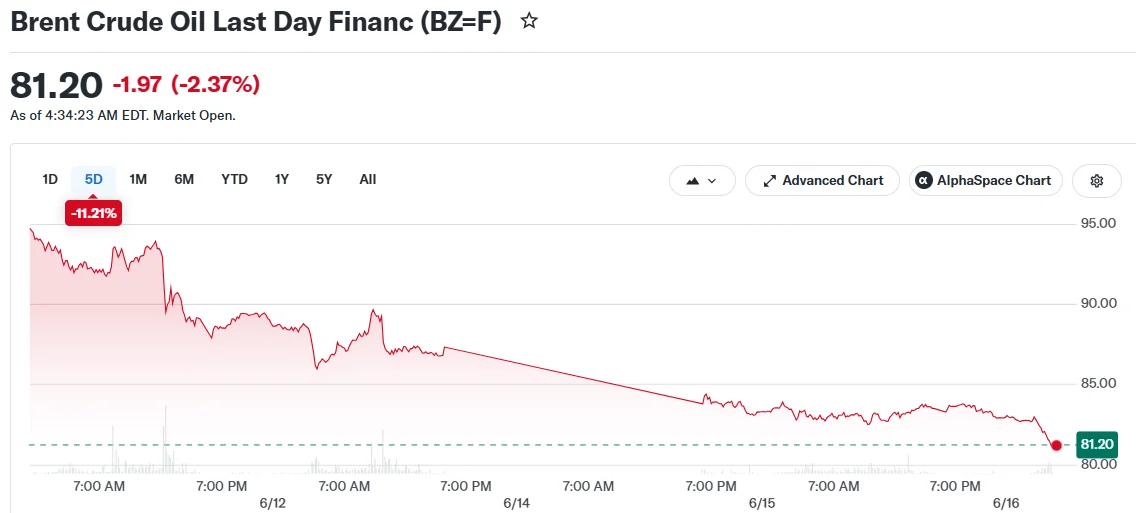
- Brent crude declined 3.4% to $87.33 while WTI fell 3.2% to $84.88 following the peace agreement announcement
Goldman Sachs has revised its crude oil price projections downward after President Trump revealed an interim agreement to end the U.S. blockade and restore operations at the Strait of Hormuz.
The investment bank now anticipates the critical waterway will return to full operational capacity by the end of July 2026, accelerating its previous timeline by one month from late August.
Goldman reduced its fourth quarter 2026 Brent crude projection to $80 per barrel from $90. The firm’s 2027 average Brent forecast was trimmed to $75 from $80. WTI is now projected to average $75 during Q4 2026 and $70 throughout 2027.
The investment bank noted that advancing the supply normalization schedule by one month reduces the fair value estimate of crude by approximately $10 and $5 per barrel for the respective timeframes.
Crude markets responded swiftly to the diplomatic breakthrough. Brent settled 3.4% lower at $87.33, while WTI dropped 3.2% to close at $84.88.

Why the Strait of Hormuz Matters
The Strait of Hormuz is responsible for transporting approximately one-fifth of global oil and LNG supply. As market participants recognized the potential for reopening, the conflict-related risk premium in prices quickly dissipated.
Gulf region flows have already climbed to an estimated 11 million barrels daily. Goldman noted that achieving pre-conflict export volumes would require only a 12 million barrel-per-day increase in Hormuz flows to reach 70% of previous levels.
During the peak of tensions, market analysts feared disruptions of 12 to 15 million barrels per day from Gulf exports. Current assessments have been revised to approximately 5 to 6 million barrels per day.
U.S. crude stockpiles declined by 7.2 million barrels to 426.5 million, positioning them nearly 5% beneath the five-year average. Distillate inventories stood 13% below typical levels.
Supply Growth and Demand Weakness
Goldman highlighted increased production from the United States, Brazil, Guyana, Venezuela, and the UAE as contributing factors to the more bearish long-term forecast.
Diminishing demand, partially attributed to China’s accelerating transition toward electric vehicles, is also pressuring the extended outlook. The bank’s analysis incorporates an assumption that slightly over 10% of demand weakness will continue.
Despite projecting a 3.2 million barrel-per-day oversupply in 2027, Goldman maintains that prices will likely stabilize near long-term equilibrium values. Strategic reserve accumulation exceeding 1 million barrels daily is expected to prevent excessive inventory accumulation.
Goldman emphasized that risks remain skewed toward higher prices. Should Hormuz remain blocked through 2027, Brent could surge above $130 in late 2026 and average $105 throughout the following year.
In a bearish scenario involving accelerated export restoration and softer consumption, Brent could decline below $60 during 2027.
Exxon CEO Darren Woods cautioned that prolonged closure of the strait would eventually exhaust alternative supply options. The bank maintained a modest security premium in its projections, acknowledging persistent disruption risks.
The official agreement signing ceremony is set for Friday.
Get 3 Free Stock Ebooks
Discover top-performing stocks in AI, Crypto, and Technology with expert analysis.
- Top 10 AI Stocks - Leading AI companies
- Top 10 Crypto Stocks - Blockchain leaders
- Top 10 Tech Stocks - Tech giants


