


Key Takeaways
- The greenback trades near its strongest point of 2026 as markets price in additional Federal Reserve tightening
- Real yields on 10-year Treasuries surpassed 2.3%, marking the highest level in more than twelve months
- Military confrontations between Washington and Tehran led to the closure of the Strait of Hormuz
- Crude benchmarks advanced 2%, with Brent trading at $77.60 per barrel, intensifying inflationary pressures
- Sterling declined 0.1% versus the dollar; the common European currency has shed 2.7% year-to-date
The greenback continues to trade near its strongest levels of 2026, buoyed by robust U.S. economic indicators, mounting inflationary pressures, and fresh military confrontations between Washington and Tehran.
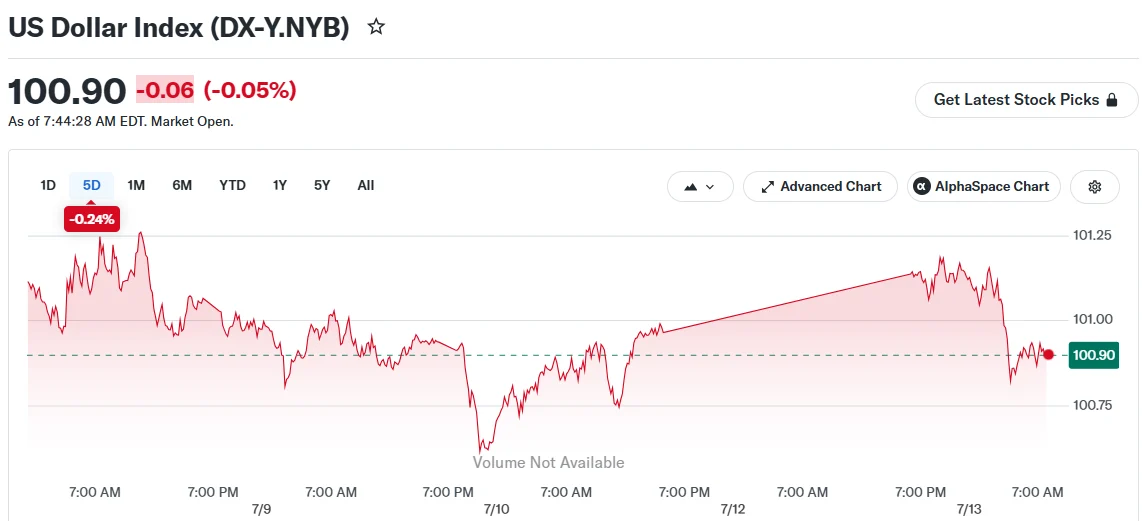
Market participants increasingly anticipate that the central bank will maintain elevated borrowing costs or implement additional rate increases. Futures markets currently reflect expectations of approximately 37 to 40 basis points of monetary tightening by December, a significant increase from positions held in early June.
The Bloomberg Dollar Spot Index remains anchored near its yearly peak. Speculative positioning data reveals that traders maintain their most bullish stance on the dollar since 2015, with net long exposure exceeding $40 billion.
Inflation-Adjusted Treasury Returns Reach 12-Month Peak
The 10-year real Treasury yield — which accounts for expected inflation — recently climbed above 2.3%. This represents the loftiest level witnessed in over a year, suggesting market participants anticipate sustained restrictive monetary conditions.
Elevated real yields enhance the appeal of dollar-based investments to international capital. However, they simultaneously depress bond valuations, creating challenges for holders of long-duration U.S. sovereign debt.

Certain portfolio managers are responding by increasing dollar allocations while reducing exposure to longer-maturity government securities. Multiple investors are financing bullish greenback positions by establishing short positions in lower-yielding currencies such as the euro and Japanese yen.
Several major financial institutions, including Bank of America, project that inflation-adjusted yields will remain elevated and anticipate continued hawkish central bank positioning, especially relative to currencies from accommodative monetary policy jurisdictions.
Dissenting voices exist. Some market participants contend that employment conditions have weakened and that real yields may have already crested. They argue that dollar appreciation and climbing yields are already tightening financial conditions sufficiently, potentially diminishing the necessity for additional central bank intervention.
Middle East Hostilities Amplify Energy and Currency Volatility
Over the weekend extending into Monday trading, American and Iranian military forces engaged in reciprocal missile and unmanned aerial vehicle strikes. Tehran targeted U.S. installations throughout the region and announced it had once again shuttered the Strait of Hormuz, a critical conduit for international petroleum transport.
Pentagon officials confirmed retaliatory strikes against Iranian air defense infrastructure and coastal surveillance installations.
Brent crude oil climbed 2% to reach $77.60 per barrel. Advancing energy prices amplify inflation concerns, which subsequently bolsters the rationale for additional Federal Reserve tightening measures.
The British pound retreated 0.1% to $1.339 during Monday’s session. Sterling has declined 0.6% against the dollar in 2026. The euro has depreciated 2.7% versus the greenback during the identical timeframe.
Lee Hardman, senior currency strategist at MUFG, characterized the foreign exchange response as “relatively modest so far,” though he cautioned that substantially elevated oil prices could emerge as a more potent driver of dollar appreciation.
Federal Reserve Chairman Kevin Warsh is scheduled to deliver congressional testimony this week, coinciding with the release of fresh U.S. inflation figures. Both developments possess the potential to materially alter rate expectations.
Get 3 Free Stock Ebooks
Discover top-performing stocks in AI, Crypto, and Technology with expert analysis.
- Top 10 AI Stocks - Leading AI companies
- Top 10 Crypto Stocks - Blockchain leaders
- Top 10 Tech Stocks - Tech giants


