


Key Highlights
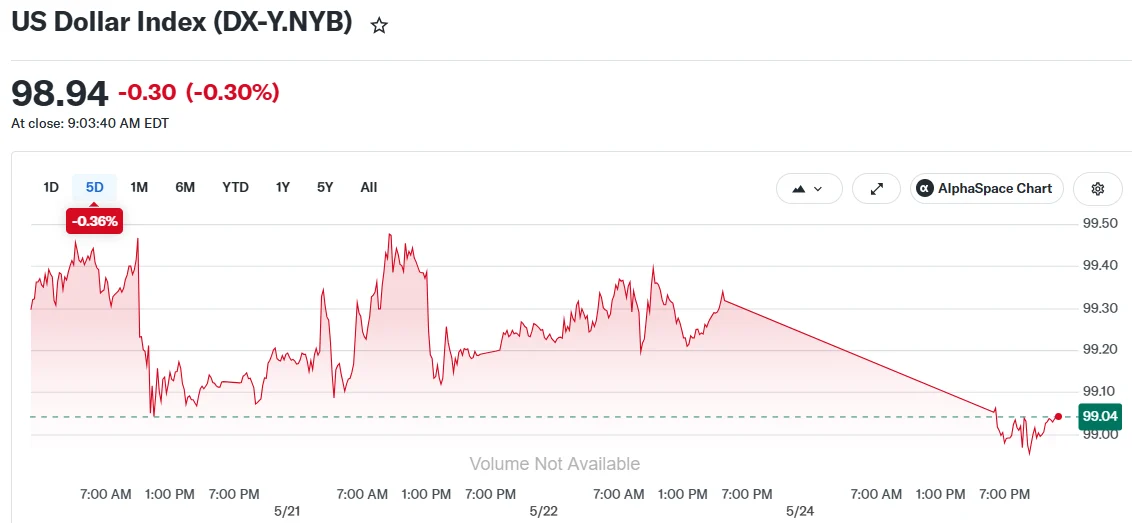
- The greenback index declined 0.3% to approximately 99.0 on Monday amid rising optimism for a U.S.-Iran diplomatic breakthrough.
- Crude oil prices experienced sharp declines, with Brent falling nearly 6% to trade under $100 per barrel.
- Major currencies including the euro, sterling, and Aussie dollar posted gains versus the greenback.
- Reports indicate a preliminary framework for U.S.-Iran negotiations has been outlined, though formal signing remains pending.
- Market strategists anticipate short-term dollar weakness if negotiations succeed, though longer-term recovery appears likely based on economic fundamentals.
The greenback retreated against a broad range of major currencies Monday as market participants grew increasingly optimistic about potential diplomatic progress between Washington and Tehran. Such an agreement could facilitate the reopening of the Strait of Hormuz, a critical waterway for international petroleum shipments.
Market activity remained subdued due to a U.S. public holiday and widespread closures across European financial centers. The reduced participation amplified price movements throughout the trading session.
The dollar index, tracking the U.S. currency’s performance against a basket of six major peers, slipped roughly 0.3% to settle at 98.97. This level marked its lowest point in ten trading sessions.
The single European currency advanced 0.4% to reach $1.1649. Sterling gained 0.55% to trade at $1.3504. Meanwhile, the Australian dollar—frequently viewed as a proxy for risk sentiment—climbed 0.64%.
The Japanese yen also appreciated modestly against its American counterpart. Tokyo’s Prime Minister Sanae Takaichi unveiled a $19 billion energy subsidy initiative designed to shield consumers from elevated fuel costs. Takaichi emphasized the program would be implemented without increasing government debt.

Crude Markets Tumble on Strait Reopening Speculation
Oil markets experienced substantial pressure. Brent crude, the global pricing benchmark, plummeted nearly 6% to $97.61 per barrel. West Texas Intermediate declined 5.3% to settle at $88.15 per barrel. Both benchmarks dropped beneath the psychologically significant $100 threshold on expectations the strategic waterway could resume normal tanker operations.
The Strait of Hormuz facilitates approximately 20% of global petroleum flows. The passageway has remained effectively closed to commercial tanker traffic for several weeks following the outbreak of hostilities involving Iran, contributing to elevated energy costs and heightened inflation concerns worldwide.
Weekend reports suggested negotiators from Washington and Tehran had substantially completed a preliminary agreement framework. A senior administration official indicated the potential arrangement would encompass reopening the strait alongside lifting the U.S. naval restrictions on Iranian maritime facilities.
However, contradictory messaging emerged subsequently. President Donald Trump communicated via Truth Social Sunday that naval enforcement measures would persist until negotiations are “reached, certified, and signed.” He instructed advisors to avoid rushing the diplomatic process.
Tehran’s foreign ministry offered its own measured response. A ministry representative confirmed substantial progress on multiple elements within a potential memorandum of understanding while cautioning that formal execution remains distant.
One area of clarification emerged from Iranian officials: Tehran confirmed it would not impose transit fees on vessels navigating the strait, reversing an earlier position. The spokesperson acknowledged, however, that specific maritime services within the waterway would carry associated charges.
Market Expert Perspectives
Strategists widely anticipate further greenback weakness should negotiations reach completion. Samara Hammoud, an economist with Commonwealth Bank of Australia, projected that a diplomatic resolution would initially pressure the dollar lower. She suggested subsequent recovery would materialize based on superior economic fundamentals relative to competing currencies.
Analysts from BCA Research indicated the dollar should maintain near-term resilience, though their medium- and long-range projections remain negative.
Chris Weston at Pepperstone observed that markets have demonstrated patience awaiting a resolution while maintaining expectations for success. He noted that should Brent approach $90 per barrel, it could diminish inflation pressures and reduce Federal Reserve motivation for additional rate increases.
Market participants are also monitoring U.S. economic data scheduled for release this week, including Tuesday’s ADP employment report and Thursday’s eurozone confidence indicators.
Get 3 Free Stock Ebooks
Discover top-performing stocks in AI, Crypto, and Technology with expert analysis.
- Top 10 AI Stocks - Leading AI companies
- Top 10 Crypto Stocks - Blockchain leaders
- Top 10 Tech Stocks - Tech giants


