


Key Takeaways
- Hapag-Lloyd shares surged approximately 6% Tuesday following an upward revision of its annual EBITDA projection to $2.7B–$3.7B from $1.1B–$3.1B
- Robust container freight demand and strengthening freight rates fueled the guidance increase
- Analysts at Barclays noted the revision was “widely anticipated” after competitor Maersk upgraded its outlook two weeks earlier
- Both Hapag-Lloyd and Maersk are gradually reintroducing sailings via the Red Sea/Suez Canal route following extended disruptions
- Management emphasized significant forecast uncertainty stemming from freight rate fluctuations and geopolitical instability
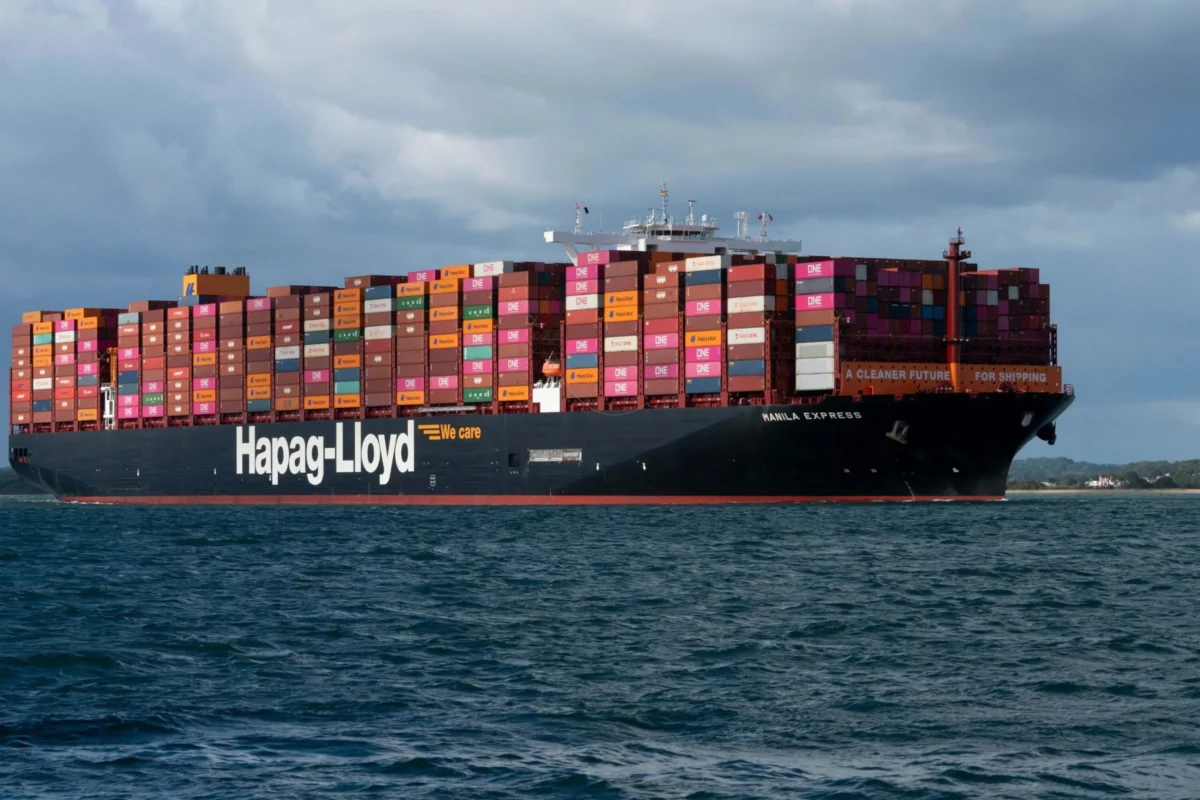
Shares of Hapag-Lloyd rallied approximately 6% during Tuesday’s trading session after the German shipping conglomerate unveiled an upgraded full-year profit outlook, attributing the boost to resilient market conditions and improving freight rate dynamics.
The Hamburg-based carrier, ranked fifth globally by container capacity, now anticipates full-year EBITDA ranging between $2.7 billion and $3.7 billion. This represents a substantial upgrade from the company’s prior guidance bracket of $1.1 billion to $3.1 billion. Additionally, Hapag-Lloyd elevated its operating income (EBIT) forecast to a span of $100 million to $1.1 billion.
The positive market reaction followed an announcement that industry observers had largely anticipated.
“We think this was widely expected following Maersk two weeks ago,” equity analysts at Barclays commented in a research note. Denmark’s Maersk had previously lifted its own profit projections last month, referencing vigorous container shipping demand.
Barclays suggested the revised outlook probably indicates stronger second-quarter performance relative to the opening quarter, though they expect a more pronounced profitability acceleration in Q3 rather than Q2. The broad guidance corridor, analysts observed, underscores constrained visibility heading into the fourth quarter.

This development unfolds against a backdrop of a global shipping sector that has navigated considerable turbulence.
Red Sea Conflict Elevates Shipping Costs
Military tensions between Israel and Iran, which intensified in late February, compelled ocean carriers such as Hapag-Lloyd and Maersk to halt operations through the Strait of Hormuz and Gulf of Oman corridor. This rerouting added substantial mileage to critical shipping lanes.
Prior to this escalation, most international shipping lines had already abandoned the Suez Canal passage after Houthi militants based in Yemen launched attacks on commercial vessels transiting the Red Sea. This security threat forced carriers onto the considerably longer routing around Africa’s Cape of Good Hope, substantially inflating transportation expenses.
These extended voyage paths translated into increased fuel consumption, prolonged transit times, and elevated freight pricing — creating financial strain for shippers while simultaneously generating revenue growth for container line operators.
Gradual Suez Canal Resumption
Earlier this month, Hapag-Lloyd alongside Maersk announced the reactivation of the AE15 service through the Red Sea corridor. This Gemini-alliance route is being operationally managed by Maersk, which is assuming the security risks associated with the region.
Maersk has subsequently introduced two additional services utilizing the Suez Canal outside its Gemini partnership framework. Hapag-Lloyd, meanwhile, has adopted a more conservative stance regarding the resumption of its proprietary routes through contested waters.
Company leadership acknowledged that the updated forecast contains considerable uncertainty, given persistent freight rate volatility and substantial geopolitical headwinds that continue to complicate industry outlooks.
Maersk equity also benefited from Tuesday’s developments, advancing roughly 2.8% during the session.
Hapag-Lloyd’s refreshed EBITDA guidance range of $2.7 billion to $3.7 billion represents a significant elevation from the previous midpoint estimate of $2.1 billion — an upgrade that investors clearly endorsed.
Get 3 Free Stock Ebooks
Discover top-performing stocks in AI, Crypto, and Technology with expert analysis.
- Top 10 AI Stocks - Leading AI companies
- Top 10 Crypto Stocks - Blockchain leaders
- Top 10 Tech Stocks - Tech giants


