



Key Points
- Iranian forces launched at least two missiles targeting commercial vessels in the Strait of Hormuz late Monday
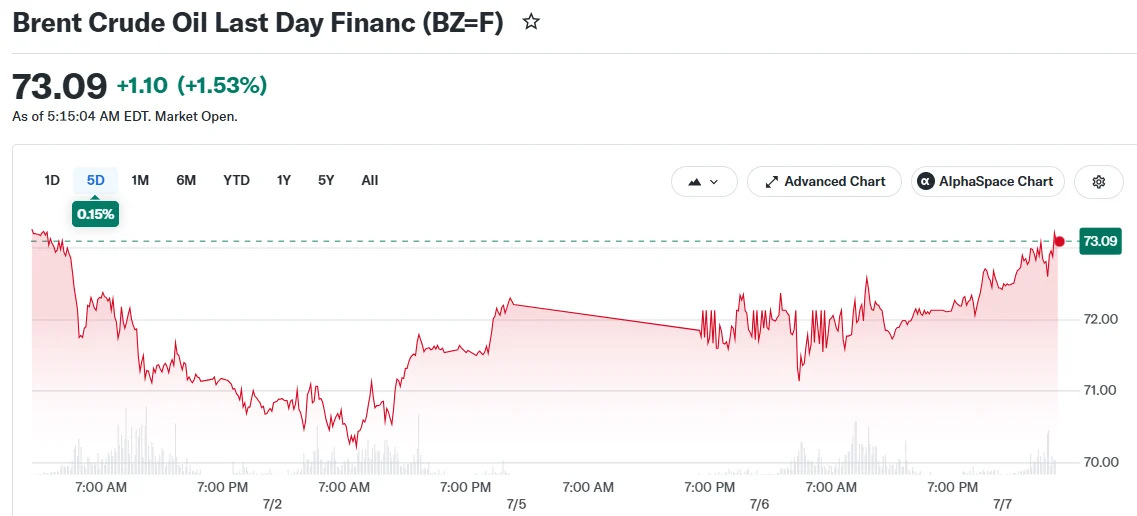
- Brent crude climbed 1.6% to reach $73.10 per barrel; WTI futures advanced 1.5% to $69.60 per barrel
- A temporary seven-day ceasefire agreement between the U.S. and Iran for the strait has lapsed
- OPEC+ decided to increase production quotas by 188,000 barrels daily starting in August
- Saudi Aramco reduced its August pricing for Arab Light crude to discount levels, marking the first such move since 2020
Crude oil markets experienced an uptick on Tuesday following Iranian military strikes against commercial shipping in the Strait of Hormuz, heightening anxieties about navigation security through one of the globe’s most critical petroleum transit points.
Brent crude advanced 1.6% to reach $73.10 per barrel during early European trading sessions. U.S. West Texas Intermediate futures similarly gained 1.5% to trade at $69.60 per barrel.
According to Axios, citing two American officials, Iranian military forces launched at least two missiles toward vessels transiting the strait late Monday evening. These strikes marked the conclusion of a week-long temporary cessation that had been negotiated as part of a U.S.-Iranian arrangement.
The U.K. Maritime Trade Operations agency additionally confirmed that a tanker navigating near Oman’s coastline was struck by an unidentified projectile, igniting a fire onboard. While Tehran has not formally acknowledged responsibility, unnamed sources speaking to Iranian state media indicated the intended target was a liquefied natural gas carrier originating from Qatar.
Fragile Diplomatic Framework Under Pressure
The missile strikes occurred precisely as a seven-day arrangement between Washington and Tehran to suspend attacks in the strategic waterway reached its expiration. This temporary accord was connected to a more comprehensive memorandum of understanding finalized fewer than three weeks prior, which now faces significant uncertainty.

Tehran has mandated that all vessels traversing the strait must utilize Iranian-approved navigation corridors. Iranian officials cautioned that any American intervention would trigger “a rapid and decisive action.”
Crude markets had retreated to pre-conflict pricing levels following a peace agreement signed in June. During the earlier phases of the conflict, which commenced in late February, oil prices had skyrocketed beyond $110 per barrel.
Deutsche Bank analysts observed that despite prices normalizing to pre-war levels, shipping traffic through the strait remains substantially below typical volumes. “There is still supply-chain stress here,” their analysis stated.
OPEC+ Boosts Output as Persian Gulf Shipments Rebound
The upward momentum in crude prices faced constraints from expanding supply. OPEC+ member nations agreed Sunday to elevate production targets by 188,000 barrels daily beginning in August. This action follows comparable increases already implemented during June and July.
The United Arab Emirates, which departed from the OPEC+ quota framework in May, reported production exceeding 3.8 million barrels daily in June, surpassing its pre-conflict output capacity.
Saudi Aramco additionally reduced the official selling price for its Arab Light crude to Asian customers. This represents the first instance the price has been positioned at a discount relative to the regional benchmark since 2020, illustrating intensifying competition for market dominance as Persian Gulf exports normalize.
MUFG analysts suggested that oil price appreciation will likely face headwinds. “Saudi Arabia has cut its August official selling prices, OPEC+ continues to unwind production cuts, Gulf exports are recovering, and the physical market remains well supplied,” stated Soojin Kim from MUFG.
The circumstances surrounding the strait remain volatile, with peace discussions continuing and authority over the waterway representing a fundamental point of contention between Tehran and Washington.
Get 3 Free Stock Ebooks
Discover top-performing stocks in AI, Crypto, and Technology with expert analysis.
- Top 10 AI Stocks - Leading AI companies
- Top 10 Crypto Stocks - Blockchain leaders
- Top 10 Tech Stocks - Tech giants


