



Key Takeaways
- Crude markets retreated Thursday with Brent losing approximately 1.3–1.5% and WTI shedding over 1%, ending a three-day winning streak
- A ceasefire deal between Israel and Lebanon was reached, though its success hinges on Hezbollah compliance — the militant group wasn’t involved in discussions
- Since late February, the Strait of Hormuz remains essentially blocked, eliminating about 20% of worldwide crude flows
- American petroleum inventories declined by 8 million barrels in the latest week — significantly exceeding forecasts of 3 million barrels
- American crude shipments abroad reached near-peak volumes at 5.9 million barrels daily as global buyers hunt for replacement supplies
Crude markets experienced downward pressure Thursday following news that Israel and Lebanon reached an agreement to cease hostilities, reducing some of the Middle Eastern tensions that had lifted oil values during the prior three trading days.
Brent crude contracts slipped roughly 1.3% to approximately $96.30 per barrel. American West Texas Intermediate crude declined about 1.2% to $94.84 per barrel.
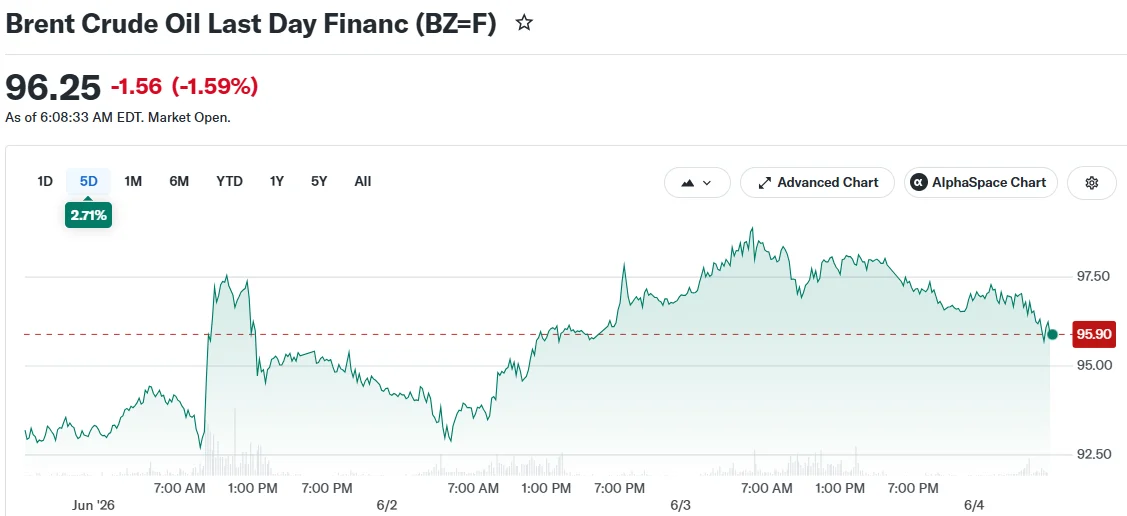
Thursday’s pullback came after the previous session’s nearly 2% rally, which had elevated both benchmarks to levels not seen in over eight days.
The ceasefire’s sustainability rests on whether Iran-supported Hezbollah will cease military operations. Since Hezbollah wasn’t a participant in the Washington-mediated negotiations, market observers question the arrangement’s durability.
Regional conflict has persisted since February’s end. Recent escalations this week reportedly included Iranian missile launches targeting Kuwait and Bahrain, plus American military strikes against Iran’s Qeshm Island positioned near the Strait of Hormuz.

Hormuz Waterway Blockade Maintains Market Tension
The Strait of Hormuz — a critical passage typically transporting approximately one-fifth of world’s oil — has remained functionally closed since hostilities erupted. This blockage has eliminated substantial crude volumes from international commerce.
Diplomatic efforts between Washington and Tehran have yielded minimal advancement. Market participants closely monitor developments for any breakthrough that might restore petroleum movement from the area.
President Donald Trump indicated during a podcast appearance that Iran had committed to abandoning nuclear weapon development, sparking modest optimism for peaceful resolution. Trump additionally informed advisers he wouldn’t authorize renewed Iranian attacks unless American personnel face casualties, per Wall Street Journal reporting.
Domestically, the U.S. House of Representatives approved a measure designed to prevent Trump from pursuing further military engagement. The legislation requires Senate passage and two-thirds supermajorities in both legislative bodies to overcome presidential veto.
ING analysts observed the market faces mounting stress: “Every day that passes without a resumption of oil flows leaves the market increasingly vulnerable.”
Sharp U.S. Inventory Decline Cushions Price Drop
A substantial reduction in American crude reserves helped prevent steeper price declines Thursday.
Energy Information Administration figures revealed petroleum stocks decreased by 8 million barrels during the week concluding May 29. Market forecasters had anticipated roughly 3 million barrels would be withdrawn.
The accelerated drawdown resulted partly from an export boom. American crude shipments overseas hit 5.9 million barrels daily, approaching historical peaks, as European and Asian purchasers desperately sought substitute sources.
The United States simultaneously withdrew another 8 million barrels from its Strategic Petroleum Reserve during the reporting period.
ING analysts highlighted that inventory depletion rates have exceeded seasonal norms. As summer’s peak consumption season nears, worldwide reserves could reach dangerously low thresholds if present trajectories persist.
The Energy Information Administration projects global petroleum stockpiles are depleting swiftly. Analysts indicate this maintains upward price pressure despite apparent geopolitical tensions moderating.
Get 3 Free Stock Ebooks
Discover top-performing stocks in AI, Crypto, and Technology with expert analysis.
- Top 10 AI Stocks - Leading AI companies
- Top 10 Crypto Stocks - Blockchain leaders
- Top 10 Tech Stocks - Tech giants


