



TLDR
- Military exchanges between the US and Iran over the weekend triggered market turbulence
- Nasdaq 100 futures slid 1%, while S&P 500 futures declined 0.3%
- Brent crude surged 3.8% approaching $79 per barrel amid Strait of Hormuz concerns
- Bitcoin retreated 1.6% to $62,943 as risk appetite diminished
- Critical inflation reports and major financial institution earnings scheduled this week
Equity futures tumbled Monday morning following weekend military actions between the United States and Iran. The Nasdaq 100 futures contract shed 1%, S&P 500 futures declined 0.3%, while Dow Jones futures remained relatively unchanged.
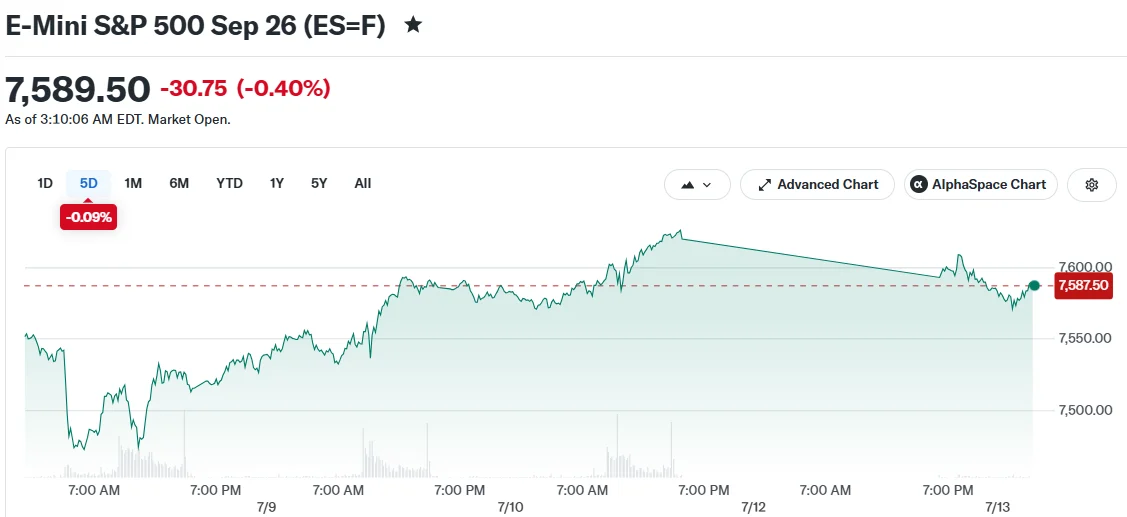
The renewed Middle Eastern conflict rattled investors who have maintained vigilant watch over regional tensions. Despite modest weekly advances for both the S&P 500 and Nasdaq, those gains now face significant headwinds.
Iran’s Islamic Revolutionary Guard Corps announced the Strait of Hormuz would be “closed until further notice.” American officials contested this claim, maintaining the strategic waterway remains navigable. However, maritime tracking service Kpler reports zero LNG shipments have passed through the strait since Saturday.
Oil prices experienced sharp upward momentum following these developments. Brent crude advanced 3.8% to reach $78.89 per barrel. West Texas Intermediate climbed 3.7% to settle at $74.04 per barrel. Deutsche Bank’s Jim Reid noted energy markets had “reacted” to accounts of vessel damage, intercepted drones, and attacks targeting energy infrastructure throughout the Gulf region.
President Trump indicated ceasefire negotiations with Iran continue, while simultaneously declaring he regards the existing ceasefire as “over.” This conflicting messaging amplified investor anxiety.

Inflation Data and Earnings in Focus
The geopolitical escalation arrives during a particularly crucial period for financial markets. Two pivotal inflation indicators await release this week. Tuesday brings the Consumer Price Index, with the Producer Price Index following Wednesday.
These measurements will enable investors to assess whether Middle Eastern developments are contributing to wider inflationary pressures. The data will additionally influence forecasts regarding Federal Reserve monetary policy adjustments throughout the remainder of the year.
Corporate earnings season accelerates this week as well. JPMorgan Chase, Goldman Sachs, and Bank of America headline Tuesday’s banking sector reports. Netflix and UnitedHealth also feature prominently on the earnings calendar.
Taiwan Semiconductor Manufacturing Company unveils quarterly performance figures this week. Market participants anticipate its results will illuminate demand patterns for AI processors, a subject commanding significant Wall Street attention.
The artificial intelligence investment theme has experienced weakening momentum recently. Market observers increasingly question the sustainability of massive AI infrastructure expenditures by leading technology corporations.
South Korean memory chip manufacturer SK Hynix witnessed shares plummet 15% Monday following Friday’s US listing introduction. The decline contributed to a 9% drop in South Korea’s KOSPI index, underscoring persistent doubts about the AI investment cycle’s longevity.
Bitcoin Drops as Risk Appetite Fades
Bitcoin declined 1.6% during the preceding 24-hour period, settling at $62,943. The cryptocurrency’s retreat mirrors a wider withdrawal from risk-oriented assets amid escalating geopolitical strains.
The benchmark 10-year US Treasury yield increased 1 basis point to 4.57%. The US dollar index weakened 0.1% relative to a basket of major currencies.
With energy prices spiking, inflation metrics approaching, and earnings season launching, this week promises to rank among the market calendar’s most eventful periods of the year.
Get 3 Free Stock Ebooks
Discover top-performing stocks in AI, Crypto, and Technology with expert analysis.
- Top 10 AI Stocks - Leading AI companies
- Top 10 Crypto Stocks - Blockchain leaders
- Top 10 Tech Stocks - Tech giants


