


Key Takeaways
- Morgan Stanley shifted its stance on Synopsys (SNPS) to Overweight from Equal-Weight, maintaining a $500 price objective.
- The rating change reflects increased conviction in Ansys merger benefits and Design IP business stabilization.
- Analyst highlights physical AI infrastructure as a significant yet overlooked growth catalyst for Synopsys’ product suite.
- The company exceeded fiscal Q3 2026 projections with non-GAAP earnings per share of $3.91 and sales reaching $2.48 billion.
- Baird independently raised SNPS to Outperform, setting a $560 price objective.
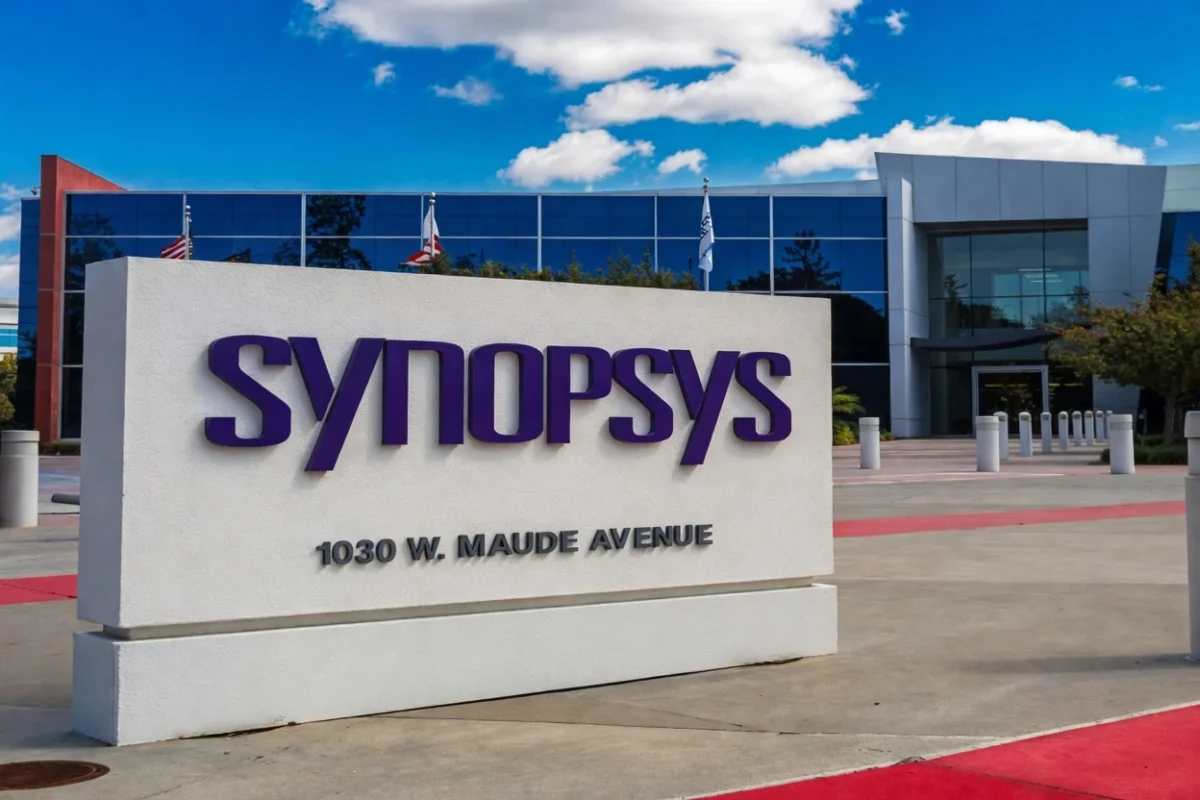
Synopsys (SNPS) secured a positive rating revision from Morgan Stanley on Tuesday, with the investment bank elevating the shares to Overweight from Equal-Weight while maintaining its $500 price objective.
The recommendation came from analyst Lee Simpson as part of Morgan Stanley’s recalibrated approach to semiconductor stocks. “As DRAM nears a late-cycle turning point and valuation spreads widen, we’re becoming more discriminating,” Simpson stated.
At the time Morgan Stanley published its analysis, SNPS shares were changing hands near $393.84, representing a roughly 5.4% decline for the session—a level the firm identified as a compelling opportunity following recent price pressure.
Earlier in the year, Morgan Stanley had adopted a neutral stance on Synopsys while awaiting definitive evidence on three critical factors: profitability metrics from the Ansys acquisition, a resumption of double-digit EDA expansion, and validation of the co-design platform’s strategic significance.

The firm now indicates sufficient visibility on these matters to justify returning to a positive rating.
Ansys Merger Benefits and Physical AI Opportunity
Central to Morgan Stanley’s investment case is the Ansys acquisition integration. Synopsys introduced Multiphysics Fusion during Q3, representing the inaugural combined product from both organizations, and Morgan Stanley anticipates management may provide updated revenue synergy projections at the forthcoming investor event.
The firm contends the market hasn’t fully appreciated how Synopsys’ technology portfolio aligns with physical AI infrastructure demands. Simpson highlighted simulation capabilities addressing thermal management, mechanical stress analysis, and fluid dynamics as especially valuable for narrowing the simulation-to-reality performance gap.
The newly unveiled Factory 2 IP framework, a tailored intellectual property offering designed for hyperscale cloud providers and custom ASIC developers requiring specialized solutions, represents another dimension Morgan Stanley expects management to emphasize.
Synopsys delivered 46% revenue expansion over the trailing twelve-month period and maintains an 83% gross profit margin. InvestingPro data indicates the shares currently trade beneath their calculated intrinsic value.
Quarterly Results Exceed Expectations and Additional Analyst Actions
Synopsys’ fiscal third quarter 2026 performance surpassed Wall Street projections. The organization delivered non-GAAP earnings per share of $3.91, exceeding the $3.67 analyst consensus, while revenue reached $2.48 billion compared to the anticipated $2.44 billion.
Management subsequently lifted its full-year guidance based on the quarterly performance. Benchmark maintained its Buy recommendation, with analyst Gary Mobley characterizing the results as a “beat-and-raise” quarter.
In a separate move, Baird elevated Synopsys to Outperform from Neutral, establishing a $560 price target. Baird pointed to encouraging growth prospects for fiscal 2027 and anticipates a return to double-digit organic revenue expansion.
On the same day, Morgan Stanley downgraded Infineon (IFNNY) to Equal-Weight from Overweight, reducing its price target to €65 from €81. The firm also lowered projections on ASML to €1,700 from €1,930 and BE Semiconductor to €220 from €260.
Regarding Infineon, Simpson observed that “PSS projections appear elevated and multiple emerging concerns leave us lacking a definitive positive catalyst.”
Morgan Stanley’s $500 valuation target on SNPS remains consistent with its prior assessment.
Get 3 Free Stock Ebooks
Discover top-performing stocks in AI, Crypto, and Technology with expert analysis.
- Top 10 AI Stocks - Leading AI companies
- Top 10 Crypto Stocks - Blockchain leaders
- Top 10 Tech Stocks - Tech giants


