


TLDR
- The Nasdaq Composite reached an all-time high on Monday, pushing Tuesday’s futures higher across all major benchmarks.
- Nvidia (NVDA) shares advanced following robust earnings from Foxconn, indicating persistent appetite for AI hardware.
- The benchmark 10-year Treasury yield climbed to 5.31%, marking its highest close in over two decades.
- Technology stocks with AI exposure, including SpaceX, Tesla, Meta, and Microsoft, delivered solid Monday gains.
- Crude oil retreated Monday before edging up Tuesday; investors await Wednesday’s Federal Reserve meeting minutes.
US stock futures posted modest gains Tuesday morning as market participants continued monitoring corporate earnings reports and the sustained surge in artificial intelligence capital expenditures. The upward momentum persisted despite advancing Treasury yields and rising diesel costs.
Nasdaq-100 futures added 0.1% following Monday’s record closing high for the Nasdaq Composite. Technology heavyweights, particularly Nvidia and its sector peers, propelled the benchmark higher.
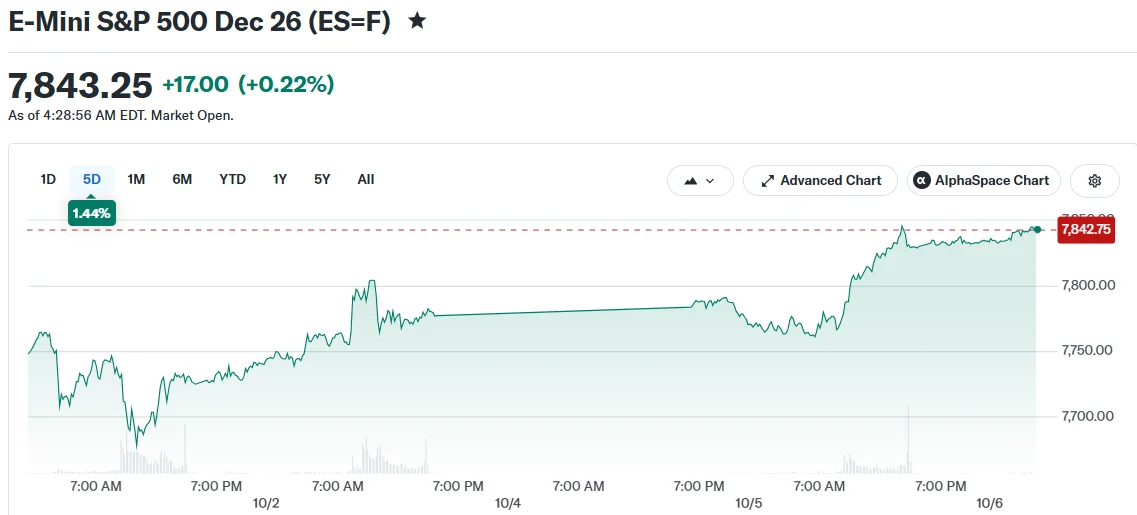
Futures tied to the Dow Jones Industrial Average climbed 0.1%, while S&P 500 contracts edged into positive territory. The S&P 500 currently trades less than 1% beneath its all-time peak.
Bond Yields Climb to Levels Unseen Since Early 2000s
Treasury market movements commanded significant attention from market participants throughout the week. The benchmark 10-year note yield advanced to 5.31%, representing its steepest closing level in nearly a quarter century.
Meanwhile, the 30-year Treasury yield pushed to 5.66%, territory last visited in 2002. The yield surge has prompted measured caution among certain investors, despite equities maintaining their upward trajectory.

Lisa Shalett, chief investment officer at Morgan Stanley Wealth Management, commented on the fixed-income turbulence in client correspondence. She identified a potential shift in Federal Reserve monetary policy framework, robust economic expansion, and elevated crude prices as key drivers.
The ongoing Middle East tensions represent an additional source of market unpredictability, she observed. Nevertheless, Shalett emphasized that present volatility levels remain well below the intensity witnessed during 2022’s equity downturn.
Technology Sector Powers Monday’s Market Advance
Equities tied to artificial intelligence applications delivered strong performance during Monday’s trading hours. SpaceX surged more than 7%, while both Nvidia and Tesla registered gains exceeding 2%.
Meta Platforms and Microsoft each posted advances above 1%. The rally followed impressive quarterly results from Taiwan-based electronics manufacturer Foxconn, a critical supplier for Nvidia’s operations.
Foxconn’s financial performance underscored ongoing worldwide appetite for AI-related infrastructure investments. Nvidia’s total market value now approaches the $6 trillion threshold.
Monday’s session saw the Nasdaq Composite climb approximately 1% to establish a fresh record closing level. The Dow Jones Industrial Average appreciated roughly 90 points, representing a 0.2% increase. The S&P 500 added 0.7%.
Across Asian markets Tuesday, Japan’s Nikkei 225 index increased 0.29%. South Korea’s Kospi benchmark declined 0.23%, whereas Australia’s S&P/ASX 200 climbed 0.53%.
Hong Kong’s Hang Seng Index advanced 0.95%. Mainland Chinese exchanges remained shuttered for the Golden Week celebration.
Oil prices retreated during Monday’s session. International benchmark Brent crude decreased 1.9% to settle at $100.32 per barrel.
West Texas Intermediate crude, the U.S. standard, fell approximately 1.8% to finish at $89.43 per barrel. Both contracts showed modest recovery Tuesday morning.
Tuesday’s corporate calendar features earnings releases from Constellation Brands and Lamb Weston Holdings. The macroeconomic data slate remains sparse for the session.
Market observers are particularly focused on Wednesday’s publication of Federal Reserve meeting minutes from the September policy gathering. These records may provide additional insight into the central bank’s latest deliberations regarding monetary policy adjustments.
Get 3 Free Stock Ebooks
Discover top-performing stocks in AI, Crypto, and Technology with expert analysis.
- Top 10 AI Stocks - Leading AI companies
- Top 10 Crypto Stocks - Blockchain leaders
- Top 10 Tech Stocks - Tech giants


