


Key Highlights
- Samsung delivered the world’s first 12-layer HBM4E memory chip samples, providing over 20% faster performance and 30%+ additional capacity versus prior-generation models.
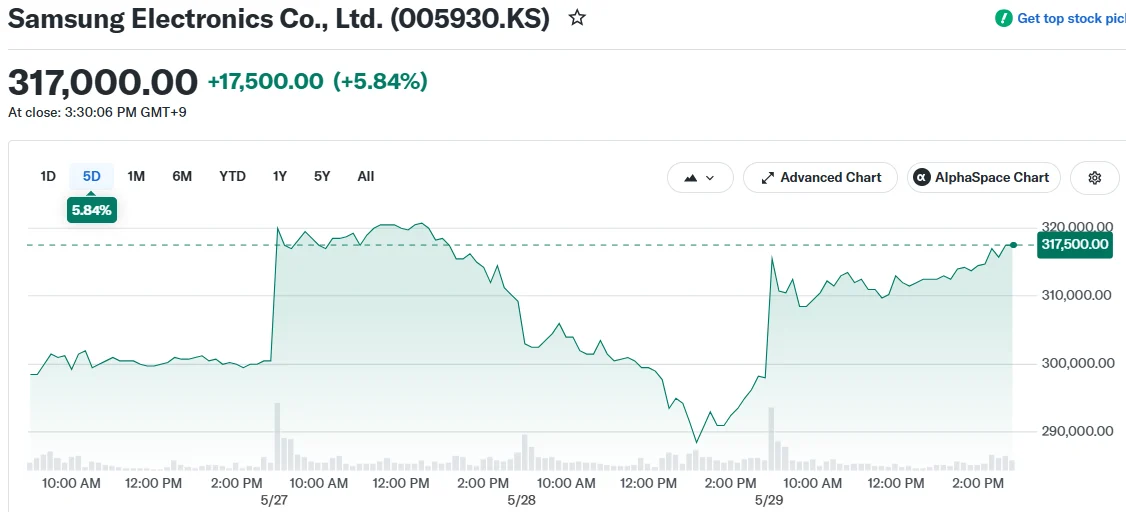
- Shares climbed 5.8% in Seoul trading following the announcement; Micron (MU) gained 2% in premarket hours.
- Industry analysts at BNP Paribas forecast the HBM memory sector will reach $76 billion in 2025 and expand to $156 billion by 2027.
- SK Hynix commands 57% of the global HBM revenue market; Samsung captures 22%, with Micron holding 21%.
- The new HBM4E technology leverages Samsung’s 1c DRAM manufacturing process combined with a cutting-edge 4-nanometer logic die.
Samsung Electronics announced Friday that it has delivered the first sample units of its 12-layer HBM4E memory chips to clients, marking an industry milestone. The announcement propelled Samsung shares up 5.8% during Seoul trading, while Micron saw approximately 2% gains before U.S. markets opened.
The advanced memory solution provides performance improvements exceeding 20% in data-processing capabilities and boasts capacity increases of more than 30% when compared to its HBM4 predecessor.
According to Samsung, the technology incorporates its newest 1c DRAM manufacturing process — representing the company’s sixth-generation 10-nanometer-class DRAM architecture — integrated with a 4-nanometer foundry logic base die.
The delivery timeline is particularly aggressive, coming merely three months after Samsung initiated HBM4 chip shipments to partners in February. This rapid progression underscores Samsung’s determined pursuit of leadership in the AI memory segment.
“Samsung plans to begin mass production for HBM4E aligned with customer schedules, following initial sample shipments and optimization,” the company said in a statement.
Among Samsung’s client roster are Nvidia, AMD, and Google — industry heavyweights fueling the demand surge for sophisticated memory solutions in artificial intelligence infrastructure.

The semiconductor manufacturer had previously indicated in April its intention to distribute HBM4E samples during the second quarter, successfully meeting that projected schedule.
Implications for Micron
Micron represents the primary American challenger to Samsung and SK Hynix in high-bandwidth memory production. While Samsung’s announcement appears competitive on its face, the market dynamics tell a more nuanced story.
Micron has publicly stated that its complete HBM4 production capacity through 2026 is already committed to customers. This pre-sold inventory cushions Micron from immediate competitive pressure stemming from Samsung’s latest development.
BNP Paribas research predicts the overall HBM market will more than double during the current year to approximately $76 billion, subsequently rising to $156 billion in 2027. Given such explosive growth projections, sufficient opportunity exists for all three major manufacturers to prosper.
As of late 2025, SK Hynix maintained market leadership with 57% of worldwide HBM revenue, according to Counterpoint Research data. Samsung secured 22% while Micron accounted for 21%.
Industry Context
Micron has demonstrated robust momentum in semiconductor markets, and Samsung’s HBM4E unveiling appears unlikely to disrupt that trajectory considering the industry-wide supply constraints that persist.
SK Hynix continues to dominate the HBM landscape, though Samsung is evidently accelerating efforts to narrow the competitive distance — and doing so faster than market observers anticipated.
Nvidia, representing one of the largest HBM chip consumers, registered a 0.78% gain Friday amid broader positive sector sentiment.
Samsung’s HBM4E employs the company’s most sophisticated DRAM process node to date, which executives assert positions the firm favorably for emerging AI hardware demands.
Get 3 Free Stock Ebooks
Discover top-performing stocks in AI, Crypto, and Technology with expert analysis.
- Top 10 AI Stocks - Leading AI companies
- Top 10 Crypto Stocks - Blockchain leaders
- Top 10 Tech Stocks - Tech giants


