



TLDR
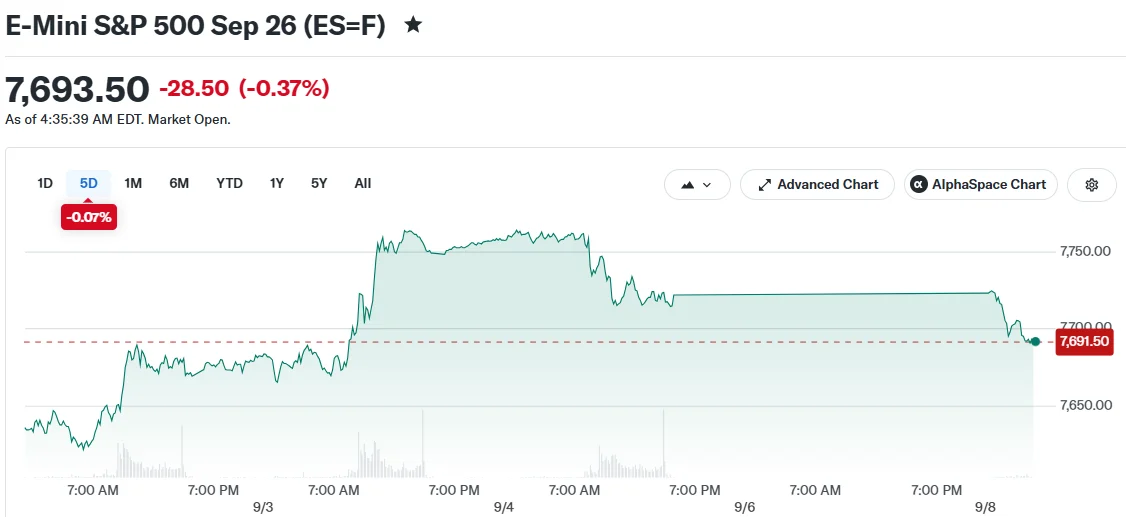
- Equity futures retreated Tuesday with Dow futures declining 0.8% while S&P 500 futures dropped 0.3%
- Brent crude oil advanced toward $100 per barrel for the third consecutive trading day
- Tehran issued warnings about potential maritime restrictions throughout the Persian Gulf region
- Robust August employment figures have rekindled speculation about additional Fed tightening
- Market participants await Friday’s inflation data and Oracle’s earnings release this week
Wall Street futures commenced Tuesday’s session on a negative note as traders returned from the extended Labor Day weekend confronting multiple headwinds. Energy markets rallied sharply, geopolitical risks in the Middle East intensified, and concerns about persistent inflation resurfaced.
Futures contracts for the Dow Jones Industrial Average retreated 0.8% to 53,013 points. The S&P 500 futures declined 0.3% to 7,691. Nasdaq 100 futures remained relatively unchanged at 29,593 points.
Energy Markets Push Toward Triple Digits
Brent crude advanced 1.4% to reach a six-week peak, climbing close to $99 per barrel. The domestic WTI benchmark edged near $93. This marked the third consecutive session of upward momentum for petroleum prices.
The rally intensified following threats from Iran to establish a maritime exclusion zone throughout the Persian Gulf waterway. Iranian authority Mohsen Rezaei characterized the warning as retaliation against alleged US “economic warfare.”
Additionally, Houthi militants supported by Tehran executed strikes against Saudi Arabian targets, heightening anxieties about energy sector vulnerabilities throughout the region.

The Persian Gulf corridor serves as a critical artery for worldwide petroleum distribution. Any interruption to maritime traffic in this area could drive energy costs significantly higher, compounding existing inflationary pressures.
Federal Reserve Policy Uncertainty Resurfaces
Friday’s unexpectedly robust August employment report surprised financial markets. The figures revealed stronger-than-anticipated payroll growth, indicating the economy maintains sufficient momentum to justify maintaining the Federal Reserve’s restrictive monetary policy stance.
Market participants are now intensely focused on Friday’s Consumer Price Index release. Should inflation metrics remain stubbornly above the central bank’s 2% objective, additional monetary tightening could materialize as early as this month.
Escalating petroleum prices increase the probability of such an outcome. Elevated energy expenses ripple through transportation networks and manufacturing sectors, ultimately contributing to generalized price increases across the economy.
Treasury bond yields also advanced Tuesday. Increasing yields elevate financing costs for corporations and households alike. They simultaneously diminish the relative attractiveness of equities versus fixed-income securities, especially impacting growth-oriented and technology sector valuations.
America’s national debt has now exceeded $40 trillion. The Treasury Department scheduled a three-year note auction Tuesday, with investor participation levels being monitored as an indicator of confidence in sovereign debt obligations.
Additional Market Pressures
President Trump issued a statement Monday demanding an immediate suspension of Bombardier’s commercial activities within the United States. The Canadian aerospace manufacturer derives over half its revenue from American operations, approximately $5 billion each year. Market participants may need to recalibrate their expectations for the company should such restrictions be implemented.
Regarding corporate earnings, GameStop was scheduled to announce quarterly results Tuesday. Oracle’s upcoming report later this week is anticipated to generate greater market impact.
The ADP Employment Change data was also slated for release Tuesday, providing market participants with supplementary insight into labor market dynamics ahead of the Federal Reserve’s upcoming policy deliberations.
Get 3 Free Stock Ebooks
Discover top-performing stocks in AI, Crypto, and Technology with expert analysis.
- Top 10 AI Stocks - Leading AI companies
- Top 10 Crypto Stocks - Blockchain leaders
- Top 10 Tech Stocks - Tech giants


