



Key Points
- The U.S. military conducted additional strikes targeting Iranian positions near the Strait of Hormuz, unsettling financial markets
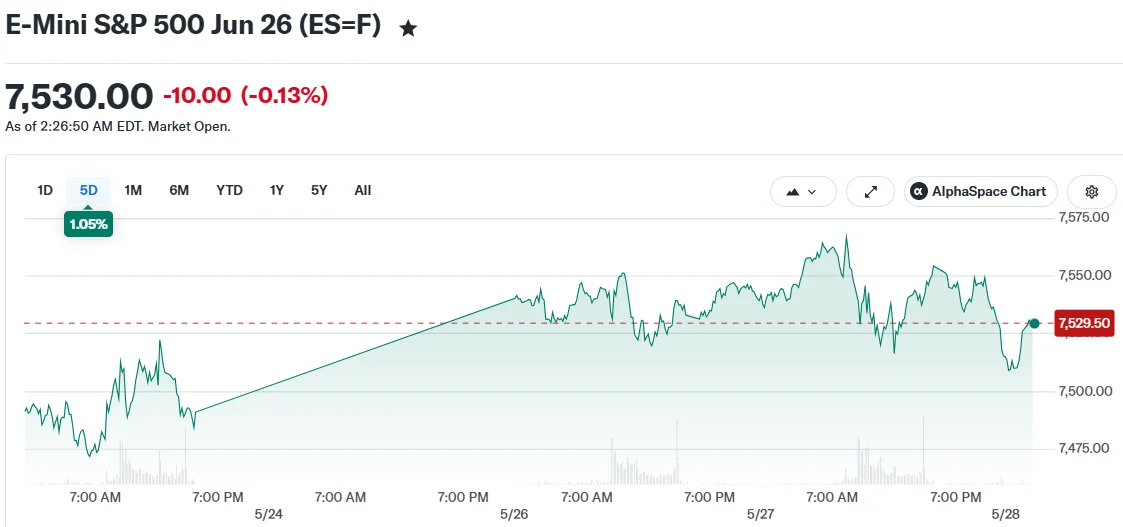
- Futures contracts for the Dow, S&P 500, and Nasdaq all traded lower during Thursday’s pre-market session
- Crude oil rallied approximately 3%, pushing Brent crude toward $94.86 per barrel
- Snowflake shares skyrocketed more than 30% following quarterly results and a major $6 billion partnership with Amazon Web Services
- Thursday’s economic calendar features the PCE inflation report, a critical metric closely monitored by Federal Reserve policymakers
Equity futures in the United States retreated during Thursday’s early trading hours following renewed U.S. military action against Iranian targets near the strategically important Strait of Hormuz, intensifying concerns about the delicate truce between Washington and Tehran.
Contracts linked to the Dow Jones Industrial Average slipped 0.2%. Futures for the S&P 500 declined 0.4%, while Nasdaq 100 futures lost 0.8%.
Overnight Developments
American military forces intercepted Iranian unmanned aerial vehicles and targeted a drone operations facility near Bandar Abbas during the late Wednesday hours, as reported by the Wall Street Journal. Military officials characterized the operations as protective measures rather than an aggressive expansion of conflict.
The three primary equity benchmarks reached all-time highs during Wednesday’s regular trading session, before geopolitical tensions resurfaced overnight. These advances occurred even as the semiconductor sector’s momentum showed signs of cooling.
According to Matt Britzman, an analyst with Hargreaves Lansdown, investors had already factored in expectations that the confrontation would remain limited. “Optimistic news now carries diminished capacity to boost investor confidence, whereas negative developments can rapidly erode market gains,” he noted.
Britzman emphasized that the resumption of military actions and uncertainty surrounding maritime transit routes and Tehran’s nuclear ambitions have reintroduced caution into trading sentiment.

Government bond yields and the U.S. dollar both moved higher. The benchmark 10-year Treasury yield increased by 2 basis points, reaching 4.51%. The greenback appreciated 0.1% versus a basket of major currencies.
Energy Markets and Corporate Results
Oil prices advanced substantially amid growing concerns about potential interruptions to vessel traffic through the Strait of Hormuz. Brent crude rallied 2.8%, trading at $94.86 per barrel. West Texas Intermediate climbed 2.8% to reach $91.20 per barrel.
Regarding corporate performance, Snowflake delivered robust quarterly figures following Wednesday’s market close while unveiling a substantial $6 billion collaboration with Amazon Web Services. The company’s shares surged over 30% during extended trading.
Marvell and HP likewise reported solid quarterly outcomes, with both enterprises highlighting artificial intelligence as a catalyst for increased expenditures on semiconductors, cloud infrastructure, and computing equipment.
Salesforce exceeded analyst projections but provided conservative forward guidance. This sparked investor apprehension regarding artificial intelligence’s potential to disrupt traditional software business models.
Thursday’s earnings calendar includes reports from Costco Wholesale, Dell Technologies, Dollar Tree, Best Buy, and The Gap.
The Personal Consumption Expenditures index, which serves as the Federal Reserve’s favored inflation indicator, is scheduled for release Thursday. This data will reveal whether inflationary momentum is accelerating sufficiently to potentially influence the Fed toward tightening monetary policy.
Financial markets continue to express overall confidence that Washington and Tehran will ultimately negotiate a lasting peace agreement. However, market strategists note that this latest escalation provides investors with justification to secure gains following several weeks of robust, AI-fueled market appreciation.
Get 3 Free Stock Ebooks
Discover top-performing stocks in AI, Crypto, and Technology with expert analysis.
- Top 10 AI Stocks - Leading AI companies
- Top 10 Crypto Stocks - Blockchain leaders
- Top 10 Tech Stocks - Tech giants


