



Key Takeaways
- The Nasdaq Composite declined 0.2% on Friday, marking its fifth consecutive session of losses, while both major indices recorded weekly drops exceeding 4% for the Nasdaq and nearly 2% for the S&P 500.
- Market sentiment deteriorated following a New York Times article indicating OpenAI might postpone its initial public offering to 2027 instead of the expected 2026 timeline.
- Chip stocks experienced significant selling pressure amid concerns about escalating memory and storage expenses following Apple’s decision to increase MacBook and iPad pricing.
- Investors grew more concerned about potential Federal Reserve interest rate increases after May’s Personal Consumption Expenditures data came in hotter than anticipated.
- The Dow Jones Industrial Average outperformed its counterparts, managing a modest weekly advance below 1%, benefiting from reduced technology sector representation.
Major US equity markets struggled throughout the week, with technology shares bearing the brunt of selling pressure. The Nasdaq Composite extended its decline to a fifth consecutive trading day on Friday, shedding 0.2%. The S&P 500 also retreated modestly. Both benchmarks concluded the week with substantial losses.
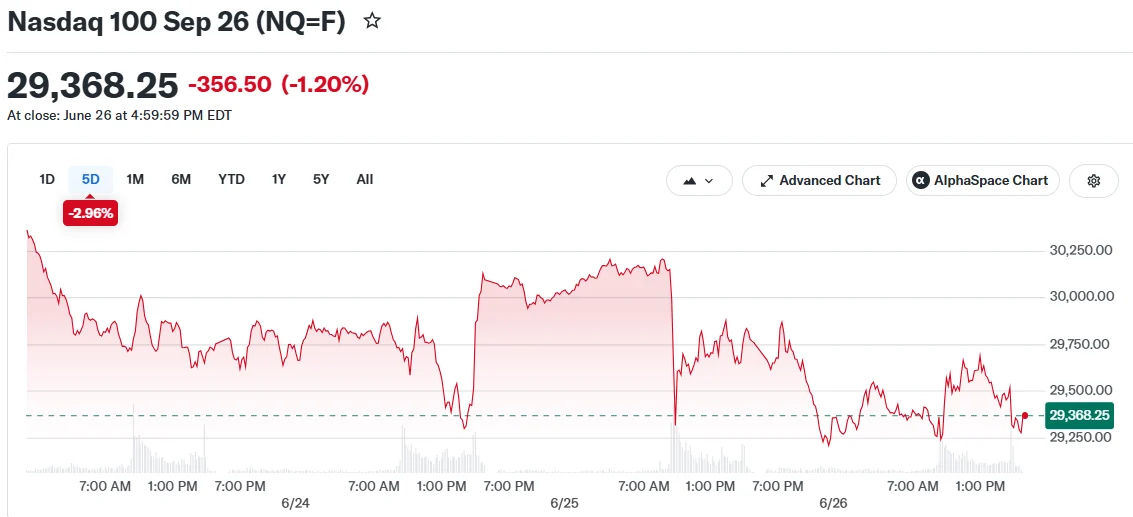
The Dow Jones Industrial Average experienced a minor decline of 56 points, representing a 0.1% decrease on Friday. Despite this, the blue-chip index managed to secure a weekly gain of just under 1%. The index’s limited technology representation provided insulation from the broader tech sector downturn.
Artificial Intelligence Skepticism Drives Market Weakness
Market participants have become progressively more skeptical about artificial intelligence investments. The sector faced multiple headwinds throughout the week, including questions about token economics and cash generation capabilities, alongside intensifying rivalry from budget-friendly AI alternatives and Chinese competitors.
A New York Times report intensified the negative sentiment. The publication indicated [[LINK_START_2]]OpenAI[[LINK_END_2]] could defer its much-awaited stock market debut from 2026 until 2027. This development dampened enthusiasm across technology equities.
Mizuho’s Daniel O’Regan, an analyst covering the space, captured the prevailing sentiment. “Feels like every time I open Bloomberg or the WSJ there’s another negative AI headline,” he observed. He noted that the continuous stream of unfavorable reports is expected to unsettle individual investors.
Semiconductor manufacturers faced particularly intense pressure. Apple’s recent price increases for MacBooks and iPads highlighted rising memory and storage component costs. Micron, a major chipmaker, delivered solid quarterly results but warned that cost pressures would persist.

Hot Inflation Numbers Revive Rate Hike Speculation
The Personal Consumption Expenditures index, which the Federal Reserve monitors closely for inflation signals, registered above expectations for May. This elevated reading reignited speculation that the central bank might implement rate increases this year, creating additional headwinds for growth-oriented and technology equities.
Elevated interest rates typically disadvantage technology companies, whose valuations depend significantly on projected future earnings. Any indication of potential borrowing cost increases tends to disproportionately impact these sectors compared to more value-oriented areas.
However, some positive indicators emerged. Market breadth metrics remained relatively solid. Approximately two-thirds of S&P 500 constituents continued trading above their 200-day moving averages as the week concluded.
David Donabedian, who serves as senior investment strategist at CIBC Private Wealth, characterized the week’s market action as a recalibration rather than a fundamental deterioration. He observed that defensive sectors including health care, real estate, and consumer staples demonstrated resilience, while industrials and technology absorbed the heaviest losses.
Oil prices retreated during the week as well. Brent crude descended to approximately $72 per barrel while West Texas Intermediate settled near $69. Shipping activity in the Strait of Hormuz proceeded normally following an incident involving a container vessel, alleviating some supply chain concerns. The United States and Iran reached a 60-day truce agreement, although regional volatility persists.
In the coming days, Wall Street confronts a holiday-abbreviated trading week. Thursday brings the crucial June employment report, which market participants will scrutinize intensely for additional insight into economic momentum and the trajectory of monetary policy.
Get 3 Free Stock Ebooks
Discover top-performing stocks in AI, Crypto, and Technology with expert analysis.
- Top 10 AI Stocks - Leading AI companies
- Top 10 Crypto Stocks - Blockchain leaders
- Top 10 Tech Stocks - Tech giants


