


Key Highlights
- Three decentralized finance platforms collectively distributed $96.3 million to their token-holding communities within a 30-day timeframe
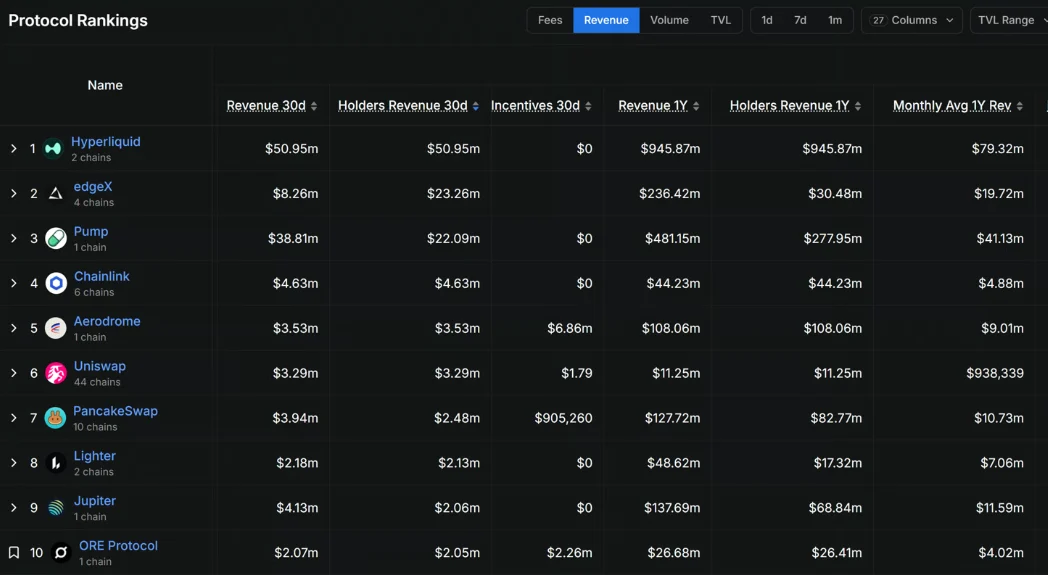
- Hyperliquid dominated distributions with $50.95 million, sourced exclusively from trading fees without any incentive spending
- Pump.fun distributed $22.09 million from $38.81 million in earnings following its transition to a balanced 50/50 allocation model on April 28, 2026
- EdgeX distributed $23.26 million despite recording just $8.26 million in platform revenue, indicating possible reserve depletion
- This trend reflects DeFi’s evolving emphasis on sustainable earnings over purely speculative growth metrics
A trio of decentralized finance platforms has channeled $96.3 million back to their token-holding communities within a single 30-day cycle, based on metrics compiled by DefiLlama. The platforms in question are Hyperliquid, Pump.fun, and EdgeX.
What makes these distributions noteworthy isn’t just the aggregate amount—it’s the divergent strategies each platform employed to fund their respective payouts. Crucially, not every dollar distributed originated from operational revenue.
Hyperliquid recorded $50.95 million in platform revenue throughout the measurement period. Every cent flowed directly to token holders. The protocol allocated zero funds toward user incentive programs. A mechanism known as the Assistance Fund, established in January 2025, captures 97% of all trading fees and deploys them to repurchase Hyperliquid tokens from secondary markets.
A governance proposal submitted by validators in December 2025 aimed to permanently eliminate approximately $920 million worth of tokens held by this fund. Should it receive approval, the initiative would fundamentally restrict token availability.
Pump.fun secured the runner-up position, channeling $22.09 million back to holders from $38.81 million in aggregate revenue. For nine consecutive months, the platform maintained a complete buyback strategy before pivoting to an evenly divided allocation structure on April 28, 2026. Currently, 50% of net proceeds fuel an automated token repurchase and burn mechanism.

Research published by CoinGecko revealed that 73.3% of Pump.fun participants recorded realized profits during April 2026, a significant climb from just 30.1% in June 2025. Engaged wallet addresses have rebounded to 3.14 million from a December 2025 bottom of 1.8 million. The majority of gains remained modest, with 65.1% of successful wallets capturing returns ranging from $1 to $500.
EdgeX’s Revenue-Distribution Gap Explained
EdgeX represents the statistical anomaly among the three. The platform channeled $23.26 million to token holders despite generating merely $8.26 million in operational revenue. This discrepancy strongly indicates the project is tapping into reserve capital or pre-allocated incentive treasuries.
The EdgeX token made its market debut on March 31, 2026, placing the project in the nascent stages of its economic model implementation. The critical question facing stakeholders is whether revenue generation can accelerate sufficiently to sustain distributions without continuous reserve withdrawals.
The Evolution Toward Sustainable DeFi Economics
These distributions emerge against a backdrop of fundamental sectoral transformation, as DeFi platforms increasingly prioritize distributing genuine earnings over inflationary token emission schemes. Andre Cronje, the architect behind Yearn.Finance, observed that DeFi in 2026 resembles traditional financial infrastructure more than speculative asset markets.
He highlighted stablecoins achieving a $320 billion valuation, decentralized trading venues facilitating north of $160 billion in monthly spot transactions, and lending protocols managing $28 billion in outstanding loans.
Additional platforms also executed holder distributions during this same window. Chainlink distributed $4.63 million, Aerodrome contributed $3.53 million, and Uniswap returned $3.29 million.
Among the three leading distributors, exclusively Hyperliquid financed its complete payout through organic fee generation. Pump.fun’s revised framework remains under evaluation following its structural adjustment, while EdgeX has yet to demonstrate long-term viability without supplementary funding.
Get 3 Free Stock Ebooks
Discover top-performing stocks in AI, Crypto, and Technology with expert analysis.
- Top 10 AI Stocks - Leading AI companies
- Top 10 Crypto Stocks - Blockchain leaders
- Top 10 Tech Stocks - Tech giants


