



Key Highlights
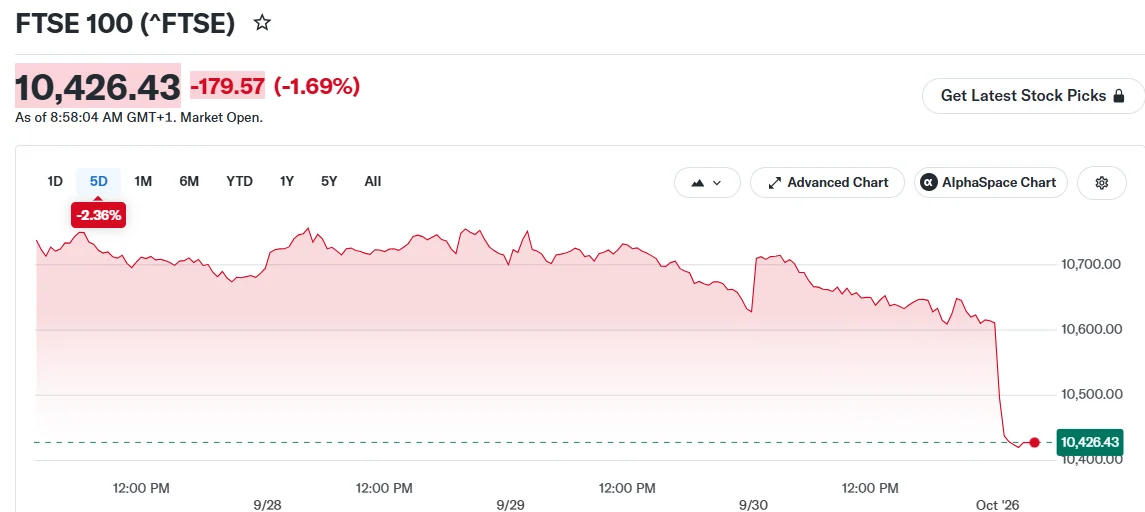
- British stocks declined more than 1% in early October trading, continuing a downward trend from Wednesday’s session.
- Yields on UK 30-year government bonds reached 6%, marking the highest point since early 1998.
- American 10-year Treasury yields advanced to 5.306%, reaching levels unseen since 2007.
- Gold climbed past $4,200 per ounce as market participants moved toward safe-haven assets.
- British residential property price appreciation decelerated to its slowest pace in nine months during September.
British stocks experienced significant declines Thursday morning as escalating government bond yields globally weighed heavily on equity valuations. The FTSE 100 retreated over 1% during opening hours, compounding Wednesday’s negative performance.
By mid-morning hours, the benchmark index had surrendered approximately 120 points, settling near 10,486. Meanwhile, the FTSE 250, representing more domestically-oriented businesses, experienced similar losses of nearly 1%. This widespread decline indicated broad market weakness extending beyond just multinational corporations.
Understanding the Government Bond Market Turmoil
The primary catalyst for equity market weakness was a widespread selloff across sovereign debt markets. British 30-year gilt yields climbed to the 6% threshold, representing the steepest level recorded since February 1998.
This surge came on the heels of a government bond auction conducted earlier in the week. Fresh 10-year UK government securities were issued at yields representing the highest returns for that maturity since 1999.
The phenomenon extended well beyond British borders. American 10-year Treasury yields pushed to 5.306% on Wednesday, marking the first time such levels had been observed since 2007.

Market participants attributed the pressure to multiple concerns including persistent inflation, expanding fiscal deficits, and increasing volumes of bond issuance. One market observer characterized the situation as a buyers strike in the debt market, suggesting insufficient demand for newly issued securities at prevailing price levels.
Rising yields on government bonds have significant implications for equity markets as they elevate discount rates applied to future corporate earnings projections. Additionally, they push borrowing costs higher for both commercial enterprises and consumers.
Continental European markets mirrored the weakness, with Germany’s DAX index declining 1.33% and France’s CAC 40 dropping 1.46% during the same trading period. Sterling also weakened, losing 0.24% versus the US dollar.
FTSE 100 Performance: Gainers and Decliners
Despite the broader market downturn, select equities posted positive returns. Rolls-Royce advanced 1.9%, while Polar Capital Technology Trust climbed 1.1%.
Precious metals mining companies benefited from strength in gold prices. Fresnillo and Endeavour Mining both recorded gains as gold traded above the $4,200 per ounce threshold.
Within mid-cap stocks, XPS Pensions surged 4.8% and AO World jumped 4.7%. Ferrexpo and Raspberry Pi also registered positive movements.
Conversely, British American Tobacco suffered a 3.2% decline. Weir Group dropped 2.7%, positioning it among the index’s most significant underperformers.
In property market developments, the UK residential sector displayed cooling momentum. Nationwide, a major mortgage provider, disclosed that annual house price appreciation moderated to 0.8% in September, down from August’s 1.6% reading.
Month-over-month, property values decreased 0.2%. Nationwide attributed the softness to elevated energy costs and anticipation of additional interest rate increases dampening purchasing activity.
Regional property markets similarly exhibited weakness throughout most areas of the nation.
In commodity markets, Brent crude advanced 1.4% to $99.44 per barrel. West Texas Intermediate crude increased 1.35% to $91.64.
Gold futures appreciated 0.25% to $4,196 per ounce, while spot gold advanced 0.22% reaching $4,165.95.
Market attention now turns to the final UK manufacturing PMI figure for September, scheduled for release Thursday afternoon. The indicator may reveal whether Britain’s economy maintains resilience despite increasingly restrictive financial conditions. Unless bond market volatility subsides, strength in defensive sectors such as mining and defense appears unlikely to offset broader downward pressure across UK equities.
Get 3 Free Stock Ebooks
Discover top-performing stocks in AI, Crypto, and Technology with expert analysis.
- Top 10 AI Stocks - Leading AI companies
- Top 10 Crypto Stocks - Blockchain leaders
- Top 10 Tech Stocks - Tech giants


