



TLDR
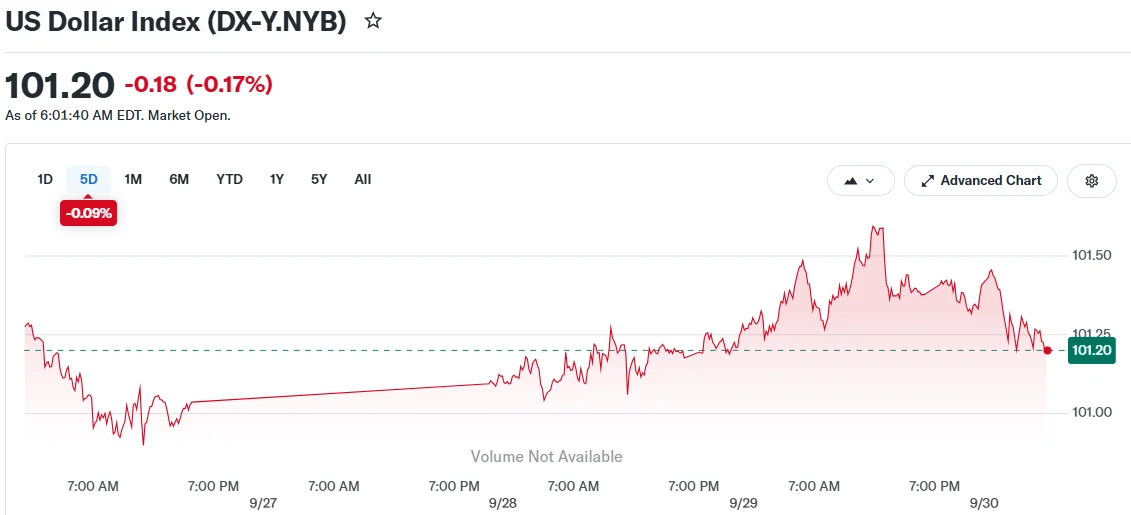
- The greenback experienced a minor decline on Wednesday while maintaining momentum for its strongest monthly showing since June.
- Federal Reserve Bank of New York President John Williams indicated rate hike decisions need not be rushed, dampening October increase speculation.
- Japan’s currency strengthened 0.3% versus the dollar amid renewed official warnings regarding volatile exchange rate movements.
- Australia’s currency touched a nine-week trough following disappointing inflation figures.
- The single European currency heads toward its steepest monthly decline versus the dollar in over a year, weighed down by energy concerns and French political uncertainty.
The greenback retreated modestly on Wednesday, easing from its peak level witnessed in nearly eight weeks. Nonetheless, the currency maintains its trajectory for the most robust monthly advance since the summer period.
The benchmark dollar index, tracking the currency’s performance against half a dozen primary trading partners, declined 0.2% to settle at 101.22. This movement followed commentary from a senior Federal Reserve policymaker suggesting a more patient approach toward monetary tightening.
John Williams, who leads the New York Federal Reserve branch, articulated that policymakers face “no need for urgency” in implementing additional interest rate increases. His statements prompted market participants to reduce expectations for an October policy move.
Central Bank Official’s Remarks Temper Tightening Expectations
Prior to Williams’ public remarks, financial markets had assigned greater than 70% probability to an October rate adjustment. Following his commentary, that likelihood descended to approximately 50%.
Market participants now turn their attention to Friday’s employment situation report and the Personal Consumption Expenditures price gauge. The PCE measurement serves as the Federal Reserve’s primary inflation indicator.

Yields on two-year government securities declined roughly 3.5 basis points in response to the commentary. This movement signals diminished expectations for imminent monetary policy tightening.
Among major global currencies, the Japanese yen registered the most significant gains on Wednesday. It appreciated 0.3% relative to the dollar, reaching 156.77 yen per greenback.
Japanese monetary authorities delivered fresh commentary regarding yen depreciation. Atsushi Mimura, the nation’s senior currency official, indicated that Prime Minister Sanae Takaichi and Finance Minister Satsuki Katayama maintain ongoing dialogue with Washington on currency matters.
Economic indicators from Japan published this week presented divergent signals. August retail sales figures disappointed expectations, while factory production experienced an unanticipated contraction.
Nevertheless, records from the Bank of Japan’s July deliberations revealed policymakers’ confidence that price growth advances toward their 2% objective. This sustains anticipation for prospective rate adjustments in Japan.
Australian Currency Weakens Following Disappointing Inflation Print
Australia’s dollar retreated 0.3% to $0.6900, breaching the $0.70 threshold. The currency reached its weakest position in nine weeks.
This decline emerged after monthly price growth statistics fell short of analyst projections. The data arrived merely one day after the Reserve Bank of Australia elevated its benchmark rate by 25 basis points to 4.60%, reaching a 15-year peak.
Given that Tuesday’s monetary policy adjustment had been fully anticipated by markets, the currency struggled to maintain support once the subdued inflation reading materialized. Commonwealth Bank of Australia analyst Joe Capurso suggested another increase might materialize as early as November, though market pricing already incorporates this possibility.
The euro registered a modest increase to $1.1354 on Wednesday. Despite this uptick, the currency remains positioned for its most substantial monthly retreat against the dollar in 14 months.
European energy costs surged earlier this month to their most elevated level since 2022. French political stalemate in anticipation of next year’s presidential contest has additionally undermined investor sentiment.
The differential between French and German sovereign bond yields has expanded to its widest margin since 2012. This development underscores mounting anxiety regarding France’s budgetary situation.
Throughout Asia, China’s yuan remained stable near 6.71 per dollar. Government statistics indicated China’s manufacturing sector resumed expansion in September, registering a reading of 50.1.
The yuan proceeds toward its seventh consecutive quarterly advance against the greenback. Chinese financial markets enter their closure period for the October 1-7 national holiday beginning this week.
The British pound reached a three-month low on Tuesday and most recently exchanged hands near $1.3227. New Zealand’s dollar descended to its lowest valuation since November, trading around $0.5638.
Get 3 Free Stock Ebooks
Discover top-performing stocks in AI, Crypto, and Technology with expert analysis.
- Top 10 AI Stocks - Leading AI companies
- Top 10 Crypto Stocks - Blockchain leaders
- Top 10 Tech Stocks - Tech giants


