


Key Takeaways
- A severe security flaw in Zcash’s Orchard privacy pool potentially enabled the creation of unlimited counterfeit ZEC tokens without detection.
- The flaw remained dormant from May 2022 until its discovery on May 29, 2026, when security researcher Taylor Hornby identified it using Anthropic’s Claude Opus 4.8 AI.
- A hard fork emergency patch was implemented on June 3, 2026, though no cryptographic method exists to verify whether the vulnerability was previously exploited.
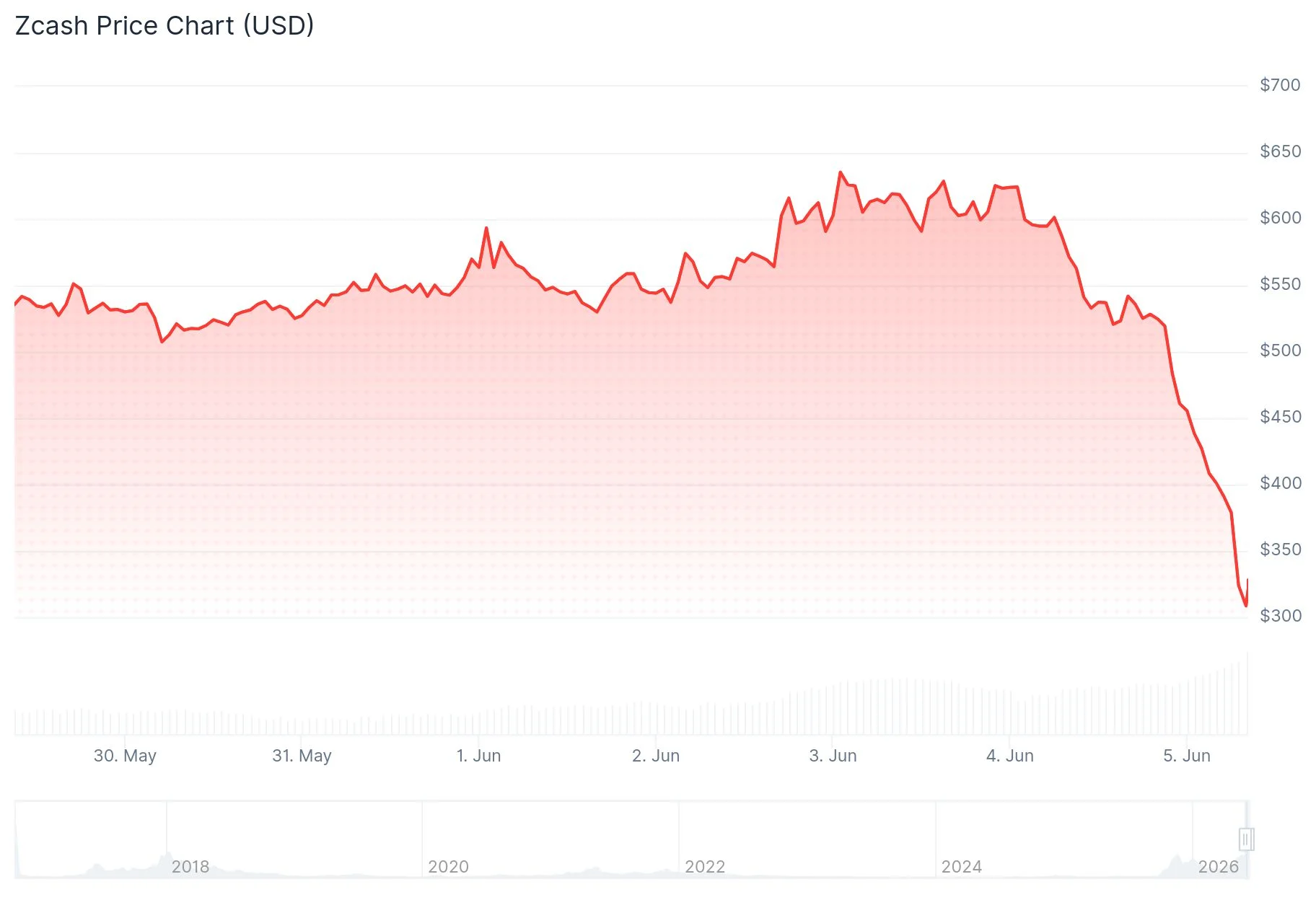
- ZEC experienced a precipitous decline of more than 30% within 24 hours, falling to approximately $400–$410, erasing over $3 billion from its market capitalization.
- Shielded Labs has announced plans for a network upgrade designed to enable transparent verification of ZEC’s complete supply authenticity.
The privacy-focused cryptocurrency Zcash experienced a dramatic market downturn following the public disclosure of a significant architectural vulnerability by nonprofit developer organization Shielded Labs. The revelation detailed a critical security weakness that had remained hidden within the protocol’s Orchard shielded pool infrastructure since May 2022.
The Orchard pool represents Zcash’s most sophisticated privacy mechanism, utilizing zero-knowledge cryptographic techniques to maintain transaction confidentiality. The discovered vulnerability permitted fraudulent inputs to bypass an elliptic curve multiplication verification process — the fundamental mathematical operation that authenticates transactions. This meant a malicious actor could have theoretically manufactured fake ZEC tokens that would remain entirely undetectable within the blockchain.
Taylor Hornby, a security specialist brought on by Shielded Labs in April 2026 with the explicit mandate to identify protocol weaknesses, uncovered the vulnerability on May 29 through the use of Anthropic’s Claude Opus 4.8 artificial intelligence model. In a controlled testing environment, he successfully constructed and executed a functional exploit capable of generating unlimited counterfeit ZEC. According to Shielded Labs, had this same attack been deployed on Zcash’s production network, it would have enabled the creation of unlimited undetectable fraudulent tokens.
[[EMBED_0]]Upon discovery, the Zcash Open Development Lab (ZODL) received immediate notification and orchestrated an emergency protocol modification through a hard fork, which went live on June 3, 2026.
Financial Markets Respond to Years of Potential Exposure
While the technical remediation was executed rapidly, market participants responded with considerable alarm. ZEC plummeted over 30% within a single day, reaching approximately $400–$410 at the time of this writing. The token’s total market capitalization contracted by more than $3 billion.

The fundamental concern troubling investors is straightforward: Shielded Labs has confirmed that no cryptographic methodology exists to definitively determine whether the vulnerability was exploited during the four-year period before remediation. Given Orchard’s privacy-preserving design, any theoretical exploitation would have occurred without leaving verifiable evidence on the blockchain.
While Shielded Labs expressed its belief that exploitation likely did not take place — citing the vulnerability’s subtle nature and the sophisticated expertise required to identify it — the organization acknowledged that users should not depend exclusively on their assessment.
Arthur Hayes, co-founder of cryptocurrency exchange BitMEX, publicly addressed his response to the situation on X, confirming he had liquidated his complete ZEC holdings. “Sadly, due to the Orchard Pool exploit, I had to dump our entire ZEC bag,” Hayes posted. He grouped Zcash alongside Hyperliquid and Near Protocol — all tokens he divested this week — referring to them collectively as “The Holy Trinity,” and declared: “The Holy Trinity is dead.” Hayes did concede that illegal ZEC minting was probably unlikely, while recognizing it “cannot be formally cryptographically proved impossible.”
[[EMBED_1]]A Recurring Challenge for the Protocol
This incident marks not the first time that a counterfeiting risk has emerged within Zcash. In 2018, the Electric Coin Company identified a comparable weakness in the zero-knowledge proof cryptography. That vulnerability was addressed in 2019 without any confirmed exploitation or losses.
Mert Mumtaz, co-founder and CEO of Solana infrastructure company Helius, characterized this category of vulnerability as inherent to the technology rather than unique to Zcash. “Almost all privacy protocols have a variant of this same vulnerability,” he stated, framing it as a theoretical risk present across most zero-knowledge privacy systems. “This same FUD comes back every five months as new people learn how privacy pools work,” he observed.
Shielded Labs has announced its intention to propose a comprehensive network upgrade that would introduce a new shielded pool with mandatory turnstile accounting for all tokens migrating from the existing Orchard pool. This mechanism would enable independent third-party verification of ZEC’s total supply integrity. The organization indicated it will release a detailed technical proposal within the coming week.
Get 3 Free Stock Ebooks
Discover top-performing stocks in AI, Crypto, and Technology with expert analysis.
- Top 10 AI Stocks - Leading AI companies
- Top 10 Crypto Stocks - Blockchain leaders
- Top 10 Tech Stocks - Tech giants


