


Key Takeaways
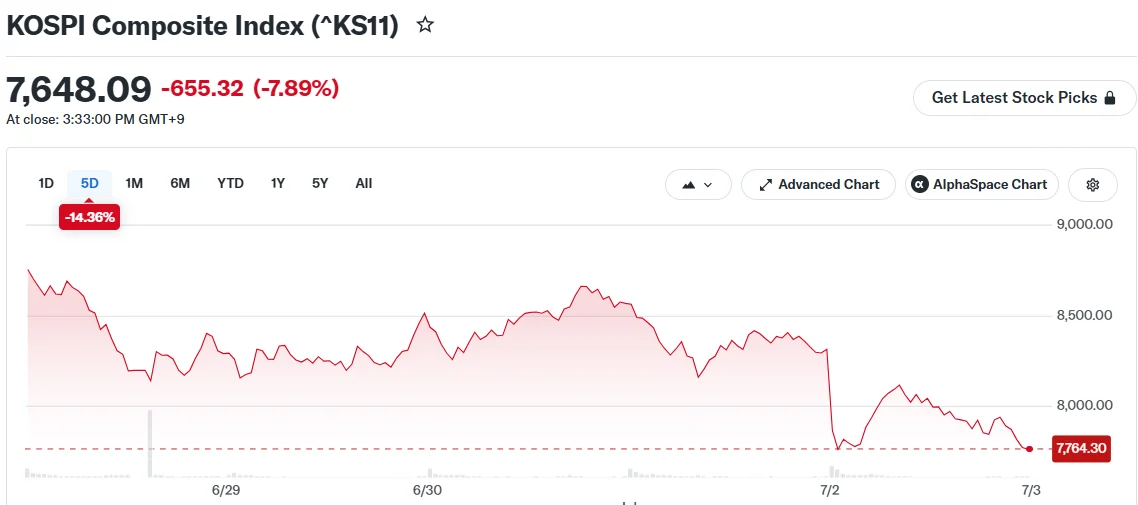
- Seoul’s KOSPI index plunged over 6% at market open Thursday, activating an automatic five-minute circuit breaker halt.
- Samsung Electronics and SK Hynix shares tumbled approximately 10% following news that AI software improvements might slash chip requirements.
- Japanese chipmaker Kioxia plummeted more than 15%, pulling the Nikkei 225 down over 2%.
- Morningstar analysts increased fair value projections for Samsung and SK Hynix, pointing to robust AI appetite and constrained supply.
- Industry observers anticipate a memory chip supply glut within two years, potentially triggering a market correction in 2029-2030.
South Korean equity markets experienced an abrupt trading suspension Thursday morning as semiconductor stocks suffered dramatic losses, automatically triggering protective circuit breakers. The decline rapidly extended throughout Asian markets, pummeling leading chip manufacturers in Japan as well.
The Catalyst Behind the Semiconductor Selloff
The KOSPI composite tumbled more than 6% immediately following the opening bell, activating a sell-side circuit breaker mechanism that paused trading activity for five minutes. Samsung Electronics shares collapsed 7.3% while SK Hynix plunged nearly 9%.
The dramatic decline followed revelations from The Information indicating that OpenAI had engineered software capable of reducing AI inference computing demands by 50%. This development sparked widespread concern that technology companies might require significantly fewer semiconductors to power their artificial intelligence applications.
Additional pressure materialized from reports that Meta Platforms intends to divest surplus cloud infrastructure capacity. This suggestion raised the possibility that corporations could maximize existing hardware utilization rather than procuring new semiconductor components.
Further complicating matters, reports emerged that Apple had initiated negotiations to source memory chips from sanctioned Chinese manufacturers, intensifying competitive pressure on traditional semiconductor suppliers.

Despite Thursday’s steep decline, SK Hynix has still delivered returns exceeding 200% year-to-date. Kioxia, Japan’s highest-valued corporation, has surged approximately 600%. The KOSPI itself has climbed nearly 83% throughout 2026.
Fabien Yip, market strategist at IG, suggested that profit-taking behavior appears to be a significant factor driving Thursday’s market movement.
Expert Perspectives on the Semiconductor Outlook
Notwithstanding Thursday’s turbulence, Morningstar elevated its valuation targets for both Samsung and SK Hynix on Wednesday.
Morningstar equity analyst Jing Jie Yu noted that the present memory chip upcycle is “performing considerably stronger than projections,” attributing this to constrained supply conditions, vigorous AI demand, and extended-term supply contracts.
However, Yu simultaneously identified a potential long-range challenge. He anticipates a substantial expansion in memory chip production capacity over the approaching two years will likely precipitate a market downturn during 2029 and 2030, coinciding with the expiration of long-term pricing contracts.
Thursday’s trading disruption represents another in a sequence of circuit breaker activations on the KOSPI throughout this year. Heavyweight semiconductor equities have generated significant intraday volatility in the benchmark index during 2026.
Yip indicated that market volatility is likely to intensify ahead of Thursday’s US nonfarm payrolls data release. He additionally highlighted that speculative short positioning in the Japanese yen has returned to July 2024 thresholds, which previously catalyzed an abrupt carry-trade liquidation.
While AI-driven demand maintains its strength presently, investors are progressively questioning the sustainability of current semiconductor pricing dynamics.
Get 3 Free Stock Ebooks
Discover top-performing stocks in AI, Crypto, and Technology with expert analysis.
- Top 10 AI Stocks - Leading AI companies
- Top 10 Crypto Stocks - Blockchain leaders
- Top 10 Tech Stocks - Tech giants


