


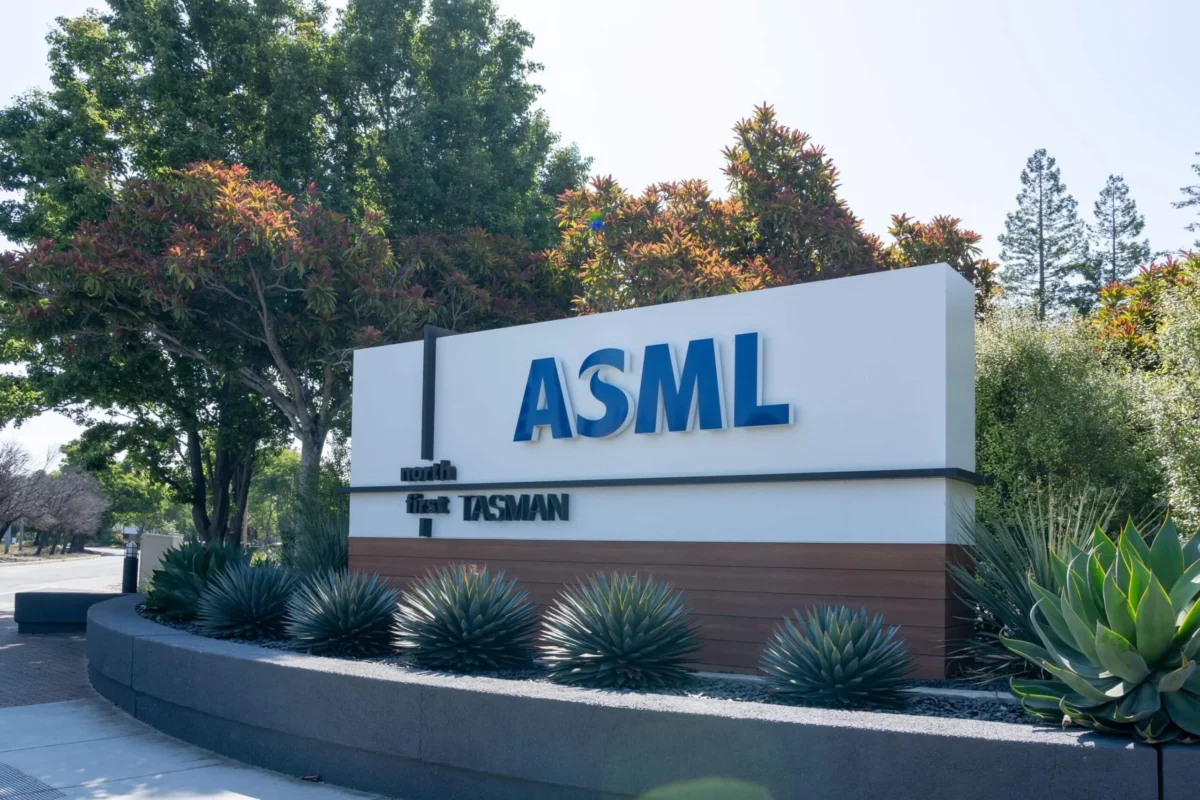
Key Points
- U.S. Commerce Secretary Howard Lutnick held discussions with ASML leadership regarding potential unauthorized delivery of an EUV lithography system to China.
- ASML issued a categorical denial, stating it has never delivered an EUV system or related specialized components to China.
- Shares of ASML declined approximately 1.99% after Bloomberg published the report.
- Washington introduced proposed legislation in April demanding allied nations conform to U.S. export restrictions aimed at limiting China’s semiconductor manufacturing capabilities.
- A December Reuters investigation revealed Chinese researchers developed an EUV prototype with assistance from ex-ASML personnel.
Shares of ASML tumbled 1.99% following a Bloomberg News revelation that U.S. Commerce Secretary Howard Lutnick conveyed concerns to ASML’s top management regarding the possibility that one of the company’s cutting-edge semiconductor manufacturing systems may have illegally reached China, violating U.S.-orchestrated export limitations.
The discussions between Lutnick and ASML leadership centered on the company’s extreme ultraviolet lithography systems, commonly referred to as EUV. These represent some of the most sophisticated and heavily regulated technologies in the global semiconductor industry.
ASML responded swiftly and forcefully. In a statement provided via email to Reuters, the Dutch semiconductor equipment manufacturer declared: “ASML has never shipped an EUV machine to China nor have we shipped to China any component, module or equipment specially designed to be used in an EUV machine.”
The statement leaves no room for ambiguity — and the company maintains its position unequivocally.

ASML further emphasized that it has “consistently adjusted its business to any development in export controls to comply to any new rules,” and firmly rejected all accusations of export control violations related to China.
For context on scale: ASML’s most sophisticated EUV lithography systems are comparable in size to a school bus and tip the scales at 180 tons. These machines aren’t something that can be easily concealed or transported.
Washington Intensifies Semiconductor Export Restrictions
The United States has been progressively strengthening its semiconductor export control framework. This past April, the administration put forward legislation requiring allied countries to harmonize their export control policies with U.S. standards — with a particular focus on restricting China’s access to advanced chip production technology.
ASML’s lithography equipment was explicitly referenced in that legislative proposal, highlighting the Dutch manufacturer’s critical position in this ongoing technological and geopolitical competition.
Neither the U.S. Commerce Department nor White House representatives were available to provide statements when Reuters attempted contact outside standard business hours.
Beijing’s Indigenous EUV Development Efforts
The broader context is crucial to understanding these concerns. This past December, Reuters published findings that Chinese researchers had successfully engineered a prototype EUV lithography system, developed by a group of former ASML engineering personnel.
That initiative was characterized as China’s equivalent of the Manhattan Project — a nationally coordinated effort to establish indigenous semiconductor manufacturing capabilities independent of Western technology suppliers and equipment.
This background likely informs the U.S. government’s heightened vigilance. If China is already constructing its own EUV systems utilizing former ASML expertise, American officials may fear the country has somehow obtained actual ASML equipment as well.
Bloomberg’s reporting did not specify how such a machine could have reached China or present concrete evidence confirming that one had. The article cited unnamed sources with knowledge of the situation.
ASML’s Amsterdam-listed shares (ASML.AS) decreased 1.68% following the report’s publication, while the U.S.-traded shares dropped 1.99%.
The story emerged on June 18, with Reuters independently verifying the key elements through ASML’s official statement.
Get 3 Free Stock Ebooks
Discover top-performing stocks in AI, Crypto, and Technology with expert analysis.
- Top 10 AI Stocks - Leading AI companies
- Top 10 Crypto Stocks - Blockchain leaders
- Top 10 Tech Stocks - Tech giants


