



Key Highlights
- BTC price remained relatively stable at $63,800, declining only 0.3% in 24 hours amid renewed U.S. military action against Iran
- Washington conducted its third wave of strikes against Iranian targets this week; Iran responded by closing the Strait of Hormuz
- Spot Bitcoin ETFs in the United States attracted $197.4 million last week, breaking an eight-week streak of outflows
- Ethereum ETFs similarly reversed course, recording $84.4 million in weekly inflows
- Market analyst Michaël van de Poppe suggests a decisive move above $65,000 could trigger a rally to $73,000–$83,000 or beyond
Bitcoin continues to demonstrate resilience around the $63,800 level despite mounting geopolitical risks stemming from intensifying Middle Eastern conflict. The United States executed its third consecutive wave of military strikes against Iranian installations this week, prompting Tehran to announce the closure of the Strait of Hormuz “indefinitely.”
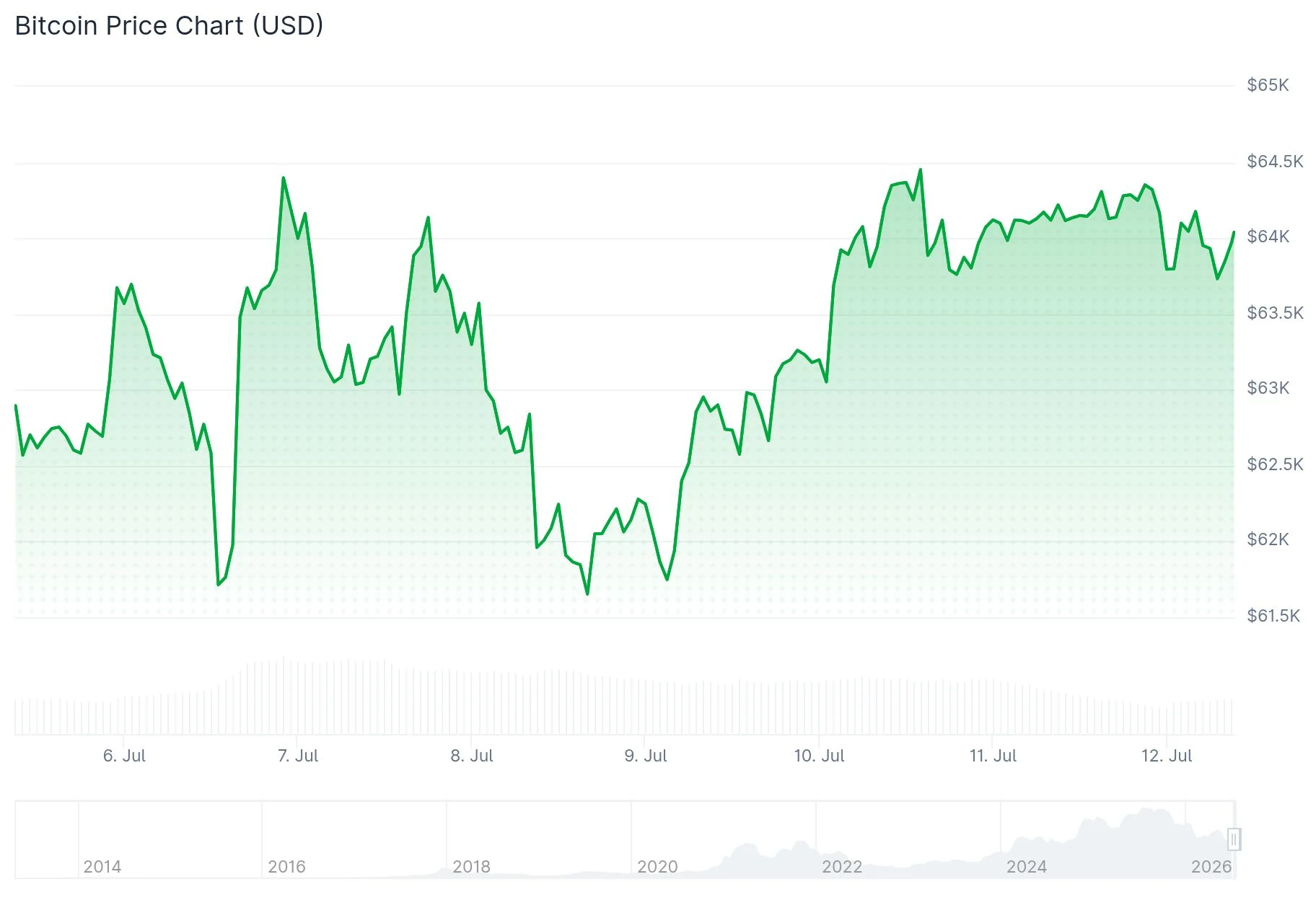
Yet Bitcoin’s price action remained remarkably subdued, slipping merely 0.3% during the 24-hour period. Weekly performance showed a 2% gain overall.
According to U.S. Central Command, President Trump authorized the military operations following Iranian attacks on a Cyprus-registered container vessel. Reports confirmed explosions across Iran’s southern coastal regions, hitting critical energy infrastructure at Bushehr and Asalouyeh, along with major port facilities in Bandar Abbas and Bandar-e Dayyer.
Shipping data indicated limited vessel activity near the Strait of Hormuz on Sunday morning, though traffic volumes remained significantly suppressed compared to typical levels.
Ethereum exhibited similar stability, hovering around $1,800 with a 2% weekly increase. Among major cryptocurrencies, Solana underperformed, dropping 5% over the seven-day period to $76. XRP declined to $1.09 while Dogecoin retreated to approximately $0.07.

When Iran initially blocked the Strait in early March, Brent crude oil surged beyond $100 per barrel and Bitcoin experienced a sharp correction. The current response, however, has been notably subdued. With traditional markets including oil, equities, and bonds shuttered for the weekend, Bitcoin remained the sole major asset class available to react to developing news.
Bitcoin ETF Products Register First Positive Week After Two-Month Drought
Spot Bitcoin exchange-traded funds in the United States captured approximately $197.4 million in net capital last week — marking their first weekly gain since early May. This development terminated an eight-week hemorrhage of capital, representing the longest consecutive outflow period since these products debuted in January 2024.
The preceding eight weeks witnessed roughly $8.26 billion exit Bitcoin ETF vehicles. Last week’s modest inflow recovered merely 2.4% of those losses.
BlackRock’s iShares Bitcoin Trust (IBIT) dominated flows, securing $86.83 million on Friday’s trading session alone. The majority of competing products reported neutral net flows for the day.
Ethereum ETF products mirrored this pattern, breaking their own eight-week outflow cycle by attracting $84.4 million for the week. BlackRock’s ETHA and Fidelity’s FETH accounted for the bulk of Friday’s $18.43 million session intake.
Technical Analyst Identifies $65,000 as Critical Resistance Threshold
Cryptocurrency market analyst Michaël van de Poppe highlighted a bullish divergence forming on Bitcoin charts as one of the most compelling indicators suggesting an imminent trend reversal. He emphasized that a sustained breach of $65,000 would validate this technical pattern, transforming current resistance into foundational support. Van de Poppe identified an initial price objective of $73,000, though he personally anticipates Bitcoin could advance toward $83,000 or higher in subsequent weeks.
Total net assets held in Bitcoin ETF products reached $77.42 billion as of Friday’s close. Despite last week’s positive momentum, both Bitcoin and Ethereum ETFs continue recording negative performance for 2026, with Bitcoin vehicles showing approximately $5.34 billion in year-to-date net outflows.
Get 3 Free Stock Ebooks
Discover top-performing stocks in AI, Crypto, and Technology with expert analysis.
- Top 10 AI Stocks - Leading AI companies
- Top 10 Crypto Stocks - Blockchain leaders
- Top 10 Tech Stocks - Tech giants


