



TLDR
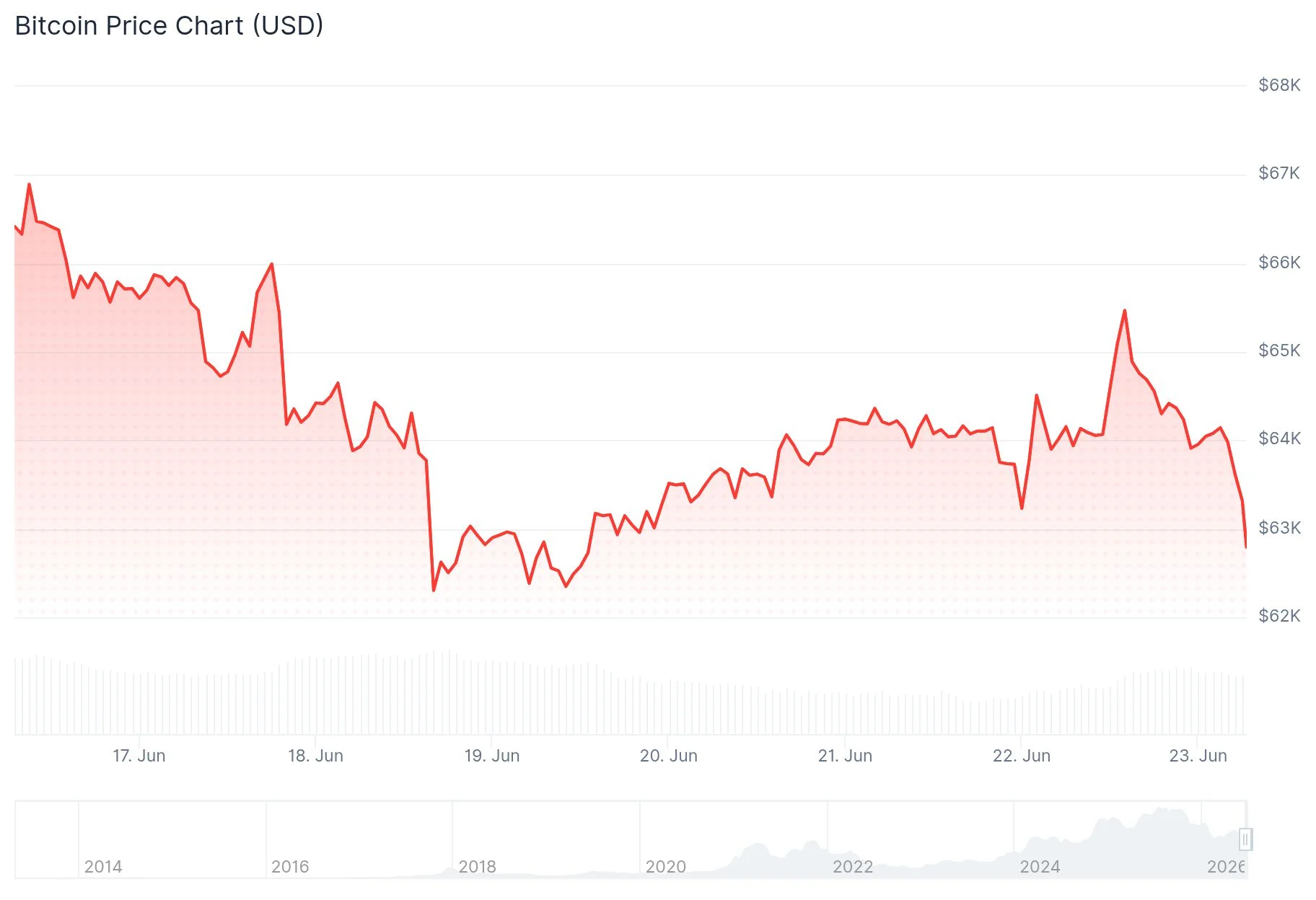
- Bitcoin advanced 0.4% to $64,129 during Monday’s session, supported by improved market sentiment following diplomatic progress between the U.S. and Iran.
- U.S. spot Bitcoin ETFs experienced their sixth consecutive week of withdrawals, amounting to $5.94 billion collectively, though the withdrawal rate has decelerated significantly.
- BTC has maintained weekly closes above the $63,000 threshold for three consecutive weeks following its 2026 bottom near $59,000.
- Open interest in Bitcoin futures contracts declined 19.5% from June’s high point, while funding rates moderated to 0.02%.
- Trader Daan Crypto Trades cautioned that without a move toward the 200 EMA in the near term, Bitcoin could revisit the $60K zone.
Bitcoin posted a marginal increase on Monday, climbing 0.4% to settle at $64,129.44. The upward movement followed encouraging developments from diplomatic negotiations between the United States and Iran, which boosted appetite for risk assets throughout financial markets.
During the G7 summit held in France, American and Iranian officials signed a memorandum of understanding that established a ceasefire agreement and guaranteed the reopening of the strategically vital Strait of Hormuz. The accord included a 60-day timeline for additional diplomatic discussions.
Geopolitical stability proved short-lived as hostilities reignited over the weekend between Israel and Iran-supported Hezbollah forces operating in Lebanon. Iran temporarily shut down access to the Strait of Hormuz once more before diplomatic channels reopened in Switzerland, where representatives from Qatar and Pakistan facilitated renewed dialogue and progress.
Bitcoin’s upside momentum remained constrained by persistent Federal Reserve policy concerns. Expectations of potential interest rate increases continued to pressure speculative assets, as investment capital shifted toward artificial intelligence-focused equities.
ETF Outflows Are Slowing
Spot Bitcoin exchange-traded funds in the United States recorded their sixth consecutive week of net capital withdrawals. Cumulatively, approximately $5.94 billion has exited these investment vehicles throughout this period.

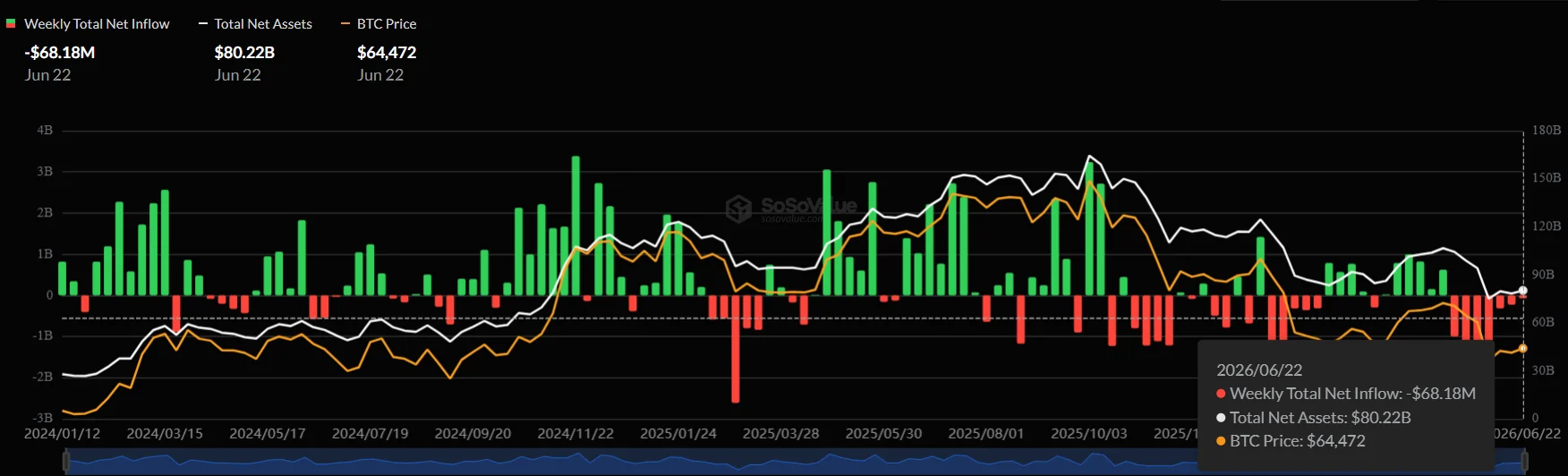
However, the withdrawal velocity has diminished substantially. Outflows measured approximately $1.72 billion during the initial week of June but contracted to roughly $227 million during the most recent week, according to Alon Shvartsman, who founded Bitcoin analytics platform Newhedge.
“If this represented the beginning of a more profound institutional liquidation, one would anticipate accelerating outflows accompanied by considerably weaker spot market performance,” Shvartsman explained to Investing.com. “Conversely, Bitcoin continues maintaining the $64,000 to $65,000 trading band.”
Cryptocurrency analyst Daan Crypto Trades shared his perspective on X, observing that Bitcoin successfully closed the week above its Weekly 200-day moving average. He cautioned that bullish participants must drive price action toward the 200 EMA promptly, otherwise a return to the $60K region becomes increasingly probable. “Some alts have been interesting to trade and have my focus in this environment,” he noted.
On-Chain Data Points to Stabilisation
Bitcoin has now recorded three consecutive weekly closing prices above the $63,000 level since establishing a 2026 trough near $59,000. Market analysts observe this behavior resembles accumulation phase patterns documented in previous market cycles.
Bitcoin futures open interest contracted 19.5% from its June 1 high of $25.96 billion to $20.89 billion by June 21. This reduction exceeded Bitcoin’s corresponding 11.4% price decline during the identical timeframe, indicating position unwinding rather than accumulation of new short positions.
Funding rates have retreated from 0.1% to 0.02%, signaling diminished long-side leverage throughout the market.
Blockchain analysis reveals that long-term holders’ realized supply reached 12.42 million BTC. Bitcoin’s distribution pressure indicator has remained dormant for 1,256 consecutive days, establishing the longest inactive period in recorded history.
Hashrate has closely mirrored the price correction throughout June. Matteo Spinosa from Doefin explained to Investing.com that this correlation represents production cost adjustment aligned with market cycles, dismissing alternative narratives suggesting AI-related miner migration.
Get 3 Free Stock Ebooks
Discover top-performing stocks in AI, Crypto, and Technology with expert analysis.
- Top 10 AI Stocks - Leading AI companies
- Top 10 Crypto Stocks - Blockchain leaders
- Top 10 Tech Stocks - Tech giants


