



Key Takeaways
- Bitcoin experienced its steepest weekly decline since the November 2022 FTX collapse, plummeting 16% below the $60,000 threshold
- Escalating US-Iran military tensions drove BTC down an additional 3% on June 9
- The cryptocurrency breached its 200-week moving average, signaling potential bear market conditions
- US spot Bitcoin ETFs have experienced more than $5.5 billion in net withdrawals over 13 consecutive trading days
- Market analyst Ted Pillows projects further declines toward the $50,000–$52,000 range before establishing a cycle low
Bitcoin tumbled beneath the $60,000 mark this past Friday, closing out its most devastating week since the notorious FTX exchange implosion in November 2022. The cryptocurrency recorded a brutal 16% plunge across seven trading days, representing the sharpest weekly contraction in more than two years.
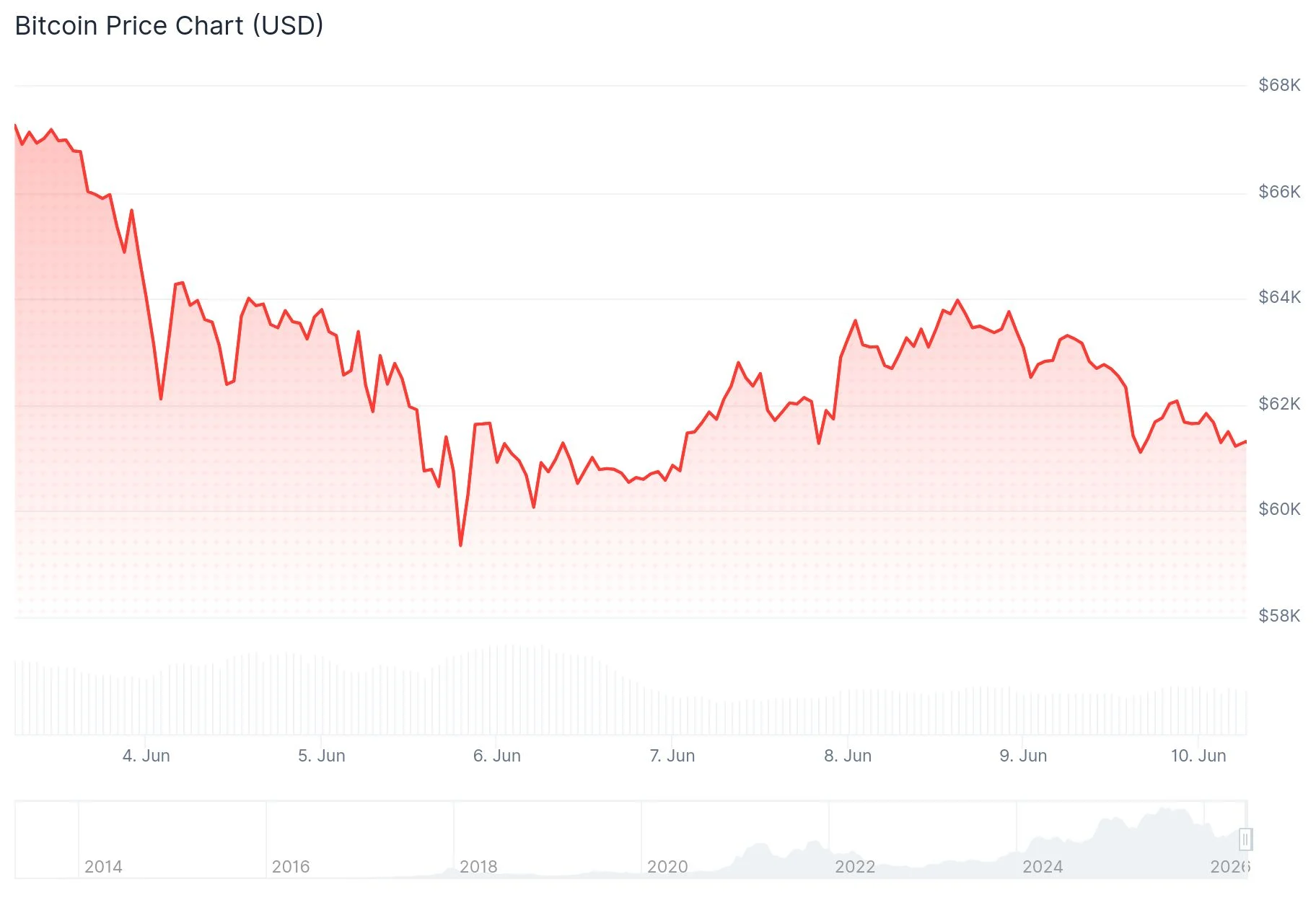
As of current market conditions, BTC is exchanging hands near $61,500, remaining more than 50% below its historic peak above $126,000.
The downward spiral intensified on June 9 following an announcement from US Central Command regarding “self-defense” military operations against Iranian targets. These strikes came in response to the downing of a US Army Apache helicopter in the vicinity of the Strait of Hormuz. Bitcoin shed 3% immediately following this development, touching $61,766.
President Trump addressed the incident via Truth Social, declaring: “The United States must, of necessity, respond to this attack.” Iranian officials have disputed claims of deliberately targeting the aircraft.
Cryptocurrency long position liquidations reached $136 million within 24 hours of the announcement, with Bitcoin representing the bulk of these forced closures, based on CoinGlass analytics.
Strategy’s Unexpected Sale and Technical Breakdown
Compounding market anxiety, Strategy Inc. — the Bitcoin-accumulating enterprise led by Michael Saylor — liquidated a modest portion of its cryptocurrency reserves, undermining the widespread conviction that the company would maintain a permanent hold. Though Strategy rapidly acquired 1,550 BTC for approximately $101 million, investor sentiment had already sustained damage.

Bitcoin additionally dropped below its 200-week moving average during the past week, a technical threshold monitored intensively by market participants. Paul Howard from crypto trading operation Wincent characterized this as “important confirmation that markets may have entered a bear phase.”
Griffin Ardern, co-founder of Primal Fund, noted that longer-duration options contracts aren’t yet displaying the bullish rotation characteristic of authentic market troughs. “I believe there is further downside,” he stated. “We are still some way off a proper bottom.”
Diverging Behavior Between Retail and Institutional Players
Blockchain analytics from Santiment reveal a divergence between small-scale and large-scale holders. Wallets containing fewer than 0.01 BTC expanded their positions by 0.36% throughout the preceding two weeks, despite BTC’s struggle to maintain the $60,000 level. Conversely, wallets holding between 10 and 10,000 BTC decreased their allocations by 0.20%.
Market analyst Ted Pillows shared his perspective on X, emphasizing that no historical Bitcoin cycle trough has ever materialized above the “Realized Price,” which presently stands at $53,000. He projected BTC will “most likely drop towards $50,000–$52,000 before a cycle bottom.”
US-registered spot Bitcoin ETFs have now recorded $5.5 billion in cumulative net withdrawals spanning 13 uninterrupted days.
Get 3 Free Stock Ebooks
Discover top-performing stocks in AI, Crypto, and Technology with expert analysis.
- Top 10 AI Stocks - Leading AI companies
- Top 10 Crypto Stocks - Blockchain leaders
- Top 10 Tech Stocks - Tech giants


