



TLDR
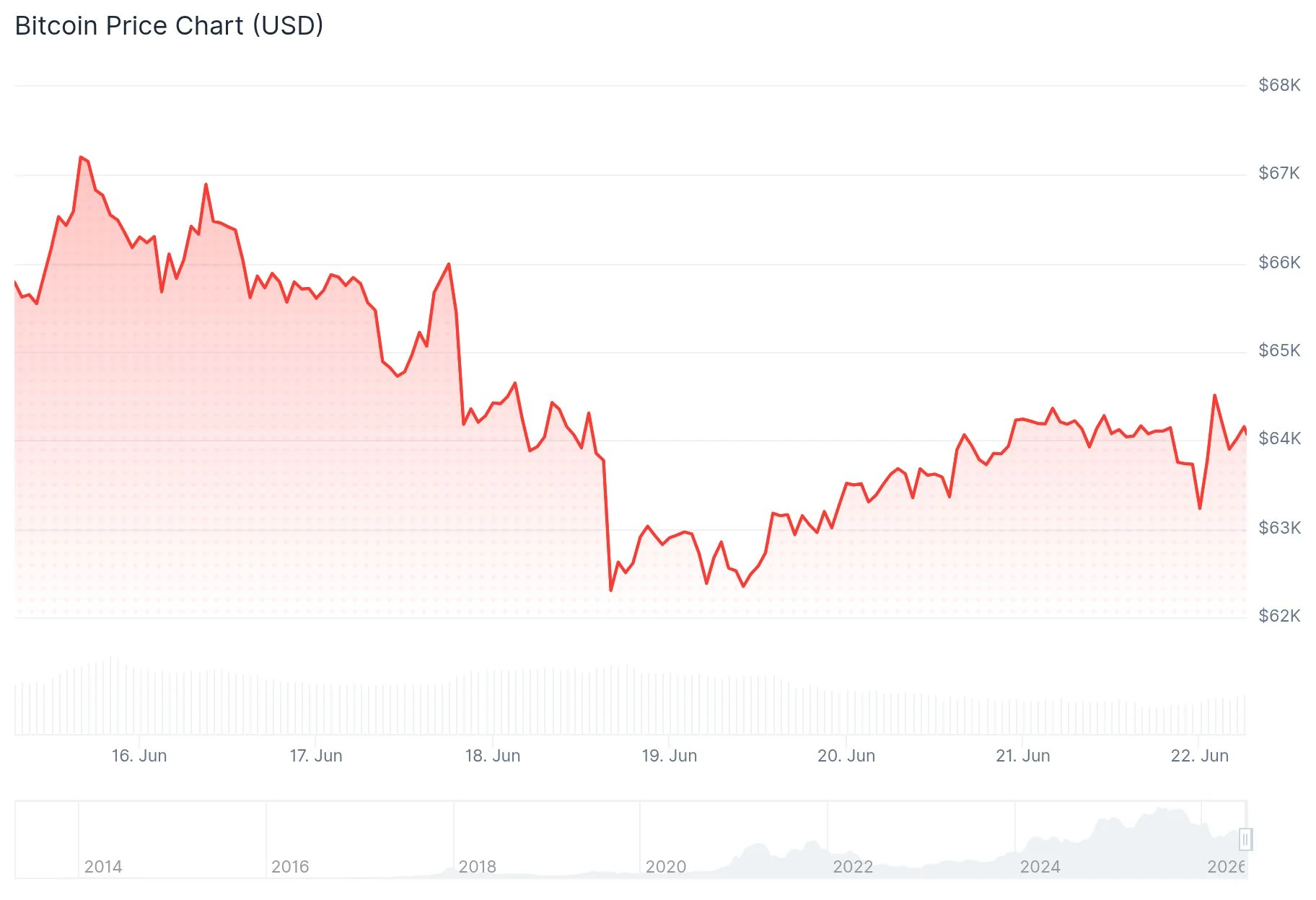
- BTC surged to $64,652 following successful diplomatic negotiations between the US and Iran in Switzerland
- The Iranian Foreign Minister announced sanctions relief on oil exports and confirmed plans to end the Hormuz Strait blockade
- Bitcoin ETFs in the United States recorded unprecedented net withdrawals totaling $6.35 billion across the previous 30-day period
- Market analysts are monitoring crucial price levels at $62,000 for support and $67,000 for resistance
- Both nations established a High-Level Committee targeting a comprehensive agreement within a 60-day timeframe
Bitcoin pushed beyond the $64,000 threshold following the conclusion of productive diplomatic discussions between Washington and Tehran. The leading cryptocurrency was changing hands at $64,652 during recent trading, representing a daily gain of 0.75%.
The upward momentum followed an official announcement from Pakistan’s Ministry of Foreign Affairs regarding the Lake Lucerne Summit’s conclusion in Switzerland. According to their joint communique, the inaugural session of a newly established High-Level Committee between American and Iranian representatives concluded with what officials characterized as a “positive and constructive atmosphere.”
Both nations committed to a structured timeline aimed at finalizing a comprehensive agreement over the next two months. Additionally, they established direct communication protocols designed to ensure the safety of commercial maritime traffic navigating through the Strait of Hormuz.
Iran’s Foreign Minister, Seyed Abbas Aragchi, took to X to validate several critical provisions of the understanding. His post confirmed that Iranian oil and petrochemical exports would operate without limitations, the naval blockade affecting Hormuz would be dismantled, and certain frozen Iranian financial assets would be unfrozen. He further indicated that a comprehensive reconstruction program for Iran is set to commence.
Aragchi credited mediation efforts by Pakistani and Qatari diplomats with achieving “major progress to end Lebanon War.” He highlighted the newly established “Lebanon deconfliction cell” as representing the “1st real test” of whether the agreement will hold.

Institutional Demand Shows Signs of Weakening
Despite the geopolitical tailwinds providing Bitcoin with near-term support, data from institutional investment channels paints a more concerning picture. According to Galaxy Research’s latest findings, spot Bitcoin ETFs operating in the United States experienced $6.35 billion in net withdrawals during the most recent 30-day measurement period — establishing a new record for outflows since tracking began.
A sustained six-week pattern of withdrawals has reduced aggregate net inflows to $53.4 billion, down significantly from the $63 billion peak recorded in October 2025. This trend indicates a notable cooling of institutional interest.
Critical Support and Resistance Zones Under Scrutiny
Bitcoin’s trading activity over the past 24 hours established boundaries between $63,188 on the low end and $64,462 at the peak, with total transaction volume exceeding $16.6 billion. The weekly performance remains modestly negative, indicating that the weekend recovery only partially offset losses sustained on Friday.
Cryptocurrency trader Daan emphasized that maintaining the $62,000 zone represents a critical requirement for bulls heading into the weekly closing period. He suggested that successfully breaching $67,000 resistance could trigger an advance toward the $73,000 level.
Market analyst BATMAN highlighted a reversal in the daily MACD momentum indicator from significantly oversold conditions as a potentially encouraging signal that a local price floor may be establishing itself.
Rekt Capital observed that historical patterns show July typically moves opposite to June’s direction when June closes in negative territory — though he warned that a weak June finish might transform any potential rally into a retest scenario rather than genuine bullish continuation.
Bitcoin continues trading within a defined range bounded by $62,000 on the downside and $67,000 on the upside, with developments surrounding the Hormuz situation and ETF capital flows serving as primary catalysts for near-term price action.
Get 3 Free Stock Ebooks
Discover top-performing stocks in AI, Crypto, and Technology with expert analysis.
- Top 10 AI Stocks - Leading AI companies
- Top 10 Crypto Stocks - Blockchain leaders
- Top 10 Tech Stocks - Tech giants


