



TLDR
- Bitcoin spot ETFs in the United States experienced a record-breaking 30-day withdrawal period, with $6.35 billion in net outflows since their January 2024 introduction
- The cryptocurrency plunged 17.4% across the last 30 days, reaching four-month price floors between $60,000 and $61,300
- Between May 15 and June 3, a relentless 13-day withdrawal period drove approximately $4.4 billion in fund exits
- The majority of redemptions hit funds managed by BlackRock and Fidelity
- BlackRock executive Jay Jacobs emphasized that temporary redemptions don’t alter the company’s strategic Bitcoin perspective
American spot Bitcoin exchange-traded funds have endured their most challenging month since debuting in January 2024. Data compiled by Galaxy Research reveals these investment vehicles suffered $6.35 billion in net redemptions across the previous 30 trading sessions.
This significant withdrawal has pushed aggregate net inflows down to $53.4 billion, a notable decline from the October 2025 zenith of $63 billion.
Galaxy Research observed that redemption activity continues to “deepen day over day,” prompting concerns about institutional appetite in the immediate future.
The cryptocurrency market has mirrored this turbulence. Bitcoin currently hovers around $64,167, representing a 17.4% monthly decline. Early June witnessed price levels plummeting to $60,000–$61,300, marking the lowest valuations in four months.
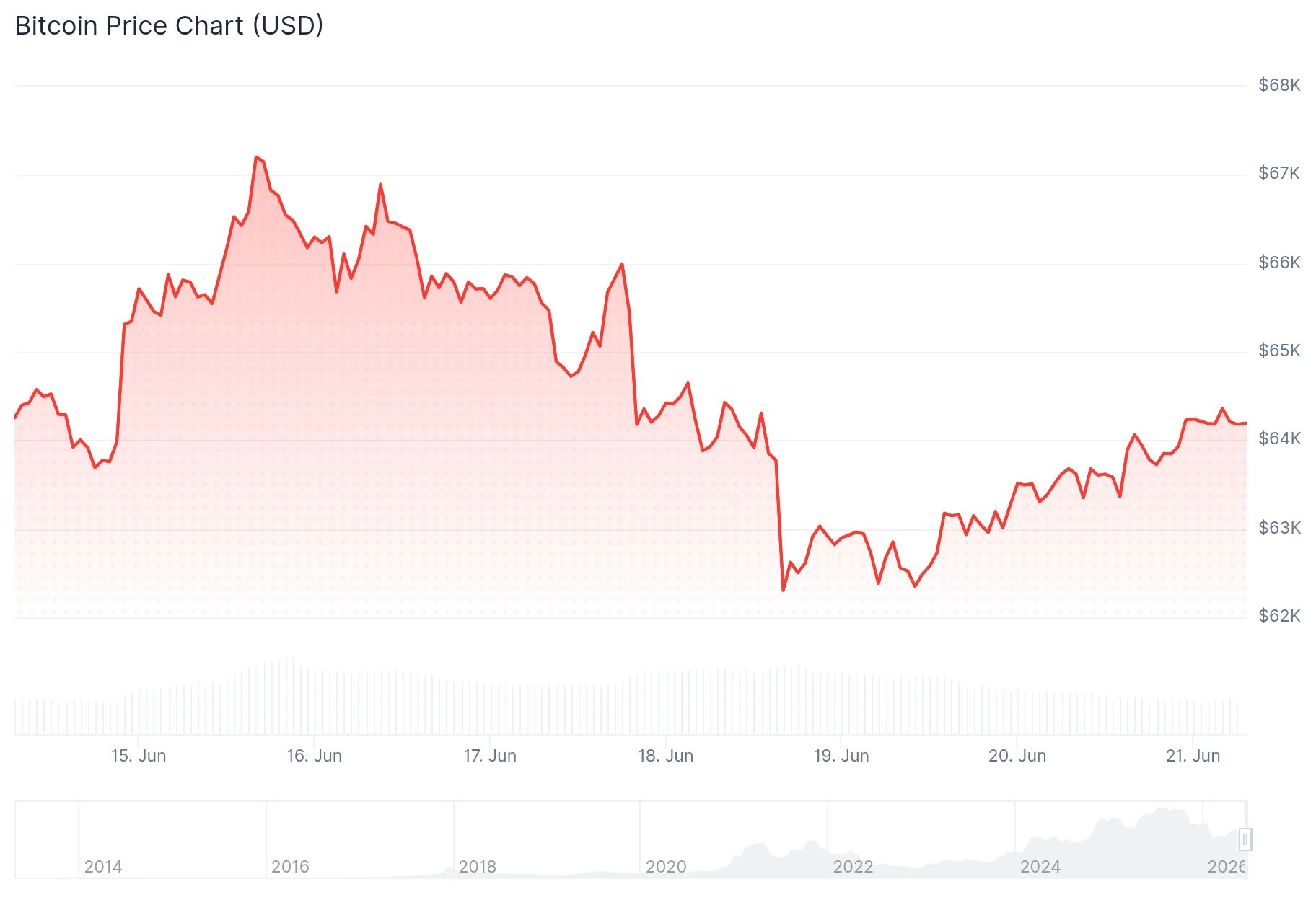
The most severe withdrawal phase occurred during the period spanning May 15 through June 3, featuring an unbroken 13-day sequence that drained approximately $4.4 billion from the marketplace. Calculated in cryptocurrency terms, this represents roughly 59,400 BTC.

Distribution of Redemption Activity
The withdrawal pattern wasn’t uniform across all products. The lion’s share of redemptions targeted the market’s two dominant players: BlackRock’s iShares Bitcoin Trust alongside Fidelity’s comparable offering. Both experienced peak single-day withdrawals measured in hundreds of millions.
A brief reprieve materialized around June 4–5, when funds registered a minimal $3 million net influx. However, redemptions quickly resumed momentum, with one seven-day period alone witnessing $1.7 billion in net exits.
Broader economic conditions have contributed significantly. Escalating US inflation metrics combined with geopolitical tensions stemming from US-Iran conflicts have pressured risk-oriented assets across the board, with Bitcoin proving no exception.
Bloomberg’s ETF specialist Eric Balchunas characterized these outflow magnitudes as “noise” within the larger narrative of institutional cryptocurrency integration.
BlackRock Maintains Strategic Position
Jay Jacobs, BlackRock’s head of US equity ETFs, challenged interpretations suggesting redemptions indicate changing institutional conviction.
“What I think is maybe sometimes misunderstood by the market is that if we see a day of outflows, there could be a million reasons why,” Jacobs explained to Cointelegraph.
He highlighted that BlackRock operates more than 450 ETF products spanning multiple asset categories, experiencing daily fluctuations in capital flows across the entire portfolio.
“In the short term, it’s absolutely not something that changes the way we view the asset or the utility of the asset,” Jacobs stated.
Jacobs referenced Bitcoin’s function as a worldwide, decentralized, nonsovereign monetary option as central to BlackRock’s investment rationale.
Perspective remains crucial when evaluating these withdrawals. Following their January 2024 launch, Bitcoin spot ETFs accumulated aggregate net inflows ranging between $50 and $60 billion. Current redemptions constitute merely a modest fraction of total invested capital.
Year-to-date 2026 flows approached equilibrium before the May–June withdrawal wave commenced.
Galaxy Research information indicates ongoing deepening of daily redemptions, positioning the upcoming weeks as a critical monitoring period for potential market stabilization indicators.
Get 3 Free Stock Ebooks
Discover top-performing stocks in AI, Crypto, and Technology with expert analysis.
- Top 10 AI Stocks - Leading AI companies
- Top 10 Crypto Stocks - Blockchain leaders
- Top 10 Tech Stocks - Tech giants


