



Quick Overview
- Cardano’s current price hovers around $0.15 with market capitalization between $5.6 billion and $5.9 billion
- Moderate scenario projects $0.60–$1.00 valuation by 2031, representing market cap of $24–$40 billion
- Optimistic outlook of $2.00–$3.50 depends on DeFi expansion, successful scaling implementation, and institutional adoption
- Pessimistic scenario maintains ADA range of $0.08–$0.15 if ecosystem growth remains stagnant
- Weighted probability analysis suggests approximately $0.85 valuation by 2031
Cardano (ADA) remains among cryptocurrency’s most polarizing blockchain platforms. Advocates highlight its peer-reviewed research methodology, robust decentralization, and dedicated following. Detractors argue its development pace lags behind competitors like Ethereum, Solana, and emerging Layer 1 platforms.
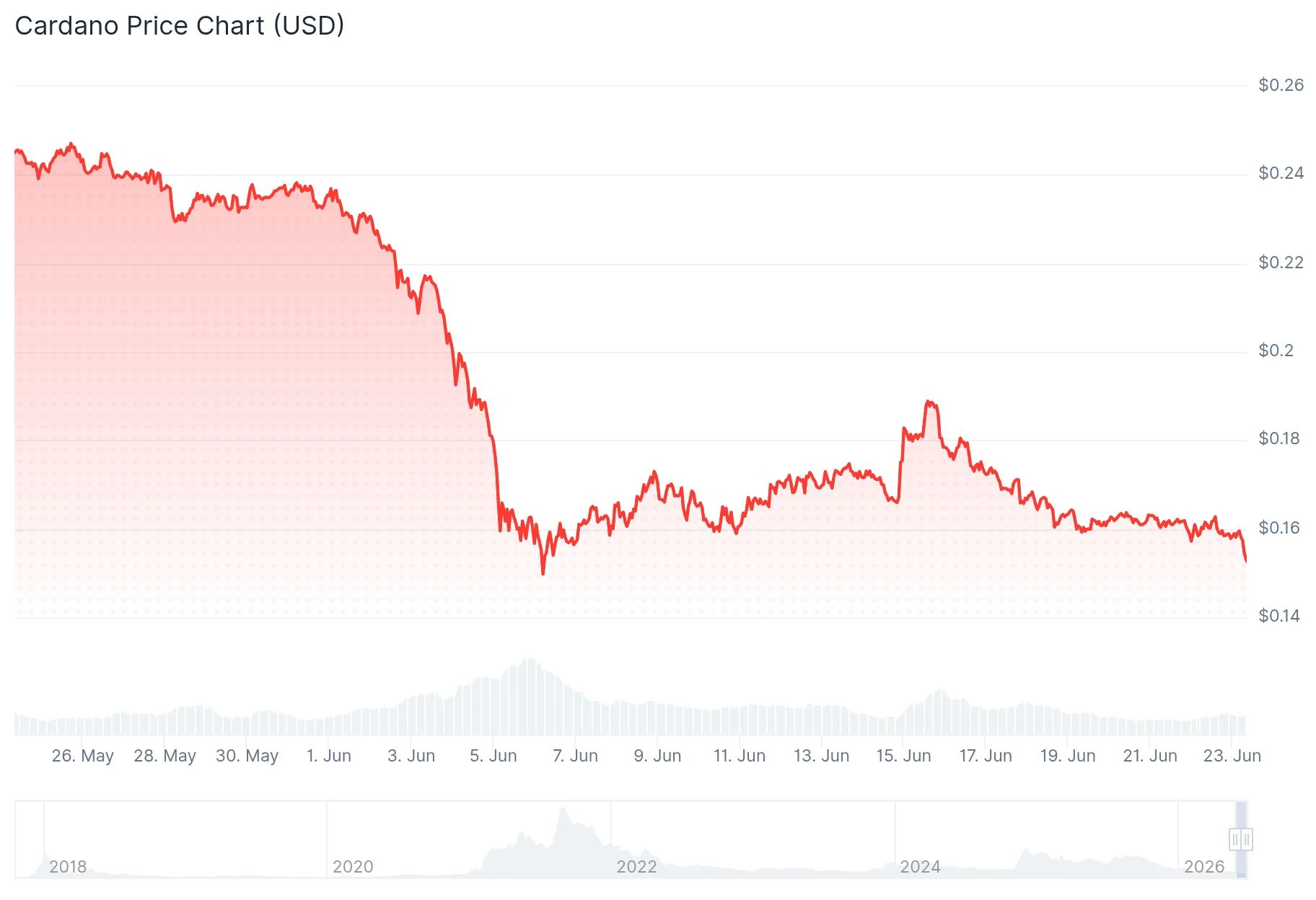
Current ADA valuation stands near $0.15. This places Cardano’s total market capitalization approximately between $5.6 billion and $5.9 billion. The network’s circulating token count reaches roughly 36.4 billion ADA, capped at a maximum 45 billion supply.
This fixed supply ceiling provides ADA with more straightforward valuation metrics compared to inflationary tokens. However, capped supply represents just one factor. Price appreciation ultimately requires demand growth.
Moderate Outlook: $0.60 To $1.00 Through 2031
The highest probability five-year trajectory suggests measured appreciation. Under this framework, Cardano maintains relevance within the Layer 1 ecosystem without capturing dominant smart contract market share.
Valuation between $0.60 and $1.00 translates to Cardano’s market capitalization reaching $24 billion through $40 billion by 2031. While representing substantial gains from present levels, this remains beneath ADA’s historical peak valuation.

This projection assumes Cardano captures benefits from broader cryptocurrency market expansion, enhanced governance structures, and successful scaling improvements. The platform currently operates within its Voltaire development phase, emphasizing community governance mechanisms.
Cardano’s development trajectory has progressed through distinct stages: Byron, Shelley, Goguen, Basho, and presently Voltaire. Each phase introduced new capabilities, though market participants await evidence of mainstream adoption materializing.
Optimistic Projection: $2.00 Through $3.50
Reaching $2.00 to $3.50 valuation requires three critical developments converging.
Initially, genuine network utilization must expand significantly—encompassing increased DeFi protocols, stablecoin deployment, asset tokenization, and functioning applications. Subsequently, scaling enhancements must demonstrate tangible performance improvements beyond technical specifications alone. Finally, institutional investors must recognize ADA as a principal regulated Layer 1 holding.
At $3.50 valuation, Cardano’s market capitalization approaches approximately $140 billion. Achieving this doesn’t necessitate surpassing Ethereum or Solana, but demands substantially narrowing the current adoption differential.
Pessimistic Scenario: $0.08 Through $0.15
Should developer engagement, DeFi liquidity pools, and user acquisition remain subdued, ADA may consolidate between $0.08 and $0.15 throughout the forecast period. Cardano would preserve its existing community while struggling to capture fresh capital inflows.
Competitive pressure constitutes the primary challenge. Ethereum maintains the most extensive developer ecosystem. Solana demonstrates leadership in transaction throughput and retail participation. Additional emerging blockchains compete aggressively for attention and liquidity.
Aggregating probability weights across these three frameworks yields an approximate $0.85 ADA valuation by 2031.
Get 3 Free Stock Ebooks
Discover top-performing stocks in AI, Crypto, and Technology with expert analysis.
- Top 10 AI Stocks - Leading AI companies
- Top 10 Crypto Stocks - Blockchain leaders
- Top 10 Tech Stocks - Tech giants


