



TLDR
- Crude markets declined Tuesday following Trump’s confirmation that diplomatic negotiations with Iran remain ongoing.
- Brent crude retreated approximately 2% to $93.06; WTI declined to roughly $90.32 per barrel.
- Markets had rallied Monday following Iranian media reports suggesting diplomatic efforts had been halted due to Israeli operations in Lebanon.
- The Strait of Hormuz continues to operate under severe restrictions, supporting elevated crude values — the waterway typically handles 20% of worldwide daily petroleum shipments.
- Market experts caution that crude values won’t immediately return to pre-crisis benchmarks even following a diplomatic breakthrough.
Commodity traders navigated choppy waters Tuesday as mixed messaging from the White House and Iranian officials created uncertainty around prospects for a comprehensive US-Iran diplomatic settlement.
Brent crude, the global petroleum pricing standard, retreated approximately 2% to $93.06 per barrel during Tuesday’s morning session. West Texas Intermediate similarly declined roughly 1.9% to $90.32 per barrel.
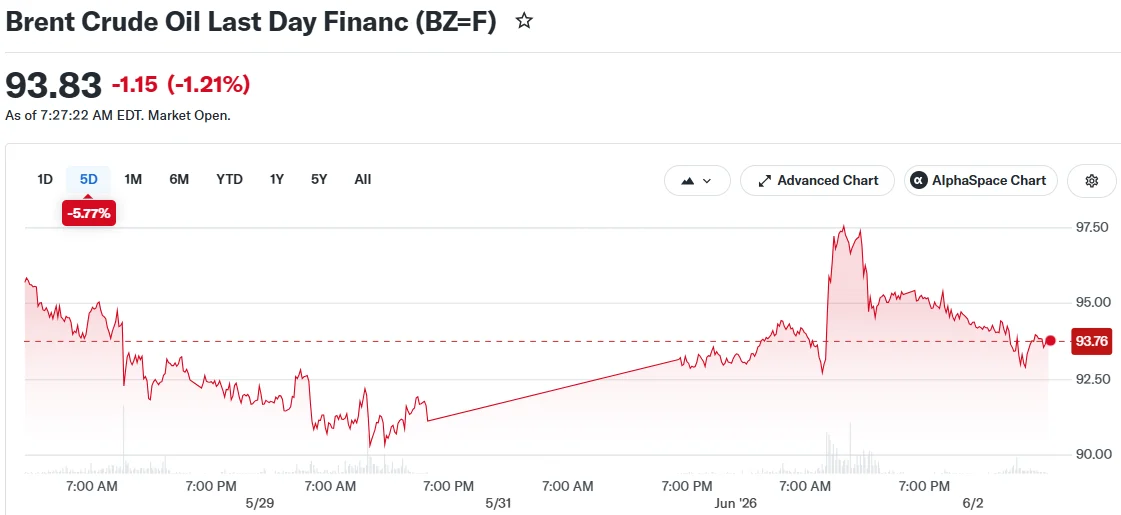
Tuesday’s decline followed a significant upward movement on Monday. Crude values surged 4.2% after Tasnim, Iran’s semi-official news outlet, published reports claiming Tehran had halted diplomatic engagement with Washington in response to Israel’s military campaign in Lebanon.
Trump subsequently disputed that characterization. Through his Truth Social platform, he announced that Hezbollah had committed to ceasing attacks against Israel, with Israel reciprocating the commitment. He emphasized that negotiations with Iranian officials continued to advance.
During a conversation with ABC News, Trump indicated a memorandum of understanding with Iran regarding the reopening of the Strait of Hormuz could materialize within seven days. He acknowledged that several outstanding issues required resolution before finalizing any agreement.

Why the Strait of Hormuz Matters
The Strait of Hormuz represents a critical maritime chokepoint situated between Iranian and Omani territories at the Persian Gulf’s entrance. Under typical operating conditions, approximately 20% of global crude oil and liquefied natural gas volumes transit through this narrow passage.
Following the escalation of regional tensions, commercial vessel traffic through the strait has faced substantial limitations. These constraints have maintained global oil prices significantly above pre-conflict trading levels.
Tasnim additionally reported that Iranian officials and their regional allies had contemplated shutting down both the Strait of Hormuz and the Bab el-Mandeb Strait, another critical waterway located at the Red Sea’s southern terminus. Such action would impact an additional major corridor for petroleum exports.
HSBC market analysts characterized the present commodity environment as a “super-squeeze,” cautioning that conditions could deteriorate further should Hormuz remain effectively closed to commercial shipping.
UBS commodity specialist Giovanni Staunovo noted Tuesday that Trump’s social media communications suggesting de-escalation were applying downward pressure on crude values. Nevertheless, he emphasized that petroleum flows through Hormuz “remain restricted.”
What Happens When a Deal Is Reached?
Market analysts anticipate crude values will decline following any diplomatic resolution, though not returning entirely to pre-conflict price points.
Dave Sekera, Morningstar’s chief US market strategist, projected prices would fall “pretty substantially” following a settlement. However, he warned that inflationary pressures resulting from prolonged elevated crude prices could persist “for at least months if not several quarters.”
The ceasefire dynamics involving Israel and Hezbollah introduced additional complexity. Trump and Israeli Prime Minister Benjamin Netanyahu offered conflicting descriptions of their telephone discussion concerning Lebanon. Lebanon’s presidential office indicated further negotiations were scheduled for Tuesday and Wednesday, targeting an extension of any ceasefire arrangement throughout Lebanese territory.
As of Tuesday morning, crude prices remained considerably elevated compared to pre-conflict benchmarks, with the Strait of Hormuz continuing to operate under significant commercial shipping restrictions.
Get 3 Free Stock Ebooks
Discover top-performing stocks in AI, Crypto, and Technology with expert analysis.
- Top 10 AI Stocks - Leading AI companies
- Top 10 Crypto Stocks - Blockchain leaders
- Top 10 Tech Stocks - Tech giants


