



Key Takeaways
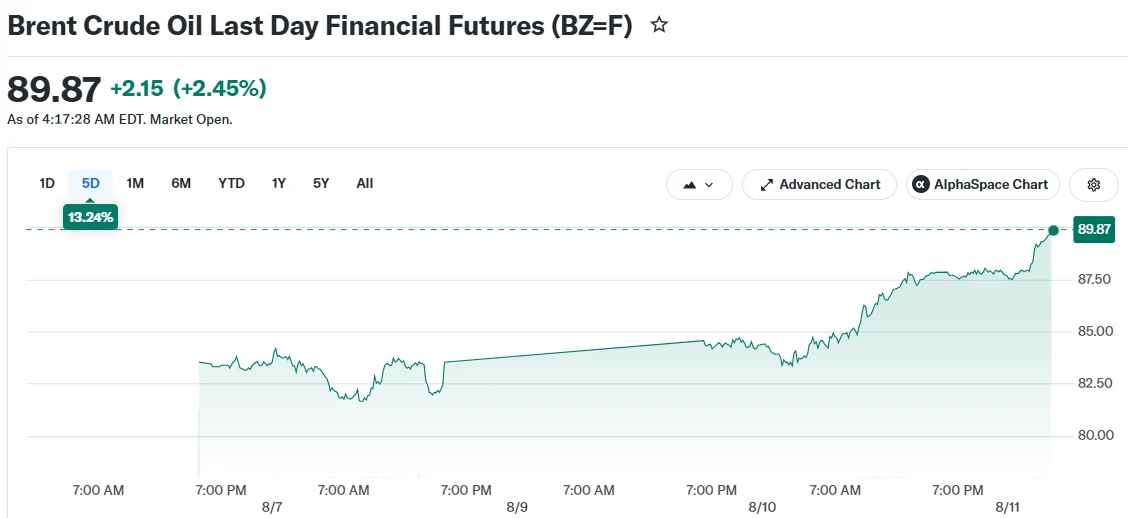
- Crude oil markets have surged approximately 10% in the last seven days amid deteriorating Strait of Hormuz negotiations
- Washington and Tehran are now exchanging demands for war reparations, creating a diplomatic deadlock
- Brent crude touched $87.93 per barrel while WTI climbed to $82.42 on Tuesday trading
- Yemen’s Houthi militants targeted Saudi Aramco’s Jazan facility, intensifying regional supply concerns
- Surging energy costs are reigniting inflation worries and prompting renewed speculation about Federal Reserve tightening
Energy markets have experienced significant upward momentum this week as diplomatic efforts between Washington and Tehran regarding the critical Strait of Hormuz shipping channel show signs of complete breakdown.
Brent crude futures advanced to $87.93 per barrel during Tuesday’s session, while West Texas Intermediate reached $82.42. Both benchmarks had registered gains exceeding 5% in Monday’s trading alone.
Diplomatic Impasse Over War Compensation Claims
The negotiations hit a major obstacle when President Donald Trump announced Monday that any peace agreement would require Iran to provide conflict compensation. Trump’s statement came as a direct counter to Tehran’s own insistence that Washington must pay war reparations before diplomatic progress can occur.
Iranian officials have indicated ongoing discussions with Oman regarding alternative maritime routes through the strategic waterway, though they maintain that complete removal of US sanctions remains a prerequisite for any deal.
Adding to the confusion, both nations are providing contradictory assessments of the strait’s operational status. US officials maintain that Hormuz continues to function, while Iranian authorities assert they’ve effectively closed the passage using naval mines and drone deployments.

Before the US-Israel confrontation with Iran escalated, the strait facilitated approximately 20% of global oil shipments. Though the channel temporarily reopened following a June peace agreement, maritime traffic has effectively ceased after Iran resumed attacks on commercial vessels in the area.
Yemen-Based Forces Strike Saudi Oil Infrastructure
Market anxieties intensified following weekend reports that Yemen’s Houthi militants successfully struck Saudi Aramco’s Jazan refinery. The Iranian-aligned Houthis announced a maritime blockade targeting Saudi Arabia in Red Sea waters last month and have issued warnings about continued strikes against shipping and petroleum facilities.
Quintex Intel strategist Stephen Innes characterized the developing situation as “quite the game of chicken,” noting that both parties are attempting to weaponize oil markets while avoiding direct military escalation.
BNZ analyst Jason Wong observed: “In the absence of any positive headlines on negotiations to reopen the strait, pressure on oil prices has been upward.”
Energy Rally Revives Price Pressure and Policy Speculation
The current oil price surge is rekindling inflation concerns. Although last month’s US employment report showed a loss of over 20,000 jobs—temporarily dampening Federal Reserve rate hike expectations—climbing energy expenses could alter the central bank’s calculus.
Cleveland Federal Reserve President Beth Hammack suggested Monday that a single 25-basis-point adjustment “probably doesn’t do a whole lot,” implying that multiple increases might be necessary based on evolving economic conditions.
Market participants are now closely monitoring Wednesday’s scheduled release of US consumer price index figures. The inflation data could provide critical guidance for the Fed’s upcoming policy decisions.
Tuesday trading in Asian equity markets showed divergent performance. Markets in Seoul, Sydney, and Singapore recorded advances, while exchanges in Hong Kong, Shanghai, and Mumbai experienced declines.
Get 3 Free Stock Ebooks
Discover top-performing stocks in AI, Crypto, and Technology with expert analysis.
- Top 10 AI Stocks - Leading AI companies
- Top 10 Crypto Stocks - Blockchain leaders
- Top 10 Tech Stocks - Tech giants


