


Key Highlights
- Brent crude surpassed the $100 per barrel threshold for the first time since midsummer
- U.S. forces eliminated five Iranian oil tankers following assaults on an American naval vessel
- Tehran retaliated with missile strikes against U.S. installations in Jordan and issued warnings to Gulf nations
- Financial analysts at Goldman Sachs project Brent prices may surge beyond $120 per barrel amid continued attacks
- Petroleum shipments through the Strait of Hormuz currently operate at approximately half of their pre-conflict volume
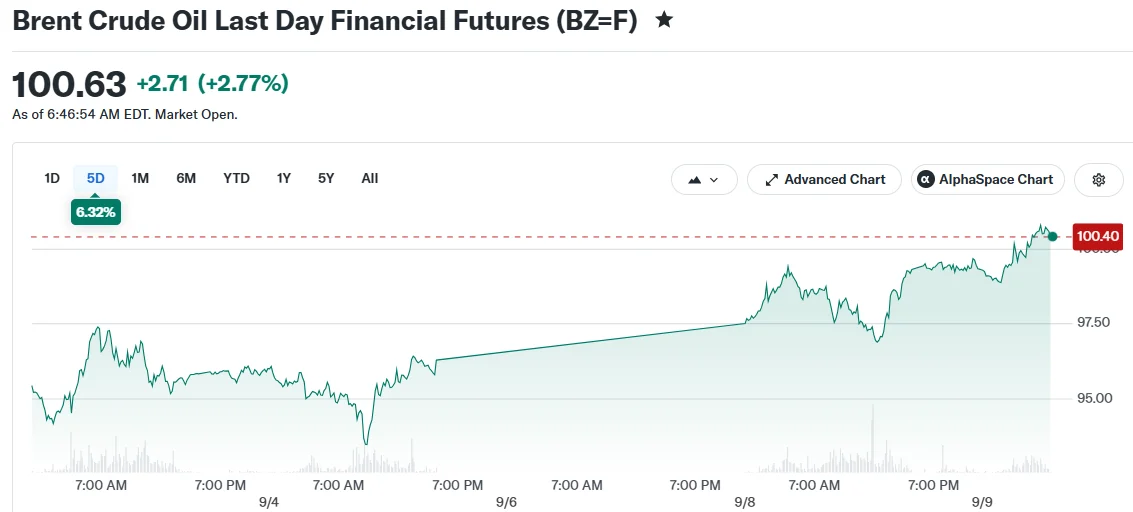
Global oil prices experienced significant upward momentum Wednesday as military confrontations between Washington and Tehran pushed Brent crude beyond the $100 per barrel milestone for the first time in several months.
Brent crude contracts climbed 2.6% to settle at $100.45 per barrel, while U.S. West Texas Intermediate advanced 2.3% to close at $95.19 per barrel.
The dramatic price increase comes on the heels of intensified military operations between both nations. American forces neutralized five Iranian oil transport vessels Tuesday, characterizing the action as a direct response to attempted strikes on a U.S. naval ship. Military officials confirmed zero American casualties.
Tehran’s counteroffensive included launching ballistic missiles targeting a U.S. military installation situated near Al Azraq in Jordan’s eastern region. Iranian authorities simultaneously issued stern advisories to Gulf region countries, including Kuwait and Bahrain, cautioning against providing assistance to American military operations.
According to Iran’s Islamic Revolutionary Guard Corps, their forces engaged 10 vessels total, comprising two American warships and eight commercial oil tankers. The ongoing hostilities have now extended into their seventh consecutive month.

Houthi Militia Operations Compound Regional Tensions
The scope of conflict expanded when Iranian-aligned Houthi militants launched coordinated strikes against energy infrastructure and commercial targets across multiple southern Saudi Arabian municipalities Tuesday. The assaults resulted in more than 70 individuals sustaining injuries.
U.S. Secretary of State Marco Rubio issued a stern declaration that America would maintain its campaign against Iranian petroleum vessels in direct response to continued aggression toward U.S. naval forces.
Market researchers at ING noted that commodity traders will likely continue factoring elevated risk premiums into pricing models given the absence of diplomatic engagement. “Recent developments only reinforce the view that we’re still some way from a restart in talks,” their analysis stated.
Notwithstanding heightened regional instability, assessments of petroleum transit through the Strait of Hormuz indicate modest improvements. Current flow estimates stand at approximately 10 million barrels daily, representing roughly 50% of volumes recorded before hostilities commenced.
Goldman Sachs Projects Potential $120 Price Point
Goldman Sachs energy analyst Daan Struyven indicated that the likelihood of Brent crude exceeding $120 per barrel continues to strengthen as maritime attacks escalate in frequency and severity.
“It’s definitely plausible,” Struyven stated to CNBC when questioned about the $120 scenario materializing.
The investment bank’s primary forecast maintains expectations that Persian Gulf oil exports will experience gradual restoration as regional producers identify alternate shipping channels and expand pipeline infrastructure.
However, Struyven emphasized that recent military escalations substantially increase the probability of an alternative scenario where export volumes remain stagnant for extended periods, consequently driving prices considerably higher.
“The probability of that scenario is definitely going up as we’re seeing an intensification and broadening of the shipping attacks,” he explained.
U.S.-Iran military exchanges had temporarily ceased for approximately 30 days as Washington pursued economic sanctions against Tehran. Hostilities recommenced in late last month, with the confrontation subsequently expanding in scope and intensity.
Brent crude previously exceeded the $100 benchmark during July trading sessions. With diplomatic negotiations remaining nonexistent, market participants continue monitoring whether maritime supply chain disruptions will further deteriorate.
Get 3 Free Stock Ebooks
Discover top-performing stocks in AI, Crypto, and Technology with expert analysis.
- Top 10 AI Stocks - Leading AI companies
- Top 10 Crypto Stocks - Blockchain leaders
- Top 10 Tech Stocks - Tech giants


