



Key Highlights
- Brent futures advanced toward $97 per barrel with WTI approaching $95, marking gains exceeding 7% across two trading sessions
- American military forces targeted Iran’s Qeshm Island while defending against incoming Iranian projectiles and unmanned aircraft
- Tehran launched ballistic missile strikes targeting Kuwait and Bahrain, prompting Kuwait to halt airport operations
- Nuclear agreement discussions between Washington and Tehran remain deadlocked despite presidential claims of ongoing dialogue
- American petroleum reserves decreased by 6.8 million barrels weekly, significantly surpassing market forecasts
Global crude markets extended their rally for a third consecutive trading session Wednesday as diplomatic efforts between Washington and Tehran deteriorated and renewed hostilities across the Middle East sent shockwaves through energy trading floors.
Brent futures pushed upward to approximately $97.46 per barrel, with West Texas Intermediate reaching $95.23. The benchmark contracts had already accumulated gains surpassing 7% during the prior two sessions.
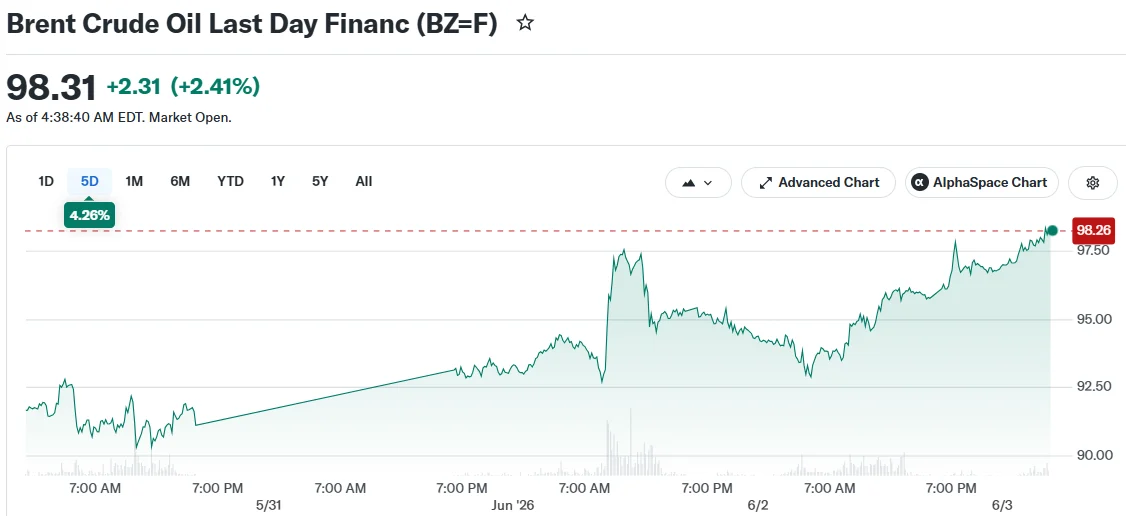
The rally intensified following multiple military confrontations throughout the region. American defense forces intercepted Tehran-launched ballistic projectiles and unmanned aerial vehicles targeting Kuwait and Bahrain, subsequently launching retaliatory strikes against an Iranian command facility.
Tehran’s forces also executed an unmanned aerial assault on Kuwait’s primary international airport, inflicting damage to a passenger terminal and compelling authorities to temporarily ground all flights.
Regional Hostilities Propel Crude Higher
American military operations expanded to include additional strikes targeting Iran’s Qeshm Island, strategically positioned adjacent to the Strait of Hormuz. This critical maritime corridor facilitates approximately 20% of global petroleum transport.

Any interruption to maritime traffic through the Strait of Hormuz carries significant implications for worldwide energy distribution networks. Market participants are incorporating elevated risk premiums as the standoff continues without resolution.
President Trump expressed continued confidence in securing an interim arrangement with Iranian leadership. Nevertheless, Tehran’s official media outlets announced suspension of negotiations, directly contradicting statements from the White House.
Reports indicate the administration is demanding Iran formalize specific nuclear commitments through written documentation before any preliminary accord receives approval. Tehran had previously provided oral commitments regarding certain nuclear provisions, according to ABC News reporting.
Supply Data Compounds Market Pressure
The ongoing uncertainty has maintained oil prices at elevated levels while introducing significant volatility. Open interest in Brent futures contracts has declined to levels unseen since August, reflecting reduced risk appetite among market participants.
“Clients are tired,” said Daan Struyven, Co-Head of Global Commodities Research at Goldman Sachs, speaking on Bloomberg TV. “It’s a challenging trading environment with headlines moving prices up and down.”
Warren Patterson, head of commodities strategy at ING, said risks remain skewed to the upside, especially heading into the third quarter when demand is typically stronger.
Adding further support to prices, the American Petroleum Institute disclosed that domestic crude reserves contracted by 6.8 million barrels during the week concluding May 29. Market analysts had projected a more modest decline of just 3.6 million barrels.
Official supply figures from the US Energy Information Administration were scheduled for release later Wednesday. Market participants were simultaneously monitoring the ADP employment assessment, ISM services index, and factory orders statistics in advance of Friday’s comprehensive nonfarm payrolls release.
The absence of ceasefire extension agreements and persistent questions surrounding Persian Gulf petroleum shipments continue applying pressure to worldwide crude availability.
Get 3 Free Stock Ebooks
Discover top-performing stocks in AI, Crypto, and Technology with expert analysis.
- Top 10 AI Stocks - Leading AI companies
- Top 10 Crypto Stocks - Blockchain leaders
- Top 10 Tech Stocks - Tech giants


