



Key Highlights
- Benchmark crude extended declines for a third consecutive session, with WTI hovering around $68 and Brent slipping under $72 per barrel
- Indirect negotiations between Washington and Tehran in Doha concluded without agreement, though participants committed to continued dialogue
- Oil shipments passing through the Strait of Hormuz surged beyond 10 million barrels daily
- American crude production reached an all-time high of 13.93 million barrels per day during April
- The OPEC+ alliance may authorize additional output increases for August, potentially weighing further on valuations
Oil prices extended their downward trajectory on Thursday as market participants digested increasing supply availability and measured optimism surrounding diplomatic engagement between Washington and Tehran in Doha.
West Texas Intermediate crude decreased approximately 1.4% to settle near $67.64 per barrel. Brent crude declined 1.3% to $70.67 per barrel. Both key benchmarks have now registered losses across three straight trading sessions.
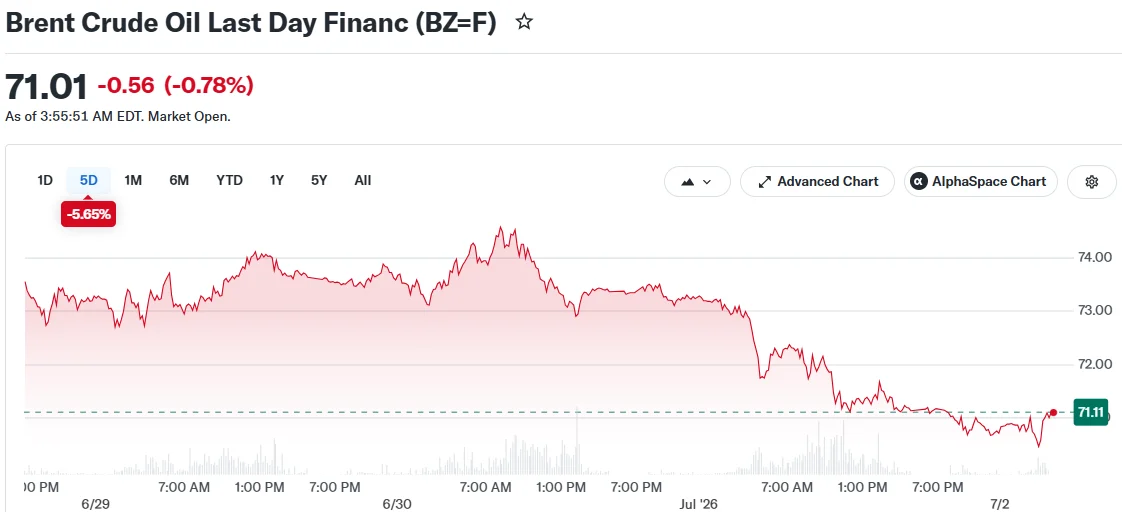
The downturn follows oil’s steepest quarterly decline since 2020.
Doha Dialogue Concludes Without Breakthrough
Indirect diplomatic engagement between American and Iranian representatives concluded in Doha following two days of technical-level discussions. Participants failed to achieve a comprehensive peace framework.
Nevertheless, Qatari mediators indicated the discussions yielded constructive advancement. Both parties pledged to maintain the negotiation process, with the subsequent round anticipated following memorial services for Iran’s late Supreme Leader Ali Khamenei, who perished in an aerial bombardment at the conflict’s outset.

Memorial observances are projected to commence July 4 and continue for multiple days, according to Iranian official media channels.
Discussions centered on maritime transit through the Strait of Hormuz and additional trust-building initiatives. President Donald Trump acknowledged meaningful advancement in the negotiations.
Despite the absence of a finalized agreement, the constructive atmosphere has alleviated market anxieties regarding potential crude supply interruptions across the region.
Supply Routes Remain Functional Amid Regional Uncertainty
Crude shipments transiting the Strait of Hormuz have escalated beyond 10 million barrels daily. This critical maritime passage links Persian Gulf producers with international consumers and represents one of the planet’s most vital petroleum corridors.
A US administration official indicated that Tehran’s capacity to interrupt shipping through the waterway is presently constrained. The United Arab Emirates has simultaneously restored its export volumes to pre-conflict thresholds, utilizing tanker vessels and pipeline infrastructure to transport oil throughout the territory.
American Production Milestone Intensifies Downward Momentum
Recently released information from the US Energy Information Administration revealed domestic crude extraction attained an unprecedented 13.93 million barrels daily throughout April. This milestone strengthens projections of abundant worldwide supply availability.
ANZ bank observed that diminishing regional tensions have mitigated supply apprehensions. The institution’s China Commodity Index advanced 0.5%, with its energy segment similarly rising 0.5%, suggesting consistent Chinese demand notwithstanding the recent price retreat.
Outlook for Energy Markets
Traders are monitoring multiple variables that could influence pricing dynamics in forthcoming weeks.
The OPEC+ coalition is anticipated to determine whether to implement another production elevation for August. Approaching US stockpile reports will likewise receive intensive scrutiny.
Continued advancement or potential obstacles in Washington-Tehran negotiations constitute the primary geopolitical uncertainty. Any interference with Strait of Hormuz shipments would continue to represent a substantial threat to worldwide energy distribution.
Currently, the convergence of historic American production, rebounding Gulf region exports, and diplomatic progress maintains downward forces on crude valuations.
Get 3 Free Stock Ebooks
Discover top-performing stocks in AI, Crypto, and Technology with expert analysis.
- Top 10 AI Stocks - Leading AI companies
- Top 10 Crypto Stocks - Blockchain leaders
- Top 10 Tech Stocks - Tech giants


