


Key Highlights
- Dogecoin rallied approximately 3% to reach $0.075 following a bounce from the critical $0.0700 support zone
- Thursday saw DOGE ETF products register $871,110 in net outflows — marking only the third outflow day since inception
- Futures Open Interest surged more than 7% within 24 hours to hit $1.04 billion, indicating growing retail participation
- The Relative Strength Index now stands at 32, climbing from oversold conditions; MACD indicator has turned bullish
- Historical data reveals July typically brings weakness for DOGE, with a median decline of 4.6% across the past dozen years
Dogecoin (DOGE) is currently changing hands around $0.075 on Friday following Thursday’s 3% upward movement. This recovery emerges as broader cryptocurrency market concerns start to subside.
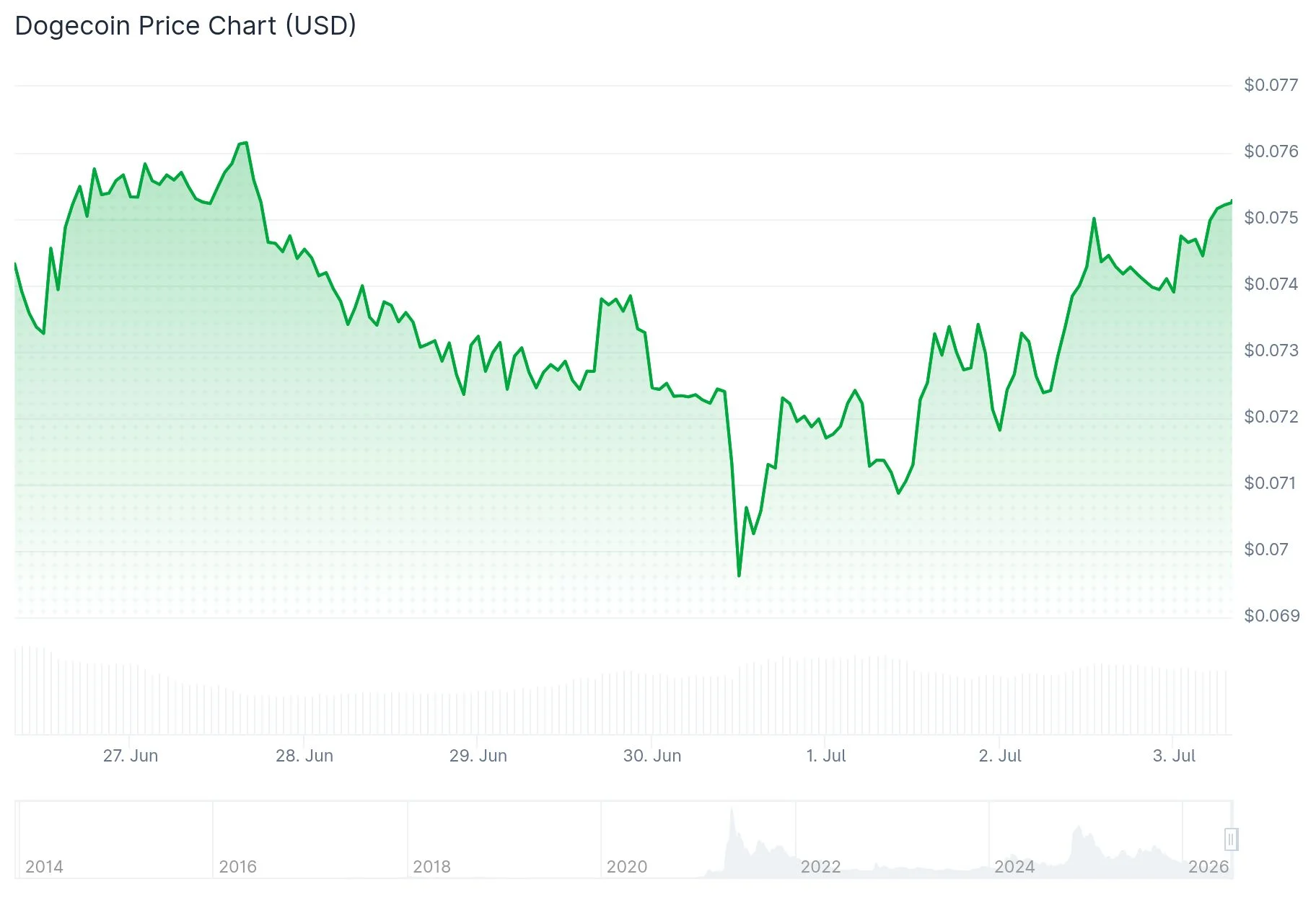
The price action found support at the $0.0700 threshold. Technical analysts have identified this bounce as forming a “morning star” candlestick pattern — a formation typically associated with potential near-term reversals.
Traders should monitor the resistance trendline positioned at $0.0776 as the next crucial barrier. Breaking above this level with a daily close could pave the way for advancement toward the 50-day exponential moving average at $0.0863. Currently, DOGE remains trading substantially beneath both its 50-day EMA ($0.0863) and 200-day EMA ($0.1093).
Market analyst Trader Tardigrade (@TATrader_Alan) shared technical analysis highlighting DOGE’s position at the lower boundary of a multi-year bullish pennant formation on the 3-month chart. His assessment suggests that price action is compressing at the pattern’s support level, potentially signaling an upcoming reversal. According to his strategy, accumulating positions at the current pattern bottom may offer better risk-reward than waiting for breakout confirmation.
Institutional Products See Withdrawals While Derivatives Activity Increases
Institutional appetite for DOGE remains muted. Exchange-traded fund products tracking Dogecoin experienced $871,110 in net withdrawals on Thursday — representing the third occasion of negative flows since these investment vehicles debuted in late 2025. Prior to this, the products had recorded nine consecutive trading sessions without any outflows.

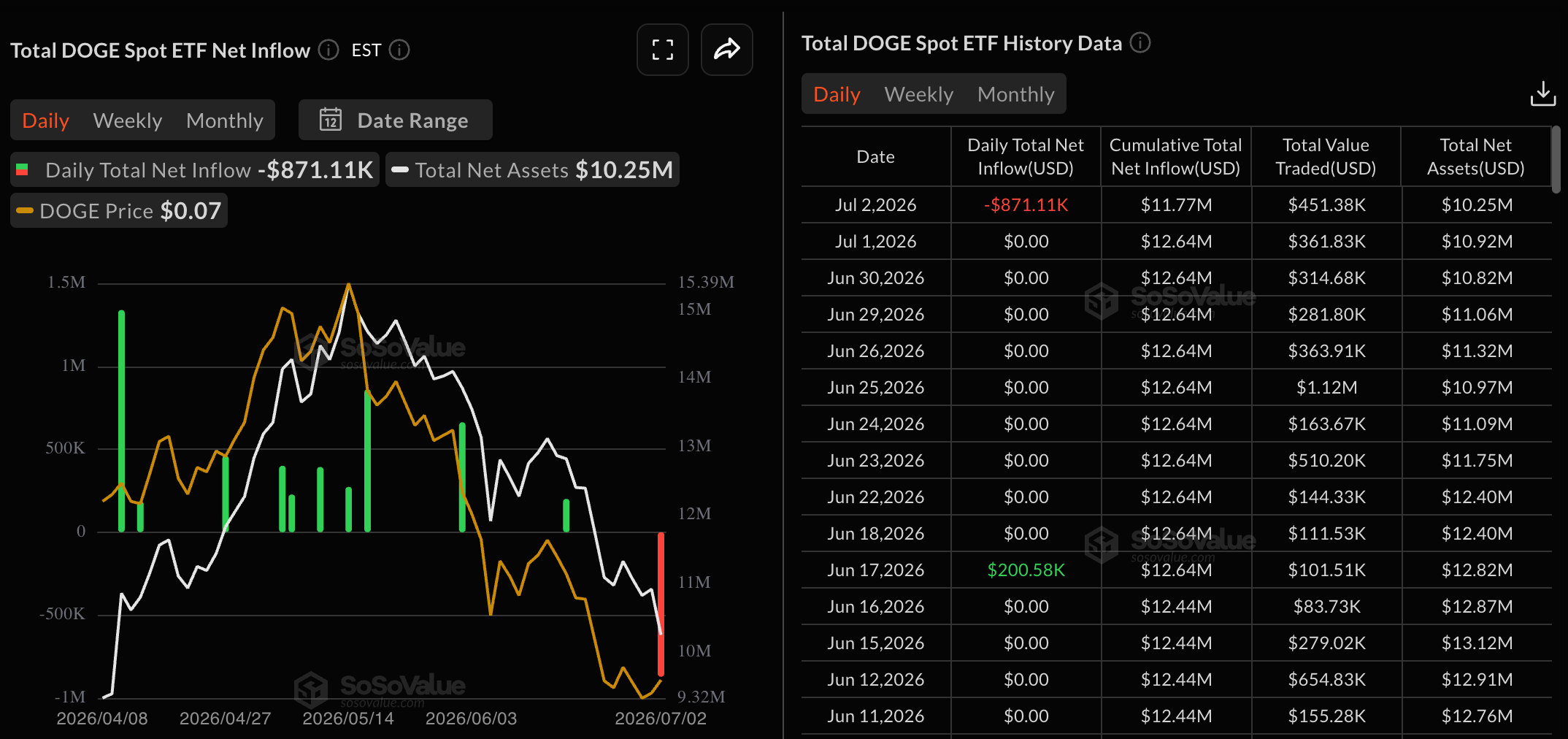
The leading DOGE ETF currently manages approximately $13.7 million in net assets under management. Since their market introduction, these institutional products have failed to stem the cryptocurrency’s price erosion.
Meanwhile, retail trading activity appears to be intensifying. Open Interest across DOGE perpetual futures contracts jumped more than 7% over a 24-hour period, reaching $1.04 billion. The funding rate has risen to 0.0099%, indicating that traders are prepared to pay a small premium for maintaining long exposure.
Historical July Performance and Inflationary Supply Dynamics
Seasonal patterns suggest challenges ahead for DOGE’s price performance as July begins. Examining the previous 12 years of data reveals that July has delivered a median return of -4.6% for the meme cryptocurrency. Only five out of those twelve July periods concluded with gains.
Dogecoin has declined approximately 55% from its price levels one year ago and remains roughly 90% below the May 2021 all-time peak.
The cryptocurrency operates without a maximum supply limit. Approximately 5.2 billion new DOGE tokens are generated annually, translating to an inflation rate near 3.4% per year. With no token burn protocol or staking mechanism to counterbalance this issuance, the market must absorb roughly 14 million DOGE daily to maintain price stability.
The daily chart’s RSI indicator reads 32, showing recovery from previously oversold readings. The MACD histogram has generated a bullish crossover above its signal line, suggesting bearish momentum may be weakening.
Near-term support remains anchored at $0.0700, with secondary support identified around $0.0642.
Get 3 Free Stock Ebooks
Discover top-performing stocks in AI, Crypto, and Technology with expert analysis.
- Top 10 AI Stocks - Leading AI companies
- Top 10 Crypto Stocks - Blockchain leaders
- Top 10 Tech Stocks - Tech giants


