


TLDR
- President Trump announced termination of the U.S.-Iran framework agreement during a NATO summit in Turkey
- The Dollar Index climbed to a one-week peak, marking its fourth consecutive session of gains
- Brent crude soared more than 6% amid Trump’s statements and Iranian military operations
- New Zealand’s central bank increased rates by 25 basis points to 2.5%, strengthening the kiwi
- Market participants await Federal Reserve June meeting minutes under new leadership of Chair Kevin Warsh
The greenback continued its upward trajectory on Wednesday following President Donald Trump’s declaration that the provisional arrangement with Iran had concluded, sparking safe-haven demand and propelling energy prices significantly higher.
During remarks at a NATO gathering in Turkey, Trump stated the framework agreement had reached its conclusion following Iranian Revolutionary Guards’ operations targeting American military installations in Bahrain and Kuwait. Tehran characterized these actions as responses to U.S. aerial strikes on Iranian soil and Washington’s elimination of sanctions exemptions for Iranian petroleum exports.
“We make a deal, and everyone’s agreed. No nuclear weapons. They go outside, talk to the press, they say we never even talked about it. As far as I’m concerned, it’s over,” Trump said.
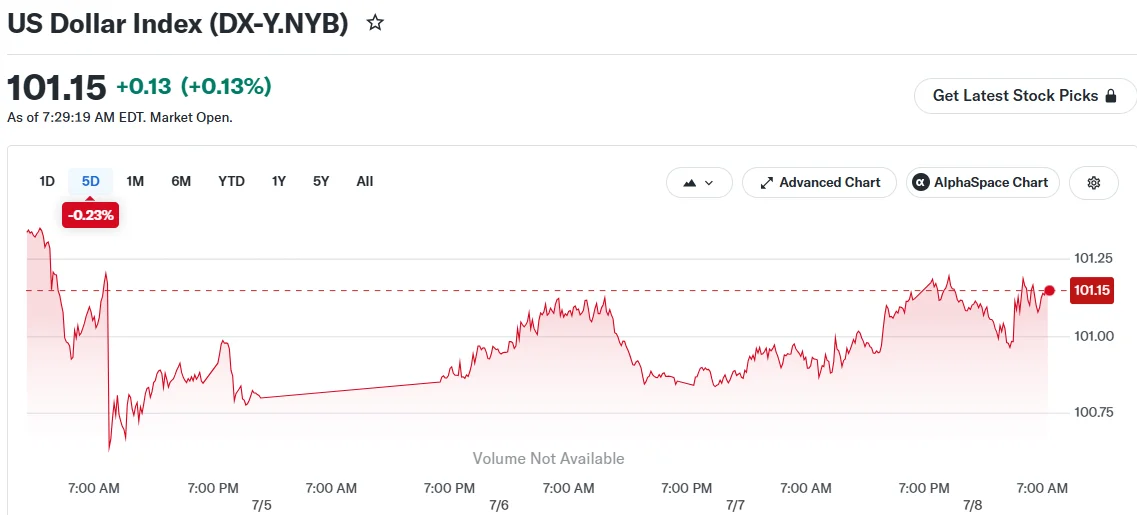
The U.S. Dollar Index, measuring the greenback’s performance versus six primary currencies, advanced 0.2% to approximately 101.17. This positioned the index close to its strongest point since July 2.
Energy Markets Surge Amid Regional Tensions
Brent crude skyrocketed 6.24% to reach $78.82 per barrel, marking a second consecutive session of increases. The surge materialized immediately following Trump’s public statements and reports of Iranian military actions against American installations in the region.
U.S. Treasury securities also experienced upward pressure. The 2-year yield advanced to 4.24%, while the benchmark 10-year yield reached a one-month peak of 4.60%. Market observers linked these movements to expectations of elevated energy expenses over extended periods.

Jane Foley, head of FX strategy at Rabobank, said the market has learned to weigh Trump’s comments carefully. “The remarks may be meant to bring the opposition to the table. Nevertheless, they will raise anxiety levels another notch,” she said.
Central Bank Activity and Fed Minutes Draw Attention
Apart from Middle Eastern geopolitical developments, market participants monitored two additional Wednesday events.
The Reserve Bank of New Zealand elevated its benchmark cash rate by 25 basis points to 2.5%, matching analyst forecasts. The central bank indicated additional monetary tightening could be necessary to manage inflationary pressures. The kiwi dollar appreciated following the announcement.
The Australian dollar similarly posted modest advances, while Japan’s currency maintained weakness. The dollar extended gains against the yen for a fourth straight session, trading near 162.48. This threshold has historically triggered cautions from Japanese officials regarding potential market intervention.
Bank of Japan board member Toichiro Asada noted that more definitive evidence of demand-driven price increases would be required before Japan pursues additional rate adjustments.
Market observers anticipated the release of Federal Reserve minutes from the June policy meeting later Wednesday — representing the inaugural session under new Chairman Kevin Warsh. Warsh has already streamlined the Fed’s policy communication and declined to provide his own rate forecasts, departing from established convention. Nine among 18 FOMC participants recently indicated expectations for at least one additional rate increase prior to year-end.
Francesco Pesole, FX strategist at ING, said he expects the minutes to reinforce a hawkish tone, which would support further dollar strength.
Get 3 Free Stock Ebooks
Discover top-performing stocks in AI, Crypto, and Technology with expert analysis.
- Top 10 AI Stocks - Leading AI companies
- Top 10 Crypto Stocks - Blockchain leaders
- Top 10 Tech Stocks - Tech giants


