



Key Highlights
- Currency markets remained largely unchanged ahead of Wednesday’s July inflation report
- Market pricing indicates an even split on the Federal Reserve’s September policy decision
- Bitcoin declined 0.2% to $63,554 while ether fell 0.1% to $1,879
- Crude oil advanced toward the $90 mark amid escalating Middle East shipping disruptions
- The Japanese currency lingered near two-week weakness despite coordinated currency intervention efforts
Currency markets showed minimal movement on Wednesday as investors adopted a wait-and-see approach before the release of July’s consumer price index data.
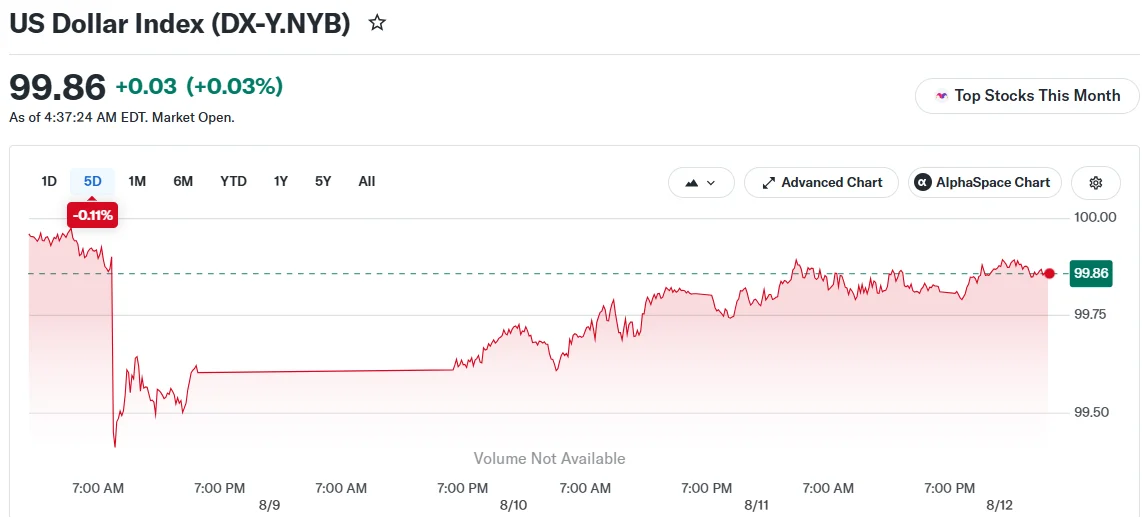
The dollar index registered a modest 0.1% gain to reach 99.88. Against major currencies, the euro remained stable at $1.1542, sterling held firm at $1.3508, and the Aussie dollar maintained its position at $0.7064.
The Japanese currency traded around 159.41 against the dollar, hovering near its lowest point in a fortnight. This weakness persists even after coordinated intervention by American and Japanese monetary authorities aimed at supporting the yen.
Market forecasters anticipate a modest 0.1% monthly increase in headline CPI numbers for July, following June’s 0.4% decline. Year-over-year inflation is expected to ease marginally to 3.4% from the previous 3.5% reading.
According to MUFG research, Wednesday’s inflation figures carry greater weight than the previous week’s disappointing employment data, considering the Federal Reserve’s heightened attention to price pressures rather than job market conditions.

Current market positioning through fed funds futures indicates a 52% likelihood of unchanged rates at the September policy gathering, compared with a 48% chance of a 25 basis point increase, based on CME FedWatch tool calculations.
Austan Goolsbee, head of the Chicago Federal Reserve, indicated on Tuesday that policymakers remain more concerned about elevated inflation than potential labour market softening. Whether this stance reflects the broader committee consensus from last month’s rate decision remains uncertain.
According to ING research, a pathway exists for gradual inflation deceleration through the end of 2026, contingent on stable crude prices and the restoration of normal Strait of Hormuz shipping operations.
Crude Advances on Middle East Shipping Disruptions
Oil prices gained ground amid ongoing maritime challenges in Middle Eastern waterways. Brent crude climbed toward the $90 per barrel threshold.
Houthi militants targeted a commercial vessel in the Bab el-Mandeb waterway. Additionally, American forces struck a container ship near Pakistani waters attempting to breach the Strait of Hormuz blockade.
Tehran authorities indicated the strait would remain inaccessible until Washington meets specific conditions to resolve the ongoing dispute. Commercial shipping volumes through this critical passage have declined substantially.
Rising crude costs present significant challenges for Asian nations dependent on oil imports, as elevated energy expenses increase import bills and potentially fuel inflationary pressures.
Australia’s central bank maintained its benchmark rate at 4.35% in a unanimous vote on Tuesday, providing stability for the Australian currency.
Digital asset markets saw bitcoin slip 0.2% to $63,554 while ether decreased 0.1% to $1,879. These marginal movements reflected the broader market’s cautious stance ahead of the inflation data release.
Get 3 Free Stock Ebooks
Discover top-performing stocks in AI, Crypto, and Technology with expert analysis.
- Top 10 AI Stocks - Leading AI companies
- Top 10 Crypto Stocks - Blockchain leaders
- Top 10 Tech Stocks - Tech giants


