


Key Takeaways
- Elon Musk took to X to ridicule Sam Altman, branding him a scammer following Apple’s lawsuit against OpenAI
- Apple initiated federal legal action claiming OpenAI stole trade secrets related to upcoming hardware products
- Former Apple executives Tang Tan and Chang Liu are specifically mentioned in the complaint
- Altman responded by insinuating that Musk’s criticism validates GPT-5.6 Sol as the leading AI model globally
- Earlier this year, a federal judge threw out Musk’s separate trade secret case against OpenAI
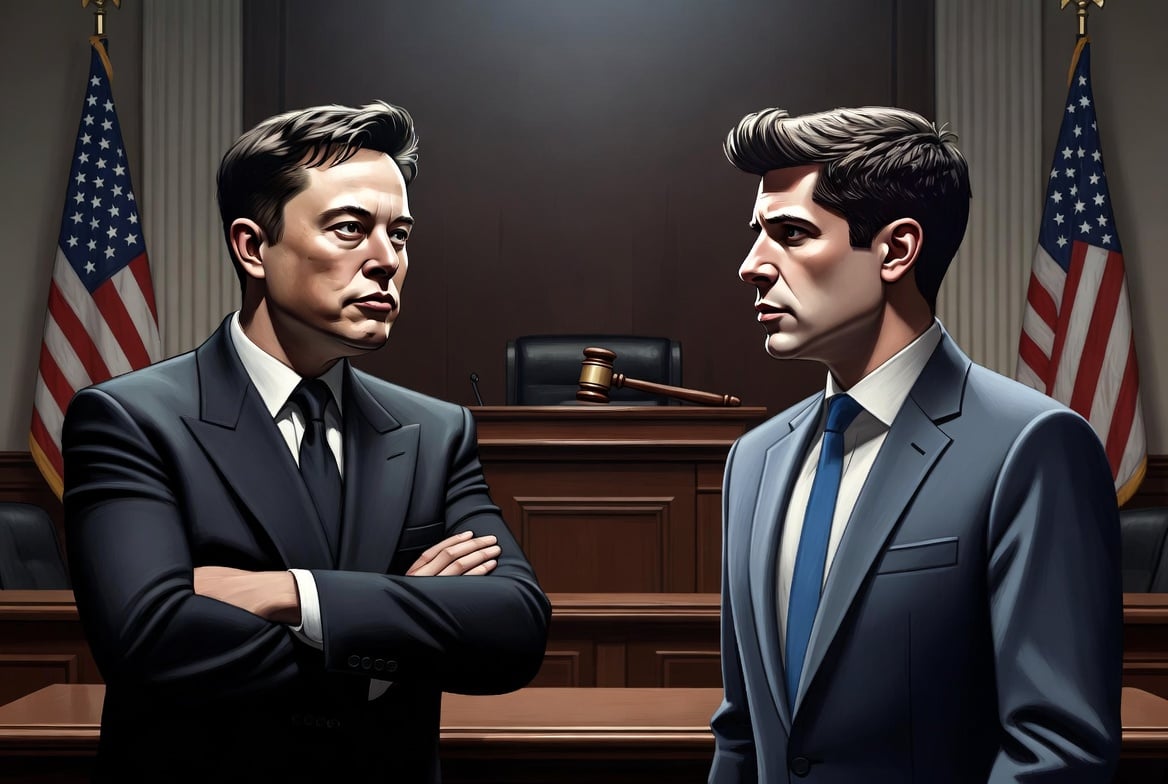
The bitter rivalry between Elon Musk and Sam Altman has erupted once more on social media. Apple’s recent federal complaint against OpenAI provided Musk with new fodder to launch attacks against his long-standing adversary.
On X, Musk reposted content highlighting a previous statement from Altman, adding his commentary: “He takes scamming to a whole new level.” In another jab, Musk quipped that Altman would likely require permission from a parole officer before visiting any SpaceX facility, making a direct reference to Apple’s legal action.
Altman wasn’t about to let the attacks go unanswered. He casually referred to Musk as “homeboy” while accusing him of “selling public market investors on short-term space datacentres,” taking aim at SpaceX’s promotional efforts regarding orbital computing infrastructure.
The confrontation intensified when Musk shared a screenshot showing Altman’s past assertion that he held no ownership stake in OpenAI and worked purely out of passion. Musk’s response was scathing: “By ‘this’ he means scamming,” adding that Altman “might literally love scamming more than any human alive.”
Altman concluded the exchange with his own interpretation of events. He suggested that Musk’s fixation on attacking him actually demonstrated that OpenAI’s newly released GPT-5.6 Sol model represents the pinnacle of AI technology. The GPT-5.6 series, which includes Sol, Terra, and Luna variants, became publicly available Thursday following the removal of US government restrictions.

The Apple Legal Complaint Against OpenAI
Apple has initiated federal litigation against [[LINK_START_0]]OpenAI[[LINK_END_0]], alleging misappropriation of trade secrets and contractual violations. The legal complaint focuses on OpenAI’s recruitment strategies and its plans for hardware development.
The lawsuit specifically identifies Tang Tan, currently serving as OpenAI’s chief hardware officer, who previously held the position of Apple VP of product design and contributed to developing the iPhone, Apple Watch, and AirPods. Chang Liu, another former Apple staffer, is also named in the filing.
According to Apple’s allegations, OpenAI actively encouraged prospective employees to bring confidential documentation, physical hardware components, technical blueprints, and unreleased product information to job interviews. The company further alleges that OpenAI leveraged proprietary data to establish contact with Apple’s manufacturing partners.
Apple’s legal demands include halting any utilization of its proprietary information, returning all confidential materials, and ensuring the preservation of relevant evidence.
OpenAI has categorically rejected these accusations. A company representative stated: “We have no interest in other companies’ trade secrets. We remain focused on building innovative technology that empowers people everywhere.”
The Ongoing Musk-Altman Conflict
Musk was among OpenAI’s original co-founders in 2015, providing financial backing during its formative period before departing in 2018 following strategic disagreements. He subsequently initiated legal proceedings against OpenAI, Altman, and Greg Brockman, challenging the organization’s transformation from its original non-profit mission.
That particular case proceeded to trial earlier this year. The jury found against Musk on procedural grounds related to the statute of limitations, and Musk announced his intention to pursue an appeal.
Additionally, just last month, a federal judge dismissed Musk’s distinct trade secret lawsuit concerning OpenAI, determining that evidence was inadequate to prove OpenAI had unlawfully obtained confidential information connected to his Grok artificial intelligence technology.
SpaceX’s artificial intelligence team recently unveiled Grok 4.5, a release many observers interpret as a direct competitive response to OpenAI’s GPT-5.6 launch.
Get 3 Free Stock Ebooks
Discover top-performing stocks in AI, Crypto, and Technology with expert analysis.
- Top 10 AI Stocks - Leading AI companies
- Top 10 Crypto Stocks - Blockchain leaders
- Top 10 Tech Stocks - Tech giants


