



Key Takeaways
- Ethereum momentarily dropped to $1,500 during June 2026, representing approximately a 70% decline from its August 2025 all-time high of $4,953.
- The altcoin has experienced sharper losses than Bitcoin, driven by elevated beta, diminished ETF inflows, and widespread leveraged liquidations.
- Breaking through $1,750 resistance could catalyze a rally toward $1,800–$2,000.
- Crypto analyst Patel continues building positions between $1,550–$1,000, projecting eventual targets of $10,000–$20,000.
- Bitcoin’s market trajectory and the ETH/BTC trading pair will primarily dictate Ethereum’s subsequent price action.
Ethereum plunged to $1,500 during June 2026 — marking its lowest valuation in several years — before mounting a modest rebound above $1,620. This development prompted an urgent question among traders: has $1,500 established the floor, or will prices continue sliding toward $1,000?
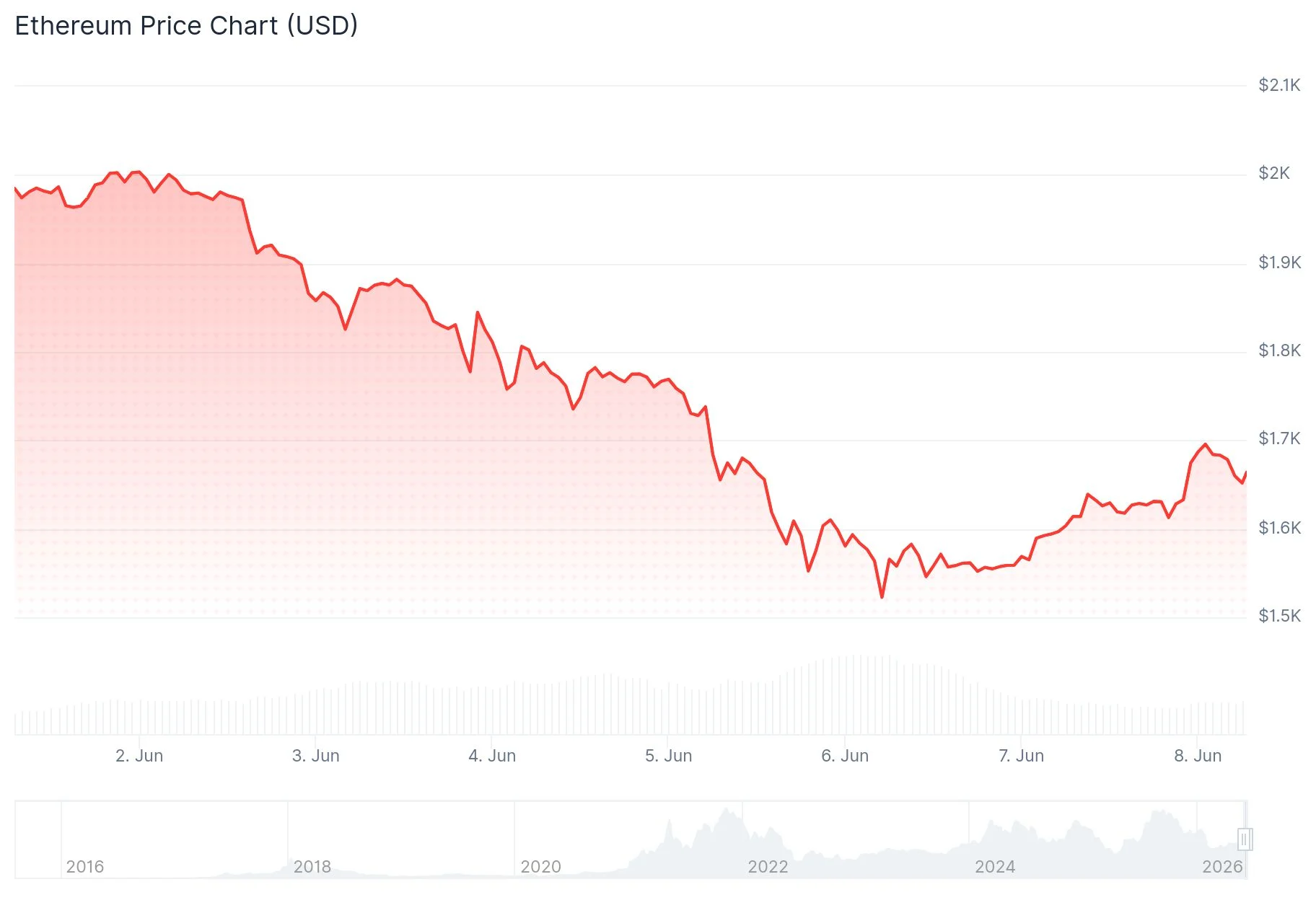
Ethereum reached its apex at $4,953 during August 2025. The subsequent decline unfolded gradually before accelerating dramatically. A robust U.S. employment report extinguished expectations for imminent Federal Reserve interest rate reductions. Escalating U.S.-Iran geopolitical tensions compounded market anxiety. Spot Bitcoin ETFs experienced unprecedented capital withdrawals, with Ethereum ETFs suffering parallel outflows. Liquidations exceeded $1 billion across leveraged cryptocurrency positions, with Ethereum long positions bearing substantial damage.
This convergence of factors propelled Ethereum toward $1,500 — a price level reminiscent of previous severe bear cycles.
Understanding ETH’s Steeper Decline Versus Bitcoin
Ethereum contracted approximately 70% from its zenith. Bitcoin declined roughly 50%. This differential stems from beta characteristics. ETH magnifies Bitcoin’s price movements bidirectionally — during market contractions, ETH typically contracts more severely.
The ETH/BTC ratio has steadily deteriorated since 2021. Bitcoin’s ETF debut in January 2024 generated consistent institutional capital flows. Ethereum’s subsequently launched ETFs never achieved comparable adoption. This demand disparity has left ETH more vulnerable during market downturns.

Leverage exposure intensified the situation. ETH long positions had become overcrowded. When June’s liquidation wave struck, these positions unwound rapidly, creating cascading downward pressure.
Prominent cryptocurrency analyst Crypto Patel confronted investor anxiety through social media commentary, cautioning followers against panic-driven decisions. He disclosed that he’s “slowly accumulating ETH/USDT in the $1,550–$1,000 range,” acknowledging that pinpointing the precise bottom remains impossible. Patel estimates Ethereum’s maximum downside around $1,000, while maintaining conviction that long-term valuations between $10,000 and $20,000 remain “very possible.” His forecast anticipates the subsequent altcoin season materializing between 2026 and 2027.
Critical Price Levels Under Observation
Following the $1,500 nadir, ETH rebounded beyond $1,620 and currently trades above its 100-hourly moving average. Immediate resistance emerges at $1,700, followed by $1,750 — corresponding to the 50% Fibonacci retracement level of the $2,005 to $1,505 decline.
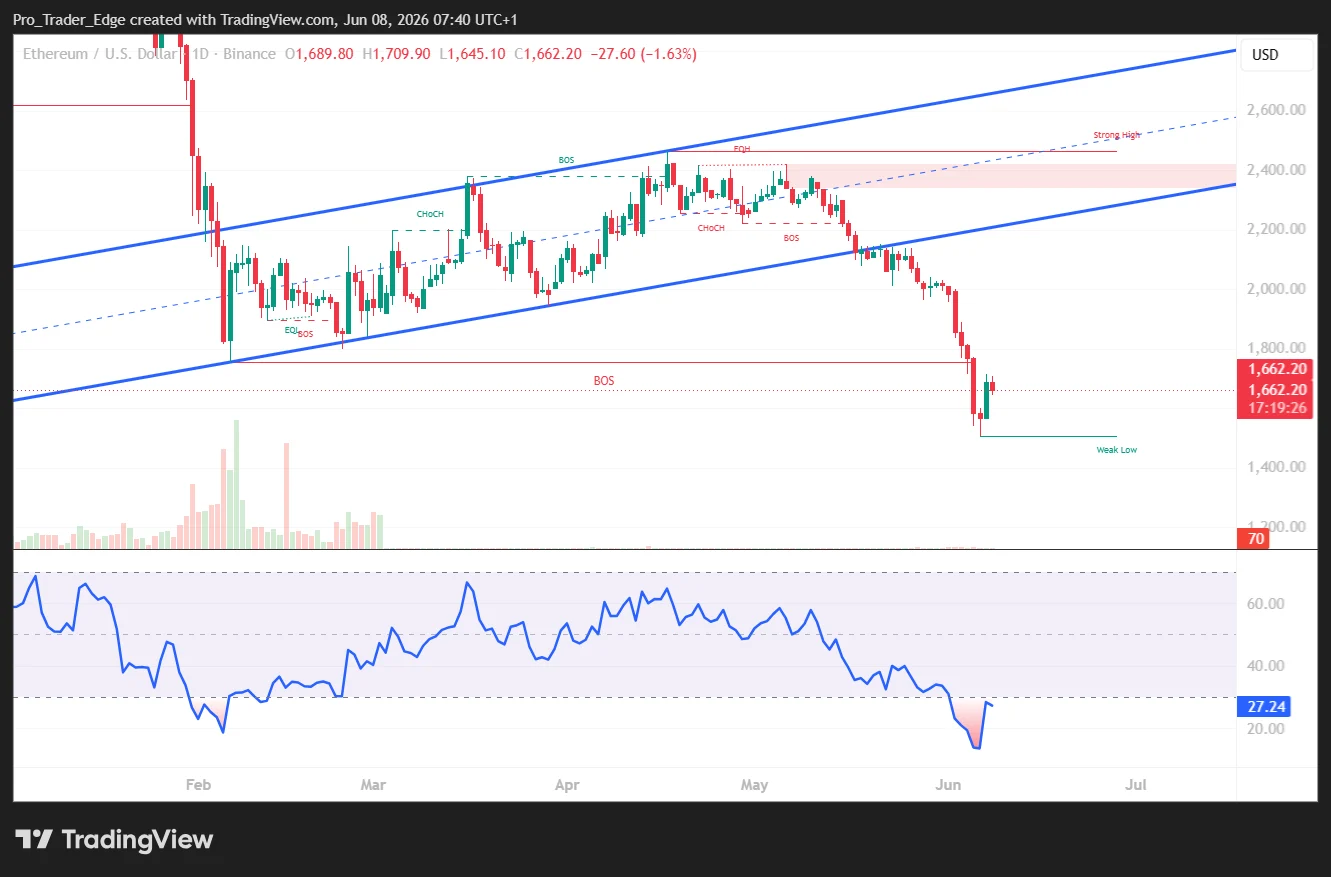
A decisive breakthrough above $1,750 could propel ETH toward $1,800, $1,885, and potentially $2,000. Should resistance at $1,750 prove insurmountable, retracement toward $1,620 and $1,600 represents the probable trajectory. The $1,500 threshold remains crucial support beneath current levels.
Ethereum treasury corporations factor into the broader narrative. BitMine carried approximately $9.58 billion in unrealized ETH losses, while SharpLink’s ETH holdings registered roughly $1.59 billion in paper losses at the cycle low. Neither organization has signaled distressed selling, though these figures underscore the balance sheet vulnerability accompanying ETH holdings through severe drawdowns.
As of early June 2026, ETH trades near $1,620 with bullish participants attempting to defend the recovery above the $1,600 threshold.
Get 3 Free Stock Ebooks
Discover top-performing stocks in AI, Crypto, and Technology with expert analysis.
- Top 10 AI Stocks - Leading AI companies
- Top 10 Crypto Stocks - Blockchain leaders
- Top 10 Tech Stocks - Tech giants


