


Quick Summary
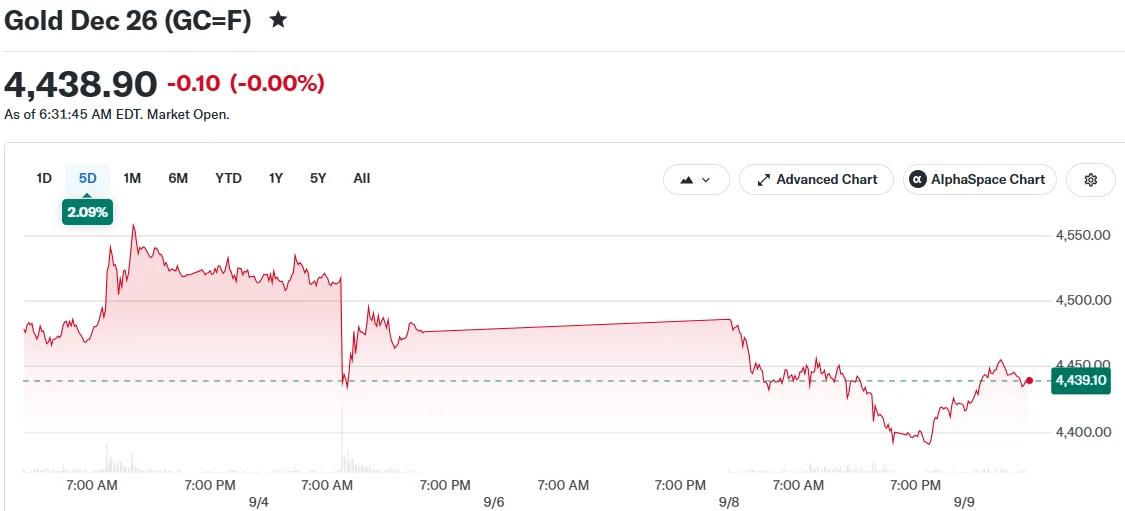
- Spot gold advanced 1.0% to reach $4,397.47 per ounce during Wednesday’s session, while futures edged up marginally to $4,441.86
- Support for gold stemmed from a softening U.S. dollar, influenced in part by yen strength
- Renewed U.S.-Iran military exchanges lifted Brent crude oil prices beyond the $100 per barrel threshold
- Traders now assign a 60% probability to the Federal Reserve implementing a 25-basis-point rate increase at next week’s policy meeting
- Key August inflation reports including CPI and PPI are scheduled for release this week, potentially influencing Fed decision-making
Gold experienced upward momentum on Wednesday, propelled by dollar weakness and escalating Middle East hostilities, though increasing probability of Federal Reserve monetary tightening limited the advance.
Spot gold appreciated 1.0% to settle at $4,397.47 per ounce. Futures contracts for gold rose modestly by 0.1% to $4,441.86 per ounce during morning trade.
The dollar index traded relatively unchanged at 98.77. Market observers attribute modest dollar pressure to recent appreciation in the Japanese yen. When the greenback weakens, gold becomes less expensive for international purchasers, typically boosting demand.
Geopolitical Tensions Intensify Market Volatility
Military confrontations between the United States and Iran in the Middle East escalated, driving Brent crude oil prices back above the $100 per barrel mark. The strategically critical Strait of Hormuz, located along Iran’s southern coastline, remains the focal point of supply disruption fears.
Elevated crude prices amplify inflation concerns. This development carries significance as monetary authorities, notably the Federal Reserve, maintain their focus on curbing inflationary pressures.

Current market pricing indicates a 60% likelihood that the Fed will implement a 25-basis-point rate increase during next Wednesday’s policy meeting. This represents a significant jump from the 40% probability assigned just seven days earlier.
Elevated interest rates typically create headwinds for gold. Since the precious metal generates no income, rising rates enhance the relative attractiveness of yield-bearing instruments such as government bonds.
“Gold has recently come under increased pressure following a change in expectations around U.S. interest rates,” said Rick Kanda, Managing Director at The Gold Bullion Company.
Upcoming Inflation Reports May Shift Market Dynamics
The yellow metal posted an impressive 10% gain throughout August, marking its strongest monthly performance since January. That rally culminated in a late-August summit of $4,685 per ounce.
Kanda observed that rapid price advances often trigger profit-taking activity, particularly when economic indicators strengthen the rationale for tighter monetary policy.
He cautioned that gold prices might retreat toward the low-$4,000 range should rate-hike expectations continue climbing. However, he acknowledged the potential for a rebound toward August’s peak levels.
Naeem Aslam of Zaye Capital Markets emphasized that geopolitical turmoil typically drives capital flows into gold as a protective hedge. Yet he cautioned that if conflicts trigger higher energy and commodity inflation, rising Treasury yields could diminish gold’s attractiveness.
Market participants are closely monitoring the forthcoming August Consumer Price Index and Producer Price Index releases scheduled for this week. These inflation metrics may prove pivotal in determining the Federal Reserve’s policy trajectory for next week’s meeting.
The central bank has repeatedly emphasized its commitment to combating inflation. Recent data showing labor market resilience has bolstered arguments favoring additional rate tightening.
Gold currently faces competing dynamics: safe-haven buying driven by deteriorating geopolitical conditions versus rate-hike pressures that elevate the opportunity cost of holding non-yielding assets.
Get 3 Free Stock Ebooks
Discover top-performing stocks in AI, Crypto, and Technology with expert analysis.
- Top 10 AI Stocks - Leading AI companies
- Top 10 Crypto Stocks - Blockchain leaders
- Top 10 Tech Stocks - Tech giants


