


TLDR
- The precious metal declined more than 1% on Monday, approaching $4,000 per ounce following renewed military action between the US and Iran
- A ceasefire agreement has been reached, with negotiations scheduled in Doha this Tuesday
- The yellow metal has tumbled approximately 23% since coordinated strikes by the US and Israel on Iran began in late February
- Traders now see over a 30% probability of Federal Reserve rate increases by the conclusion of 2026
- Critical employment figures and other economic releases this week may shape monetary policy direction
Renewed military confrontations between the United States and Iran during the weekend drove precious metals lower on Monday, with gold approaching the psychologically significant $4,000 threshold as concerns about rising prices resurfaced.
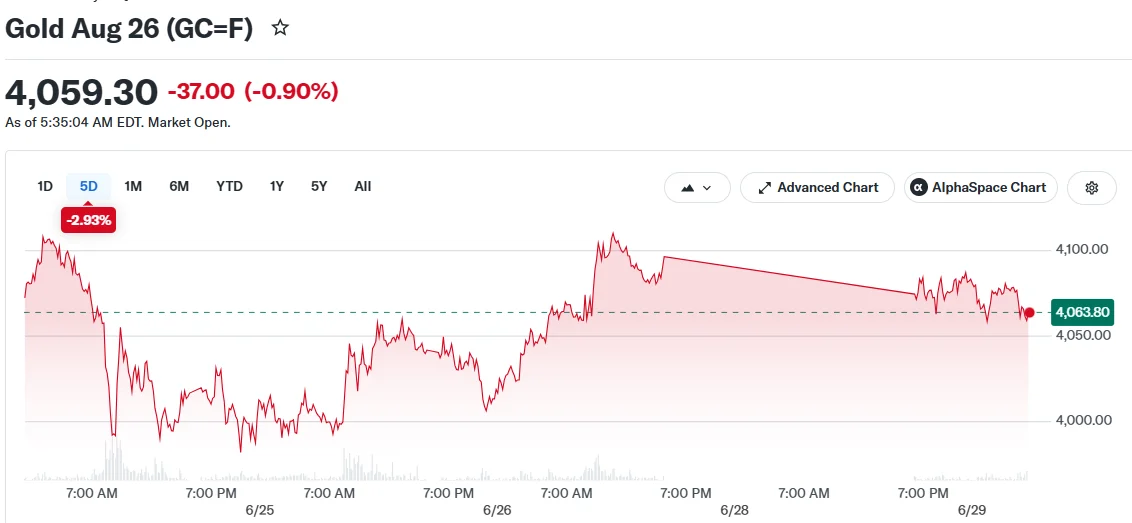
Spot gold declined 1.1% to reach $4,043.62 per ounce during early trading hours in Asia. Futures contracts for the metal dropped 1% to settle at $4,056.77.
Military operations between Washington and Tehran erupted in the Persian Gulf region over the weekend, undermining a temporary ceasefire that had recently stabilized energy commodity markets. A commercial vessel transporting Qatari petroleum was damaged during the clashes, creating disruptions to maritime traffic through the strategically vital Strait of Hormuz.
Notwithstanding the escalation, both nations have committed to cease hostilities. Diplomatic negotiations are scheduled to commence in Doha on Tuesday, according to reporting by Axios, which cited anonymous administration sources.
Precious Metal Faces Headwinds From Rising Rates and Currency Strength
Gold has experienced a prolonged downward trajectory spanning several months. The metal has shed roughly 23% of its value since coordinated military operations against Iran were initiated by the United States and Israel during the final days of February.

Escalating energy costs stemming from the regional conflict have contributed to accelerating inflation, strengthening market expectations that policymakers at major central banks will maintain restrictive monetary conditions for an extended period. This environment has created significant headwinds for gold, an asset that generates no income or dividends.
Trading data from CME Fedwatch indicates that market participants are now assigning greater than 30% probability to the scenario where the Federal Reserve implements rate increases before 2026 concludes.
Additional downward pressure has emerged from the robust performance of the US dollar and elevated Treasury yields. The Federal Reserve’s June policy meeting conveyed a more restrictive stance, while recent inflation statistics exceeded expectations despite remaining within analyst forecasts.
The personal consumption expenditures price index, which serves as the Fed’s preferred inflation measurement, advanced 0.4% during May. Treasury yields experienced a modest decline following the release of that data point.
Other precious metals similarly retreated on Monday. Silver tumbled 1.8% to $58.11 per ounce. Platinum decreased 0.4% to $1,612.20.
Employment Report Expected to Drive Market Sentiment
Market participants are monitoring several economic data releases scheduled for this week to gauge the future trajectory of interest rates.
Industrial production figures from Japan, purchasing managers surveys from China, and inflation metrics from Europe are all on the calendar.
However, the primary focus will center on the United States nonfarm payrolls release covering June activity. Resilience in the labor market would provide Federal Reserve policymakers with additional justification for implementing rate increases.
Evidence of continued robust hiring activity could drive gold prices even lower, as elevated interest rates increase the opportunity cost associated with holding non-income-generating assets such as precious metals.
The diplomatic discussions scheduled for Doha on Tuesday will also attract significant attention. A durable peace agreement could alleviate upward pressure on energy prices and moderate inflation expectations, fundamentally altering the outlook for gold valuations.
Currently, the metal remains trapped near its lowest levels in months, pressured by the dual forces of geopolitical instability and the likelihood of higher financing costs ahead.
Get 3 Free Stock Ebooks
Discover top-performing stocks in AI, Crypto, and Technology with expert analysis.
- Top 10 AI Stocks - Leading AI companies
- Top 10 Crypto Stocks - Blockchain leaders
- Top 10 Tech Stocks - Tech giants


