



Key Highlights
- Gold surpassed $4,400 per ounce, marking its strongest performance in over eight weeks
- The precious metal gained 2.4% on Friday following disappointing U.S. employment figures
- Market participants are focused on Wednesday’s consumer price index and Thursday’s producer price data
- Diplomatic impasse between the U.S. and Iran over Strait of Hormuz access is fueling crude oil gains
- People’s Bank of China recorded its largest monthly gold reserve increase since October 2023 in July
The yellow metal continues its upward trajectory as market participants monitor forthcoming U.S. inflation statistics and escalating diplomatic friction surrounding the Strait of Hormuz.
Spot gold advanced 0.4% to reach $4,407.79 per ounce during Tuesday’s trading session. Meanwhile, gold futures jumped 1.1% to settle at $4,467.59. The precious metal has climbed to levels not witnessed in more than eight weeks.
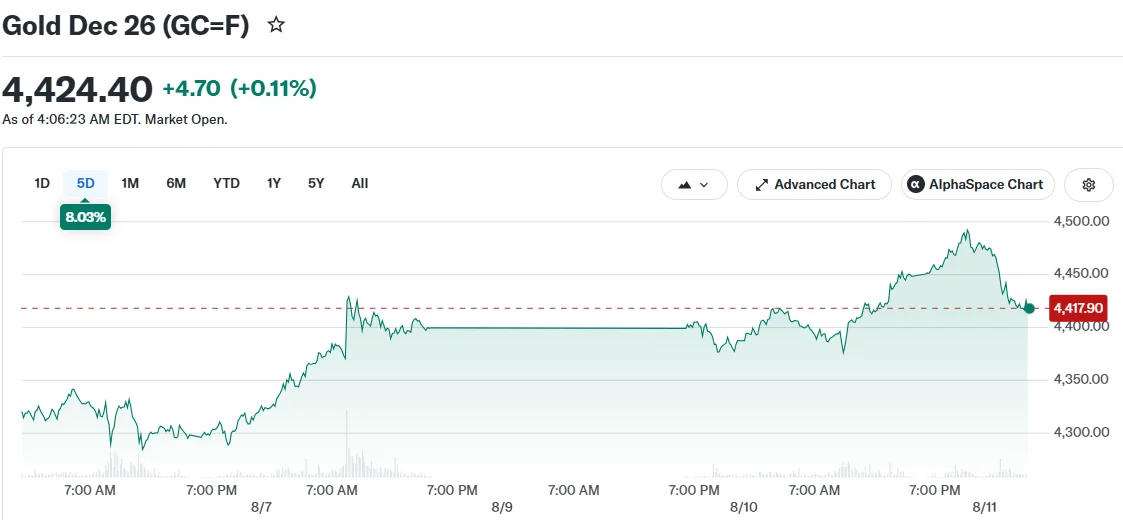
This recent surge extends an impressive two-day rally. The metal accumulated gains of 3.6% across Monday and Friday’s sessions, propelled by July’s disappointing U.S. nonfarm payroll figures that fell short of market expectations.
Monday’s settlement around $4,390 represented the strongest daily close in nearly ten weeks. The precious metal has staged a significant recovery from its June trough of $3,942.
All Eyes on Upcoming Inflation Reports
Market participants are eagerly anticipating Wednesday’s release of the consumer price index. Economic forecasters predict a modest 0.1% increase for July, contrasting with the previous month’s 0.4% decrease.

The producer price index, scheduled for release on Thursday, will also receive significant attention. These dual reports are expected to influence market sentiment regarding the Federal Reserve’s upcoming monetary policy decisions.
Current market pricing suggests a 52% probability of a rate increase in September, climbing to 81% for a move by December, based on CME FedWatch indicators.
Beth Hammack, President of the Cleveland Federal Reserve, indicated that several rate increases might still be necessary to achieve the 2% inflation target. She was among three policymakers who opposed maintaining current rate levels at the previous meeting.
Since gold generates no yield, it typically becomes less attractive during periods of rising interest rates. However, buyers have continued to accumulate positions despite this headwind.
Market strategists at IG attribute the rally to momentum-chasing behavior, short position unwinding, and safe-haven demand. Traders who failed to capitalize on gold’s retreat toward $4,000 are now pursuing the recovery.
Geopolitical Friction and Energy Markets Compound Uncertainty
The Strait of Hormuz situation continues to present significant risk. Iranian officials indicated progress toward an agreement with Oman regarding alternative maritime routes, while emphasizing that additional U.S. concessions are required before reopening the strategic waterway.
President Donald Trump introduced additional requirements for Iran this week, diminishing expectations for an imminent resolution. Crude oil maintained its three-session advance in response.
Elevated oil prices increase inflationary pressures, potentially compelling the Federal Reserve to maintain restrictive monetary policy for an extended period. This dynamic creates an ambiguous outlook for precious metals.
Chinese demand continues to provide solid underlying support. The People’s Bank of China expanded its gold holdings in July by the largest amount since October 2023.
Chinese gold-backed exchange-traded funds also registered increased capital inflows during the previous week, reinforcing the buying trend.
From a technical perspective, market analysts identify resistance in the $4,460 to $4,500 range. A decisive move above this zone could pave the way toward $5,000, although that target remains substantially higher than current trading levels.
Gold continues to trade approximately 17% below the levels observed before the onset of the Iran conflict in late February.
Get 3 Free Stock Ebooks
Discover top-performing stocks in AI, Crypto, and Technology with expert analysis.
- Top 10 AI Stocks - Leading AI companies
- Top 10 Crypto Stocks - Blockchain leaders
- Top 10 Tech Stocks - Tech giants


