


Key Takeaways
- Asian technology equities experienced pullback Monday as semiconductor investors locked in gains following previous week’s strong performance
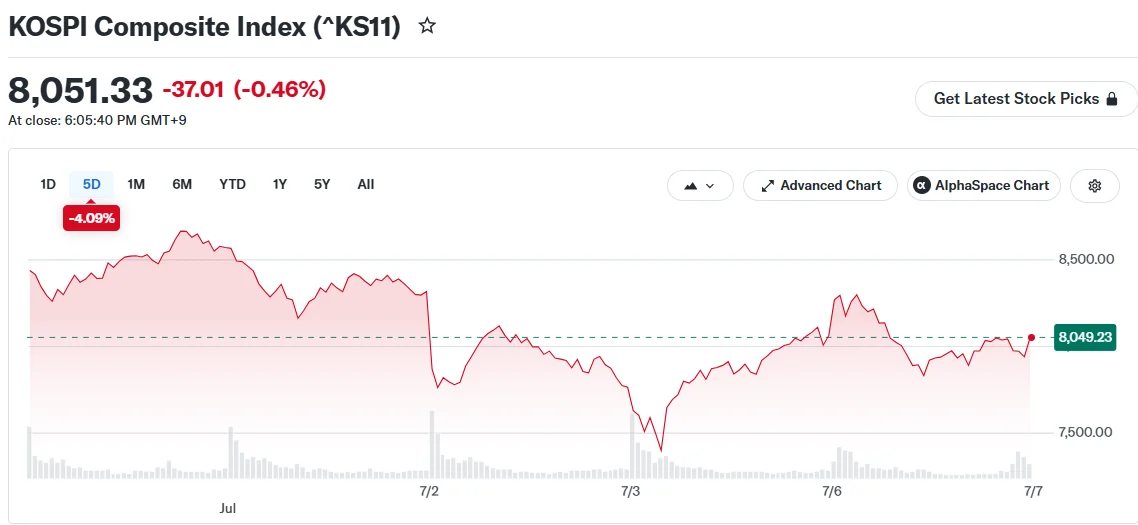
- South Korea’s KOSPI index declined 0.5%, driven by SK Hynix’s 4%+ drop and Samsung Electronics’ retreat
- SK Hynix moves forward with plans for $29 billion American depositary receipt listing on Nasdaq
- Goldman Sachs projects over 20% appreciation potential for KOSPI within 12-month timeframe
- Declining crude oil prices and reduced geopolitical risk boosted markets in Hong Kong, Indonesia, and India
Asian equity markets with significant technology exposure experienced a retreat Monday as traders secured profits from semiconductor positions following the prior week’s substantial rally. The downturn was particularly pronounced across South Korean and Japanese exchanges, both featuring considerable chip industry representation.
South Korea’s KOSPI index finished the session down 0.5%, erasing earlier positive momentum. Japan’s Nikkei 225 similarly edged into negative territory. Mainland China’s CSI 300 declined 0.6%, whereas Taiwan’s primary benchmark remained relatively stable.
Semiconductor Sector Drives Losses
SK Hynix plummeted more than 4% during Seoul trading, with Samsung Electronics declining approximately 1.5%. Battery producer LG Energy Solution tumbled nearly 4%. MediaTek retreated 1.4% in Taipei.
International investors recorded net sales of Korean equities totaling 828.8 billion won throughout the session. The Korean won depreciated 0.3% versus the U.S. dollar.
Despite Monday’s setback, the KOSPI has surged roughly 86% year-to-date, establishing South Korea as Asia’s top-performing stock market during 2026’s initial half. Artificial intelligence memory chip manufacturers have primarily fueled these impressive returns.

A notable exception was Hon Hai Precision Industry, commonly referred to as Foxconn. The manufacturer advanced 0.6% following disclosure of record-breaking June and second-quarter revenue, propelled by robust AI server demand. Taiwan Semiconductor Manufacturing also registered modest gains.
SK Hynix is advancing preparations to introduce 17.79 million fresh shares via American depositary receipts on the Nasdaq exchange, representing a transaction valued near $29 billion. South Korean President Lee Jae Myung additionally urged government officials to expedite major semiconductor and AI initiatives unveiled last week.
Bank of America characterized the recent artificial intelligence stock correction as a positioning adjustment rather than fundamental deterioration. The financial institution emphasized that AI infrastructure investment continues uninterrupted despite increasingly discriminating investor sentiment.
Goldman Sachs Maintains Positive Korean Outlook
Goldman Sachs reaffirmed its projection of more than 20% appreciation potential for the KOSPI throughout the coming 12 months, establishing a 12,000 price target. The investment bank anticipates the market rally will expand beyond AI semiconductor stocks into energy, materials, and industrial sectors.
Goldman observed that international capital flows are already shifting toward alternative AI-connected industries and industrial companies. The firm additionally highlighted that retail investors maintain moderate exposure levels, with Korean households continuing to heavily favor real estate holdings and foreign equities over domestic stock positions.
The bank projects earnings expansion of 320% during 2026, succeeded by an additional 35% increase throughout 2027.
Mixed Performance Across Asia-Pacific
Beyond the chip sector, market conditions proved more favorable. Hong Kong’s Hang Seng climbed 0.9%. Indonesia advanced 0.8% while India’s Nifty 50 appreciated 0.7%.
Declining petroleum prices contributed to improved market sentiment. OPEC+ approved another output increase for August, maintaining elevated supply projections and alleviating inflation worries.
Market participants now turn attention toward Federal Reserve meeting minutes scheduled for Wednesday release, alongside inflation reports from China, Taiwan, Thailand, and the Philippines. Taiwan’s June trade statistics will be scrutinized for confirmation that AI demand continues supporting export activity.
Get 3 Free Stock Ebooks
Discover top-performing stocks in AI, Crypto, and Technology with expert analysis.
- Top 10 AI Stocks - Leading AI companies
- Top 10 Crypto Stocks - Blockchain leaders
- Top 10 Tech Stocks - Tech giants


