



Key Takeaways
- JPMorgan advises taking advantage of the recent decline in semiconductor stocks following a challenging start to H2 2026
- The SOX index declined 5.4% in the previous week before rebounding 2.5% on Monday’s opening
- The investment bank’s preferred hierarchy places semiconductors first, followed by hyperscalers, then “AI at risk” investments
- JPMorgan maintains a negative stance on software, business services, and media sectors, viewing them as vulnerable to AI disruption
- The bank anticipates expanded market participation during the second half, benefiting small-cap and global equity markets
Semiconductor equities experienced a challenging beginning to the latter half of 2026. The PHLX Semiconductor Sector Index (SOX) dropped 5.4% throughout the abbreviated trading period preceding the Independence Day holiday, marking its consecutive second weekly loss.
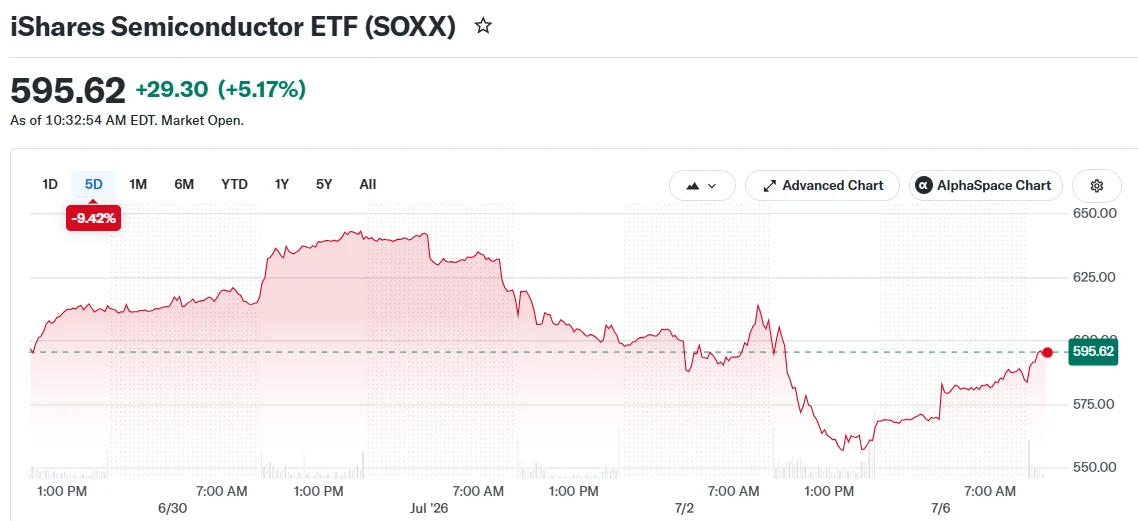
However, analysts at JPMorgan view this recent downturn as a strategic entry point rather than a concerning trend.
JPMorgan’s strategist Mislav Matejka communicated to investors in Monday’s research note that the semiconductor growth cycle remains far from its apex. He emphasized that significant additional supply capacity isn’t expected to materialize until 2028.
Market sentiment reflected this optimism. The SOX index jumped 2.5% at Monday’s opening bell. The Nasdaq Composite climbed 0.7% shortly following the market open as enthusiasm for AI chip investments returned to Wall Street.
Multiple equities that underperformed during the prior week spearheaded Monday’s recovery. Applied Materials, Marvell, and Broadcom all posted gains. Memory-focused companies such as Western Digital, Seagate, and Sandisk also recovered, propelling the Roundhill Memory ETF upward by over 6.1%.

JPMorgan’s Areas of Concern
Despite JPMorgan’s optimistic outlook on semiconductors, the investment bank expresses greater caution regarding other segments of the AI investment landscape.
Matejka indicated the firm’s investment priority ranks “semis over hyperscalers over AI at risk plays.” Regarding the Magnificent Seven collectively, he stated they are “likely to see derating continuing on monetization fears.”
JPMorgan maintains its “fundamentally bearish” position on sectors it identifies as AI cannibalization investments, encompassing software, business services, and media. While the bank acknowledges potential short-term recoveries when these sectors become oversold, its fundamental outlook remains cautious.
The underlying concern centers on AI technologies eroding revenues for companies within these industries rather than generating incremental growth.
JPMorgan’s Global Equity Forecast for H2 2026
Extending beyond semiconductors, JPMorgan anticipates new record highs for worldwide equity markets during the year’s second half.
The investment bank cites robust earnings projections, moderating inflationary pressures, and conservative investor positioning as fundamental supporting elements.
Matejka also identified the resolution of geopolitical tensions involving Iran as a potential market catalyst. He suggested that crude oil valuations, inflation forecasts, government bond yields, and central bank policy expectations could all reverse from their Q2 movements.
He noted that artificial intelligence “unlikely to be the only story in town” throughout the second half. Small-capitalization stocks, cyclical sectors, and international equity markets are all positioned to gain as market breadth expands.
Concerns about stagflation, which dampened investor confidence in recent months, are also projected to diminish, according to the strategist’s assessment.
JPMorgan’s primary thesis is straightforward: semiconductors represent the optimal investment vehicle for AI exposure currently, while alternative AI-related investments present elevated risk profiles.
Get 3 Free Stock Ebooks
Discover top-performing stocks in AI, Crypto, and Technology with expert analysis.
- Top 10 AI Stocks - Leading AI companies
- Top 10 Crypto Stocks - Blockchain leaders
- Top 10 Tech Stocks - Tech giants


