


Key Highlights
- Second quarter revenue totaled $30.4M, representing a 50% decline from the prior year and falling below the consensus forecast of $33.42M
- The company recorded an operating loss of $141M, a significant reversal from the $11M operating profit posted in Q2 2025
- Continuing operations generated negative adjusted EBITDA of $24M, contrasting with the positive $7M reported one year earlier
- The company maintains $819M in total liquidity, comprised of $698M in unrestricted cash reserves and $121M in Bitcoin holdings
- Each of the three flagship HPC facilities is approaching complete permitting status, with tenant discussions underway at all locations
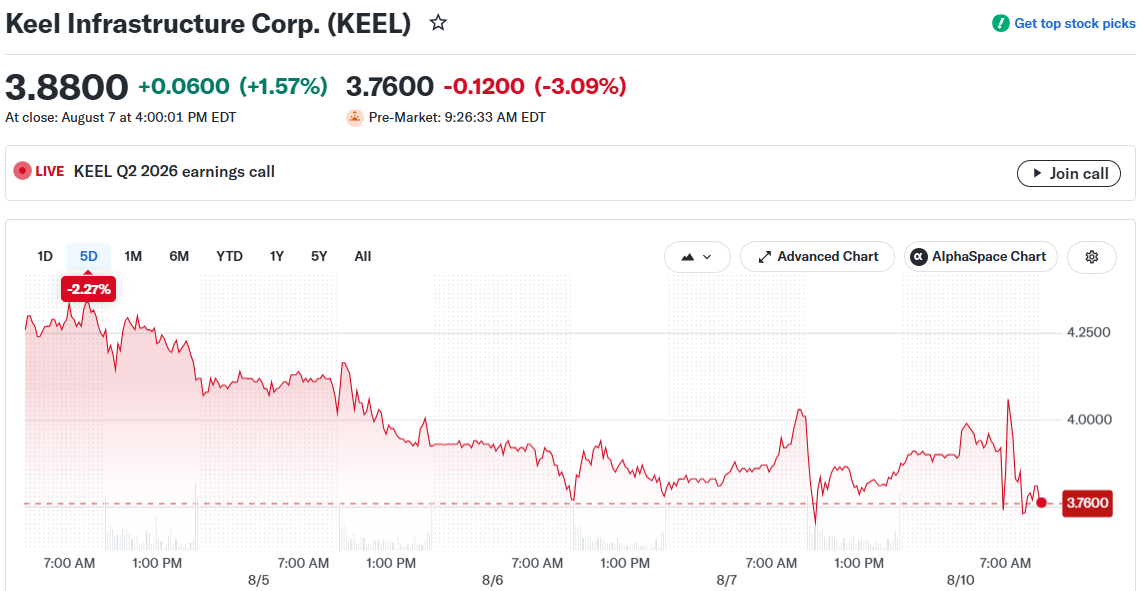
On August 10, Keel Infrastructure (KEEL) unveiled its second quarter 2026 financial performance, posting revenue of $30.4 million that came in below analyst expectations of $33.42 million. Despite the miss, shares gained 1.57% in trading following the announcement.
The year-over-year revenue decline of 50% reflects the company’s deliberate exit from Bitcoin mining activities and the impact of lower cryptocurrency valuations. Keel ceased cryptocurrency mining operations at its Moses Lake facility in April 2026, marking a pivotal moment in its strategic transformation toward high-performance computing infrastructure development.
Operating results showed a loss of $140.8 million for the quarter, a stark contrast to the $10.8 million in operating income generated during the same quarter of 2025. This figure includes $84 million in non-cash depreciation charges.
The company posted a net loss of $65 million, translating to $0.11 per share. This represents a reversal from the prior year’s Q2 performance, which delivered net income of $13 million, or $0.02 per diluted share.
On an adjusted EBITDA basis, continuing operations generated a negative $23.7 million, down sharply from the positive $6.6 million achieved in the second quarter of 2025.

Chief Executive Officer Ben Gagnon emphasized the company’s strategic focus on power availability as the fundamental competitive advantage. “Power is the constraint. Everything else is downstream of it,” Gagnon stated in the earnings release.
During the quarter, Keel successfully completed a convertible note offering that generated $458 million in capital. The company’s total liquidity position reached approximately $819 million as of August 7.
This substantial liquidity cushion consists of approximately $698 million in unrestricted cash alongside $121 million worth of unencumbered Bitcoin assets.
HPC Site Development Updates
Each of Keel’s three priority development sites is moving toward complete permitting status. Environmental permit submissions are advancing at all locations, while the Panther Creek and Sharon sites have already obtained necessary zoning approvals and land development permissions.
The company has taken possession of its initial Vertiv infrastructure modules at the Moses Lake location and is finalizing fiber optic connectivity agreements at all three facilities.
In Quebec, Keel made significant progress on its Sherbrooke data center initiative by securing an agreement with Hydro-Sherbrooke for the conditional acquisition of 96 MW of existing electrical capacity, accompanied by a land acquisition contract.
Executive Appointments and Cryptocurrency Exit
The company named Ganesh Aiyer as President, tasking him with overseeing commercial strategy and expansion initiatives. Keel has also finalized the shutdown of all domestic Bitcoin mining activities.
From April 1 through August 7, 2026, the company liquidated 1,085 Bitcoin, generating $75 million in cash proceeds as part of its announced cryptocurrency portfolio reduction strategy.
The company’s remaining Bitcoin holdings total 1,861 BTC as of August 7.
General and administrative costs increased to $31 million from $19 million in the year-ago quarter, reflecting strategic investments in specialized senior talent as Keel transitions into active project execution and management.
Chief Financial Officer Jonathan Mir noted that the company’s current capitalization represents the strongest financial position in its history, and emphasized management’s intent to structure individual site financing arrangements that maximize shareholder value creation.
Tenant negotiations are currently active with multiple prospective customers at each of the three flagship sites, with available 2027 capacity remaining across both the PJM interconnection region and Washington state.
Get 3 Free Stock Ebooks
Discover top-performing stocks in AI, Crypto, and Technology with expert analysis.
- Top 10 AI Stocks - Leading AI companies
- Top 10 Crypto Stocks - Blockchain leaders
- Top 10 Tech Stocks - Tech giants


