


Key Takeaways
- The KOSPI plunged more than 5% on Wednesday, crossing the 20% threshold from its June peak to confirm bear market status
- Samsung Electronics declined 6.3% even after delivering record-breaking Q2 earnings
- SK Hynix tumbled 5.7% following a previous day’s 6% decline
- South Korea’s Finance Minister issued warnings about risks from leveraged ETFs tied to semiconductor stocks
- The won surged beyond 1,500 per dollar, strengthened by anticipation of SK Hynix’s major U.S. share offering
South Korea’s benchmark equity index officially crossed into bear market territory on Wednesday following a dramatic selldown led by semiconductor stocks amid increasing skepticism surrounding artificial intelligence growth prospects.
The KOSPI concluded trading down 5.35%, settling at 7,246.79 points. This marks a decline exceeding 20% from its peak closing level of 9,114.55 reached on June 22, satisfying the traditional bear market criteria.
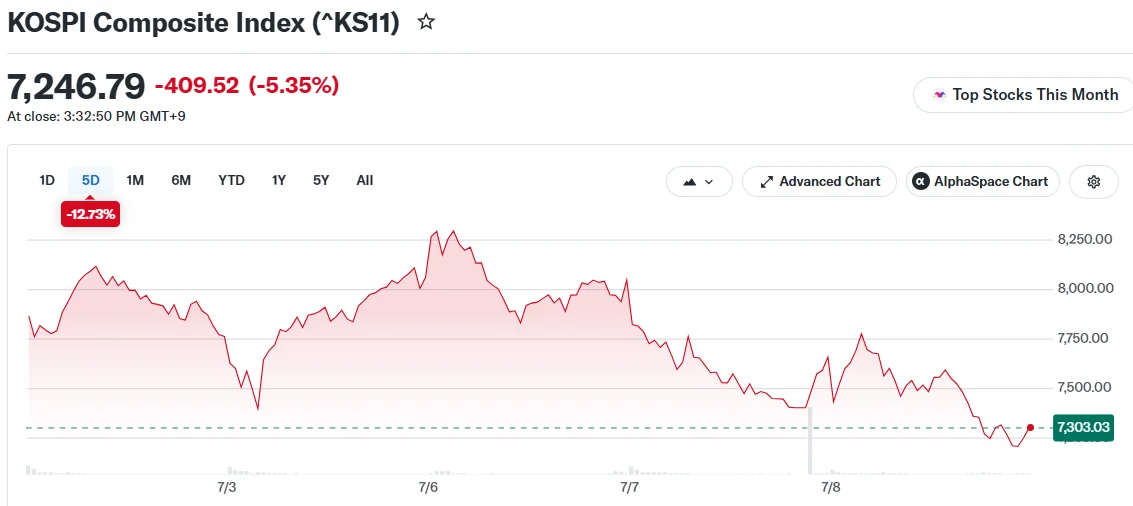
Market conditions were turbulent throughout the trading session. The benchmark temporarily climbed 1.8% before tumbling as steeply as 6.1%, activating a “sidecar” mechanism that temporarily halted algorithmic trading operations.
Samsung’s Blockbuster Results Fail to Prevent Stock Decline
Samsung Electronics dropped 6.3% on Wednesday, despite announcing record-setting second-quarter financial results. The challenge stemmed from revenue figures, which disappointed some optimistic forecasts.
This shortfall sparked concerns about whether Samsung and comparable companies can sustain the aggressive growth trajectory that investors had anticipated. Following a stock appreciation of more than 100% over the previous year, numerous shareholders opted to lock in gains.

SK Hynix similarly declined 5.7%, extending a 6% loss from the prior session. Market anxiety intensified after reports emerged suggesting Apple might source chips from Chinese manufacturers due to supply constraints in South Korea, potentially impacting memory chip pricing dynamics.
Leveraged ETF Products Amplify Market Volatility
South Korea’s Finance Minister Koo Yun-cheol announced that authorities would carefully track potential dangers associated with single-stock leveraged ETFs connected to chipmaking companies. Multiple such investment vehicles have debuted since May, and their elevated leverage ratios have exacerbated the downturn.
This represented the sixth circuit breaker activation for the KOSPI this year, and only the 12th occurrence throughout its trading history.
Hyundai Motor, which had surged 120% during the preceding 12 months based on Nvidia collaborations and artificial intelligence initiatives, also retreated 4.7% on Wednesday.
The Philadelphia Semiconductor Index in the United States fell 4.7% during the previous trading session, contributing additional downward momentum to South Korean chip equities.
Currency Gains Ground as International Capital Returns
The South Korean won advanced past the 1,500 threshold, appreciating 1.2% to reach 1,498.5 against the dollar. This represented its most robust position since May 29.
The currency appreciation was partially attributed to dollar sales connected with SK Hynix’s forthcoming U.S. equity offering, anticipated to rank among the largest global share issuances.
International investors purchased Korean equities worth a net 335.9 billion won on Wednesday, breaking a 13-consecutive-session selling streak.
Deputy Finance Minister Moon Ji-sung indicated that headwinds from foreign profit-taking activities should diminish during the year’s latter half as market dynamics normalize.
The KOSPI had previously held the distinction of being the top-performing major global equity index this year before the recent correction. The benchmark’s retreat underscores a wider reassessment of sentiment regarding AI-related valuations.
Get 3 Free Stock Ebooks
Discover top-performing stocks in AI, Crypto, and Technology with expert analysis.
- Top 10 AI Stocks - Leading AI companies
- Top 10 Crypto Stocks - Blockchain leaders
- Top 10 Tech Stocks - Tech giants


