


Quick Overview
- First-quarter net income reached $903 million ($1.46 per diluted share), climbing from $866 million in the prior-year period.
- Total sales hit $46.12 billion, representing ~2% growth and surpassing the analyst consensus of $45.59 billion.
- Adjusted earnings per share came in at $1.58, falling a single penny short of the $1.59 Wall Street target.
- Digital commerce sales surged 19%; Kroger Precision Marketing profit climbed over 20%.
- Shares declined approximately 7% during the trading session despite exceeding revenue forecasts.
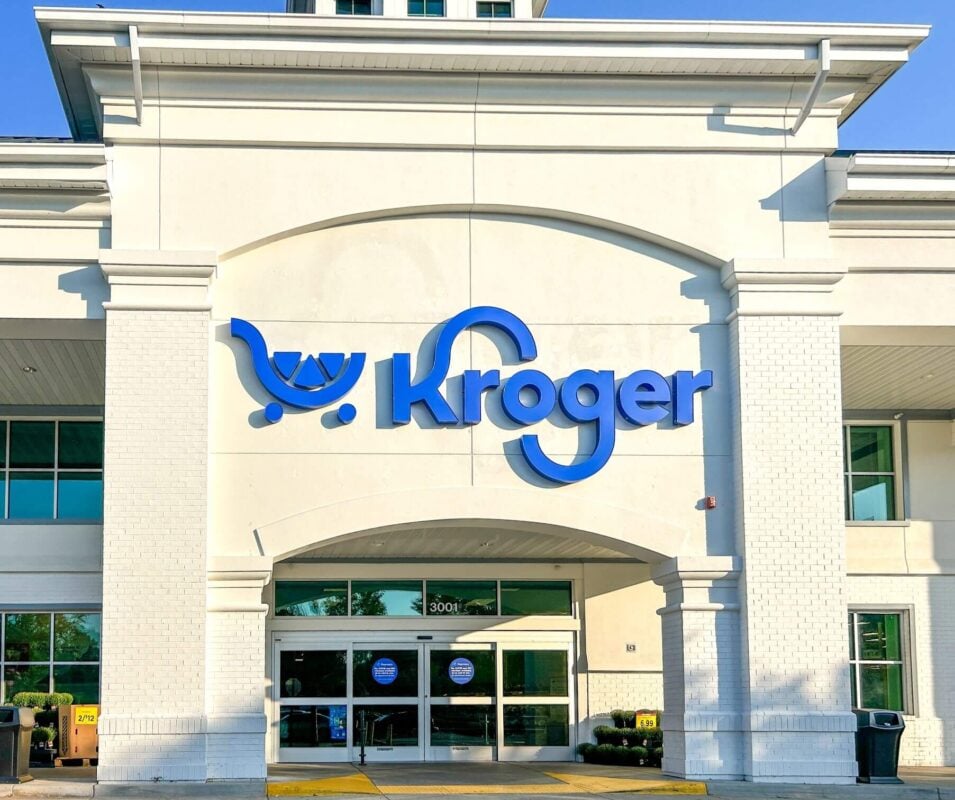
Kroger delivered first-quarter sales of $46.12 billion on Thursday, surpassing Wall Street’s $45.59 billion projection, yet shares tumbled roughly 7% as investors reacted negatively to a minuscule earnings shortfall and shrinking profit margins.
The grocery giant reported net income of $903 million, translating to $1.46 per diluted share, compared to $866 million, or $1.30 per share, during the corresponding quarter of the previous year.
When adjusted for one-time items, Kroger delivered earnings of $1.58 per share—missing the Street’s $1.59 expectation by just a single cent. That marginal shortfall proved sufficient to trigger selling pressure.
Comparable store sales excluding fuel increased 1% on a year-over-year basis. While the gain appears modest, it aligned with the company’s previously issued guidance expectations.

Gross profit margin contracted to 22.7% from 23% recorded in the same quarter last year. Management attributed the compression to an unfavorable sales mix weighted toward lower-margin fuel, elevated transportation expenses, and declining egg pricing.
These negative factors were only partially balanced by improved pharmacy category mix, enhanced digital commerce profitability, and more favorable supplier agreements.
Digital Channels and Advertising Platform Deliver Strong Performance
Adjusted digital commerce revenue expanded 19% during the period, a metric Kroger emphasized in its announcement. The company’s retail media arm—Kroger Precision Marketing—posted profit growth exceeding 20%.
Both segments represent strategic investment priorities for Kroger, and the latest figures indicate these initiatives are generating meaningful returns.
Operating income nonetheless increased to $1.407 billion versus $1.322 billion in the year-ago quarter, supported by reduced depreciation and amortization expenses that helped absorb climbing overhead and labor costs.
Greg Foran, CEO who assumed leadership earlier this year, maintained a balanced outlook. “We are pleased with our first quarter results, but we know there is more work to do,” he stated.
Management Maintains Full-Year Financial Targets
Kroger reaffirmed its fiscal 2026 projections. The company continues to anticipate comparable-store sales growth of 1% to 2% excluding fuel, adjusted earnings per share in the $5.10 to $5.30 range, and free cash flow between $2.7 billion and $2.9 billion.
The unchanged outlook suggests leadership remains confident in current business momentum, despite intensifying competition across the grocery sector.
Value-focused shoppers have prompted Kroger to implement price reductions across thousands of items. Management indicated these discounts will be financed partially through cost savings achieved via direct-sourcing arrangements and enhanced operational technology.
The fundamental challenge facing Kroger centers on deteriorating gross margins amid persistent cost pressures. The retailer is simultaneously investing in competitive pricing while attempting to safeguard profitability.
Shares declined approximately 3% in premarket activity following the earnings release, before accelerating losses to roughly 7% during regular trading hours.
Get 3 Free Stock Ebooks
Discover top-performing stocks in AI, Crypto, and Technology with expert analysis.
- Top 10 AI Stocks - Leading AI companies
- Top 10 Crypto Stocks - Blockchain leaders
- Top 10 Tech Stocks - Tech giants


