


Key Highlights
- BTC declined 2.7% to approximately $63,200 following Monday’s U.S. market close, with ETH, XRP, and Solana following suit
- South Korea’s Kospi index experienced a catastrophic 10%+ drop, marking one of its worst single-day performances
- Nvidia (NVDA) shed roughly 5% as artificial intelligence infrastructure investment surpasses $750 billion threshold
- Federal Reserve commences two-day policy meeting Tuesday, rate announcement scheduled for Wednesday
- Senate shelves CLARITY Act for Russia sanctions legislation, delaying crypto framework beyond August 8 congressional recess
Bitcoin experienced a sharp 2.7% decline to approximately $63,200 during Tuesday trading as Asian financial markets underwent severe corrections and mounting apprehension over artificial intelligence expenditures shook technology sector equities.
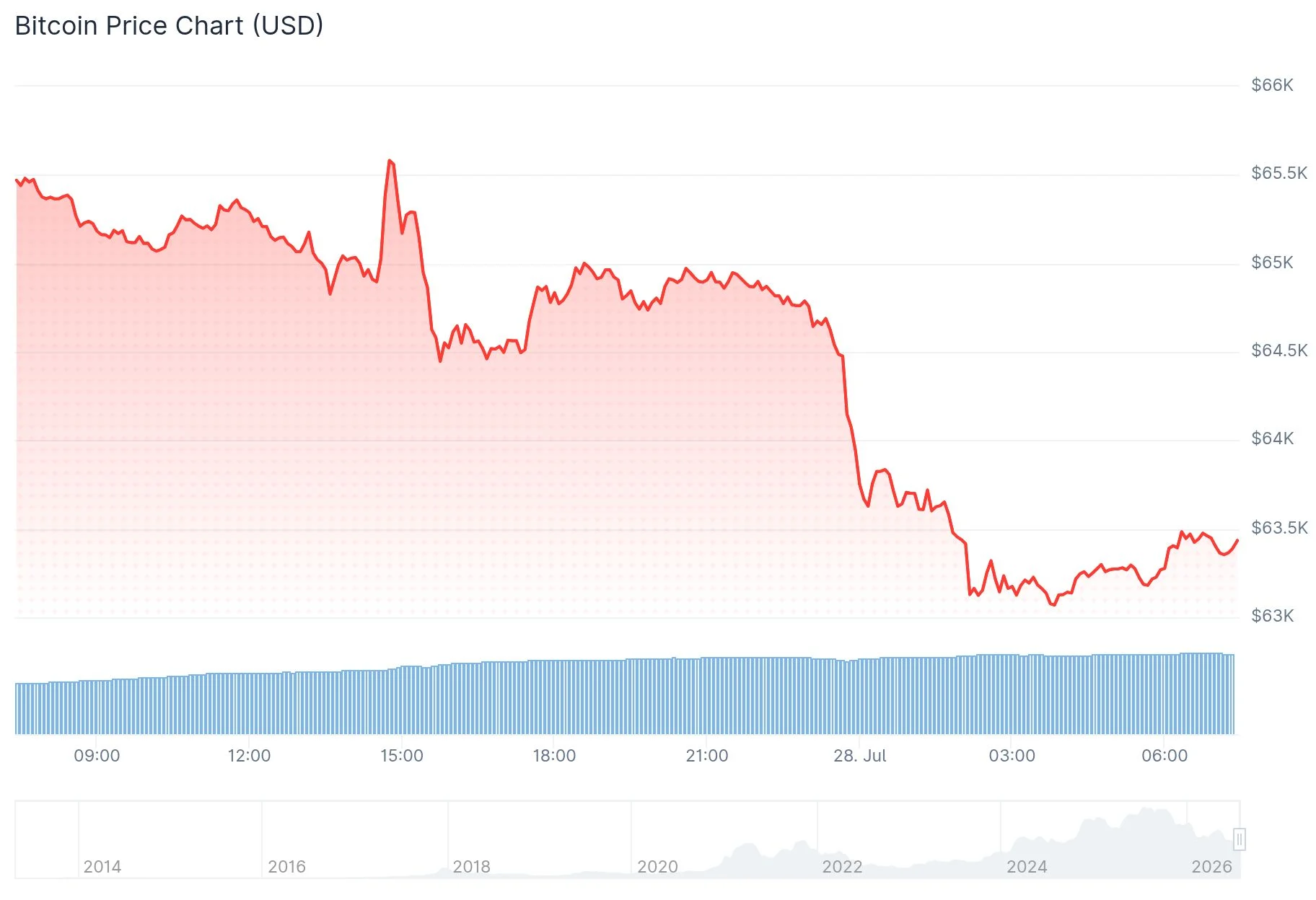
The cryptocurrency’s descent followed Monday’s U.S. equity market closure. BTC had maintained stability around the $65,000 mark prior to the downturn. Alternative digital assets including Ether, XRP, and Solana experienced comparable losses.
The South Korean Kospi benchmark tumbled more than 10% in what represents its most dramatic single-session decline in recent memory. The index has now surrendered 25% of its value from peak levels recorded in mid-June. Major technology manufacturers Samsung and SK Hynix both concluded trading down nearly 14%.
The catalyst emerged from reports detailing accelerating progress by Chinese memory semiconductor producers. CXMT’s spectacular market entrance, coupled with domestic advancement in sophisticated chip fabrication equipment, disturbed investors who had positioned themselves heavily in South Korean chip manufacturers.
Mounting AI Investment Anxiety Pressures Technology Sector
Nvidia experienced approximately a 5% decline Monday following revelations that its artificial intelligence-related financial obligations have exceeded $750 billion. This development intensified scrutiny regarding the long-term viability of substantial AI infrastructure capital deployment.

Tesla and Alphabet had previously highlighted increasing AI expenditures during earnings reports released last week. Market participants are now anticipating quarterly results from Microsoft, Meta, Apple, and Amazon scheduled for release throughout this week.
Nasdaq 100 futures contracts declined 1% during Asian trading hours Tuesday. S&P 500 futures retreated 0.3%. Dow futures remained essentially unchanged.
Japan’s Nikkei 225 plummeted nearly 4% Tuesday as the regional market correction expanded geographically.
Research analysts at Bitfinex observed that Bitcoin doesn’t consistently correlate with equity market movements. They explained that BTC typically mirrors stock performance when pressure originates from macroeconomic factors or interest rate dynamics, but can diverge when triggers are sector-specific such as technology company earnings.
Federal Reserve Meeting and Cryptocurrency Legislative Developments
The Federal Reserve initiates its two-day monetary policy deliberation Tuesday, with the official announcement scheduled for Wednesday. Financial markets broadly anticipate rates will remain unchanged. Nevertheless, derivatives pricing suggests approximately a 38% likelihood of a rate increase this week and an 80% probability of an adjustment in September.
Core Personal Consumption Expenditures and Gross Domestic Product figures are scheduled for Thursday’s release, establishing this 48-hour period as the most turbulent timeframe this week for interest rate-sensitive financial instruments.
Regarding cryptocurrency legislation, Senate leadership has sidelined the CLARITY Act to accommodate a Russia sanctions measure. A floor vote appears improbable before the August 8 congressional recess, postponing the regulatory framework that numerous industry participants had anticipated would facilitate institutional capital inflows.
Oil prices retreated following a temporary cessation of tensions between the United States and Iran. President Trump indicated diplomatic discussions continue and suggested an agreement remains achievable.
Johnson & Johnson unveiled a proposed $5.5 billion resolution addressing ovarian talc-related litigation. Separately, the Federal Aviation Administration recommended inspections for hundreds of Boeing 737 MAX aircraft concerning improperly installed seating components.
Get 3 Free Stock Ebooks
Discover top-performing stocks in AI, Crypto, and Technology with expert analysis.
- Top 10 AI Stocks - Leading AI companies
- Top 10 Crypto Stocks - Blockchain leaders
- Top 10 Tech Stocks - Tech giants


