


Key Takeaways
- NVDA market capitalization reaches $4.71 trillion with modest 4.5% yearly gains, while Apple surges 14% to $4.51 trillion valuation
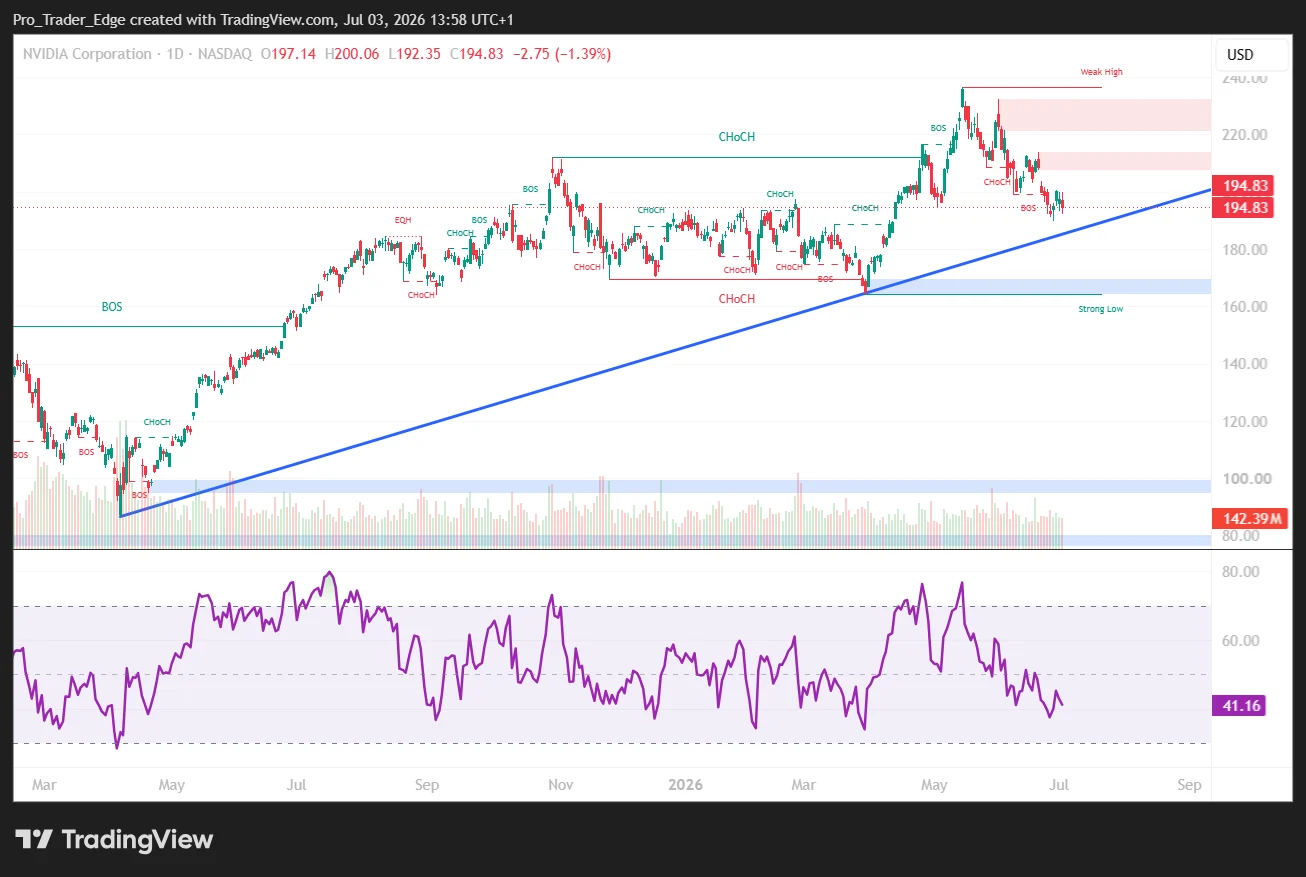
- Shares began Friday trading at $194.83, declining 1.4% and sitting beneath the 50-day moving average of $210.37
- Company commits to distributing 50% of free cash flow through share repurchases and dividends, supported by $80 billion buyback program
- Institutional investors control 65.27% of shares with recent position increases, though directors liquidated over $189 million in June
- Analyst consensus maintains Buy rating with $303.84 mean price target, including Goldman Sachs’ $285 projection
Nvidia (NVDA) shares commenced Friday’s session at $194.83, sliding 1.4% lower, as the chip giant defending its position as the world’s most valuable company encounters mounting pressure from Apple.
Apple’s market capitalization has expanded 14% since January to reach $4.51 trillion. Meanwhile, Nvidia shows more modest growth of 4.5% during the identical timeframe, maintaining a $4.71 trillion valuation. The distance between them continues shrinking.
The semiconductor leader has occupied the number one position for 258 straight trading days since retaking it from Microsoft in late June 2024. This represents the seventh-longest continuous reign this century, though Apple has demonstrated far greater staying power with streaks extending to 1,344 days.
The critical question facing investors is whether Nvidia possesses the resilience Apple has demonstrated. Achieving this milestone might require adopting several strategies from Apple’s successful blueprint.

Apple’s winning strategy combines tightly integrated hardware-software ecosystems, aggressive share repurchase programs, and an extraordinarily loyal customer base that rarely switches platforms. Nvidia is pursuing similar initiatives across these dimensions, though with inconsistent results.
Capital Allocation and Share Repurchase Strategy
Regarding capital returns, Nvidia is making progress but hasn’t matched Apple’s commitment. Apple distributes virtually all free cash flow back to investors. Nvidia targets 50% distribution via dividends and buybacks, with plans to increase this percentage gradually.
The $80 billion share repurchase program unveiled in May demonstrates serious commitment. Additionally, the company boosted its quarterly dividend to $0.25 per share, representing a dramatic increase from the previous $0.01 — translating to $1.00 annually with a 0.5% yield.
During its latest reporting period, Nvidia exceeded earnings projections with $1.87 earnings per share against the $1.76 consensus forecast. Revenue reached $81.61 billion, representing 85.2% year-over-year growth and surpassing the $78.42 billion analyst projection.
CUDA Ecosystem and Emerging Competition
Nvidia’s CUDA software platform has historically served as the adhesive keeping customers locked into its hardware ecosystem. This strategy proved highly effective during AI model training phases. The crucial challenge ahead is whether this competitive advantage persists during inference — the production deployment stage of AI models.
Competitors such as Cerebras Systems assert their processors deliver superior inference performance compared to Nvidia chips. Simultaneously, Alphabet and Amazon are engineering proprietary chips, despite maintaining substantial Nvidia hardware purchases.
This dynamic — where largest customers simultaneously represent potential competitors — constitutes the primary risk factor overhanging the stock.
Institutional ownership data presents a generally positive picture. Generali Investments expanded its NVDA holdings by 8.6% during Q1 to 59,500 shares valued at $10.4 million, establishing it as their second-largest holding. Brighton Jones increased its position by 12.4%. Hudson Value Partners boosted its stake by 30.7%.
However, two board members executed substantial sales in June. Stephen C. Neal liquidated 15,500 shares at $215.73. Mark A. Stevens disposed of 885,000 shares at $210.17, generating approximately $186 million in proceeds. Insider sales totaled $410.6 million over the past quarter.
Nvidia’s 52-week trading range spans $157.34 to $236.54. Current pricing sits beneath the 50-day moving average of $210.37, while remaining above the 200-day moving average of $193.50.
Analyst sentiment remains decidedly positive with Buy consensus and a $303.84 average price target. Goldman Sachs maintains a $285 projection, while Rothschild & Co Redburn recently elevated its target to $300.
Get 3 Free Stock Ebooks
Discover top-performing stocks in AI, Crypto, and Technology with expert analysis.
- Top 10 AI Stocks - Leading AI companies
- Top 10 Crypto Stocks - Blockchain leaders
- Top 10 Tech Stocks - Tech giants


