



Key Takeaways
- XRP processes cross-border payments in 3–5 seconds at minimal cost, demonstrating genuine utility
- Approximately 33–34 billion XRP stays locked in escrow agreements, presenting continuous supply headwinds
- Ripple settled with the SEC in 2025 for $125 million; programmatic XRP sales were deemed non-securities
- RLUSD, Ripple’s proprietary stablecoin, offers an alternative to XRP for settlements, potentially diluting demand
- With a market valuation near $65.9 billion, XRP represents a legitimate long-term option but not an obvious undervaluation
XRP has accumulated sufficient operational history to demonstrate tangible utility. Transactions finalize within 3 to 5 seconds, transaction costs remain negligible, and the token serves as the foundation for Ripple’s international payment infrastructure. These characteristics are verifiable, not speculative claims.
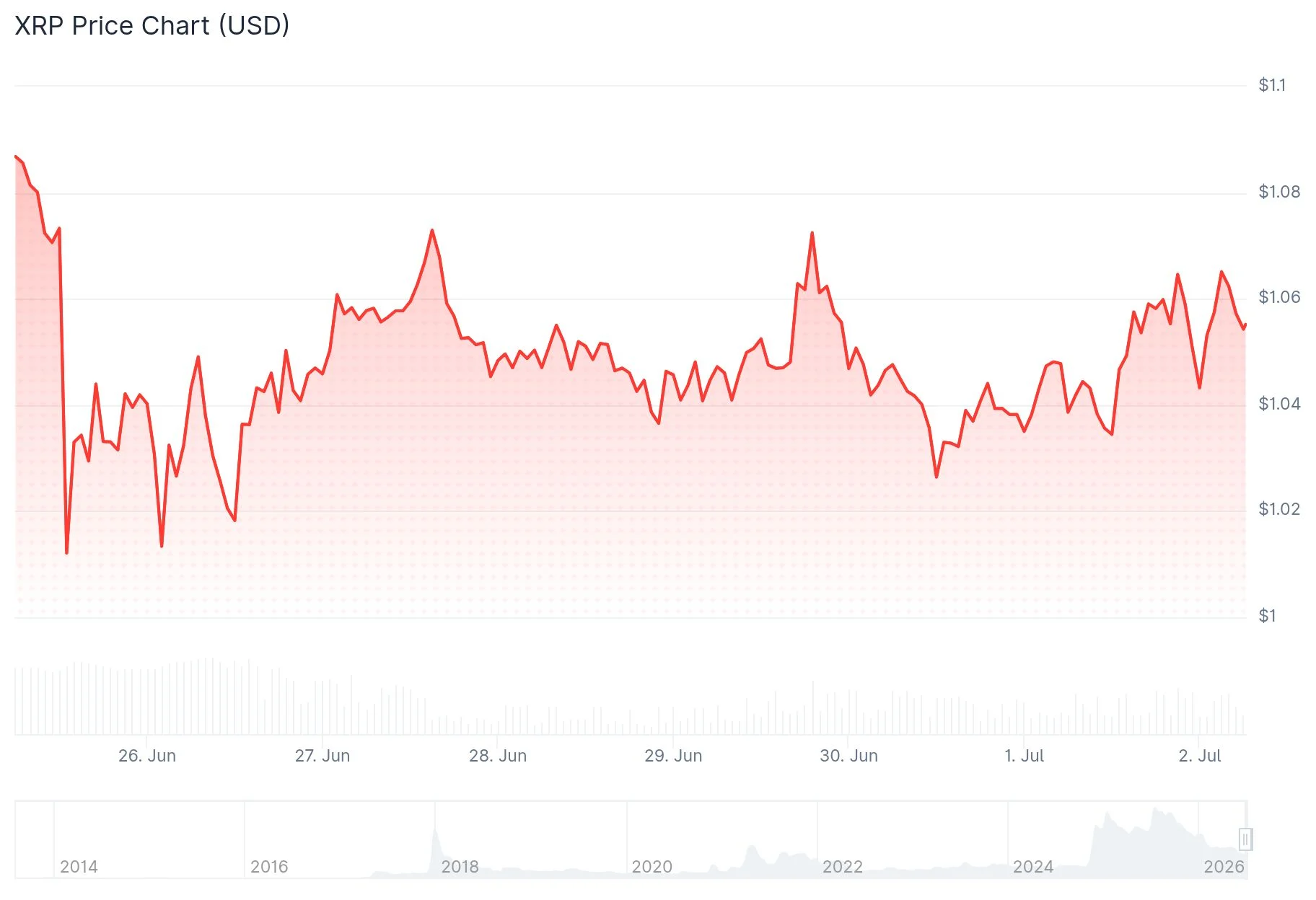
The XRP Ledger (XRPL) processed 769,646 transactions on June 16, 2026 alone. During peak usage periods earlier in 2026, successful payment operations exceeded 2.7 million. This transaction volume confirms meaningful network adoption.
Beyond simple value transfers, the XRPL has incorporated additional functionality. Native automated market maker (AMM) features and oracle integrations now provide foundational decentralized finance capabilities within the protocol.
Supply Dynamics and Escrow Concerns
A critical consideration for prospective long-term holders involves token economics. According to CoinGecko data, circulating supply stands at approximately 62 billion XRP, while total supply approaches 100 billion tokens. Between 33 and 34 billion XRP remains secured in escrow arrangements.
Ripple’s escrow mechanism permits the release of up to 1 billion XRP monthly. Unreleased tokens return to escrow, creating more transparency than typical vesting schedules. Nevertheless, the substantial locked supply represents persistent downward pressure that undermines scarcity narratives.

The Value Capture Question
This represents perhaps the most significant challenge to the long-term investment thesis. Ripple’s payment infrastructure allows participants to settle transactions using either XRP or RLUSD, the company’s native stablecoin. When Ripple expands its customer base but directs settlement volume toward RLUSD, XRP utility does not proportionally increase.
RLUSD achieved a market capitalization exceeding $611 million by August 2025, with continued expansion thereafter. This growth trajectory demonstrates that RLUSD is securing adoption as a settlement mechanism within Ripple’s own ecosystem.
This creates a fundamental question for anyone considering long-term XRP positions: what percentage of Ripple’s commercial success actually translates into XRP token demand?
Regulatory Clarity Achievement
The regulatory environment brightened considerably in 2025. Reuters coverage confirmed the SEC litigation concluded with Ripple paying a $125 million penalty. The judicial determination established that programmatic XRP sales through public exchanges did not constitute securities offerings, though specific institutional sales by Ripple violated securities regulations.
This resolution provides XRP with greater regulatory definition than the majority of alternative cryptocurrencies possess within United States jurisdiction.
XRPL governance has also decentralized notably. Ripple currently operates just 1 of 35 validators on the standard trusted node list, with primary oversight responsibilities transferred to the XRPL Foundation.
With a market capitalization hovering around $66 billion, XRP ranks among the largest cryptocurrency assets. This scale suggests that much of the upside from its established advantages may already be reflected in current valuations.
Get 3 Free Stock Ebooks
Discover top-performing stocks in AI, Crypto, and Technology with expert analysis.
- Top 10 AI Stocks - Leading AI companies
- Top 10 Crypto Stocks - Blockchain leaders
- Top 10 Tech Stocks - Tech giants


